
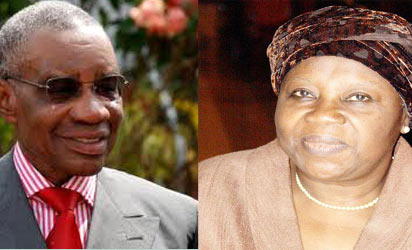
Ex CJN Justice Dahiru Musdapher and Aloma Mukhtar CJN
By Ikechukwu Nnochiri
Remarkably, since 1963 when the Federal Republic of Nigeria was proclaimed and Dr Nnamdi Azikiwe became its first President, no woman has ever headed the judiciary.
Statutorily, the Chief Justice of Nigeria, CJN, heads the Supreme Court and the National Judicial Council, NJC, a position that has been the exclusive preserve men since the country gained independence.
As it stands today, Nigeria has produced twelve indigenous CJNs, with the first being Justice Adetokunbo Ademola, who held sway at the apex court bench from 1958 to 1972.
Prior to 1963, the Judicial Committee of the Privy Council, JCPC, served as the highest court of the land and sits on appeal over any disputed judgment of the Federal Supreme Court, which existed at that time.

*CJN Justice Dahiru Musdapher and Aloma Mukhtar JSC
Following the abolition of the JCPC, the Supreme Court became the highest court in Nigeria while the Court of Appeal which was originally known as the Federal Court of Appeal, came into existence in 1976 to entertain appeals from the High Courts of each of 36 states of the federation.
The Apex Court in its current form was shaped by the Supreme Court Act of 1990 and by Chapter VII of the 1999 constitution of Nigeria.
Under the constitution, the Supreme Court has both original and appellate jurisdiction over all lower federal courts and highest state courts. Decisions rendered by the court are binding on all courts in Nigeria except the Supreme Court itself.
While section 230 of the 1999 constitution, provides that the apex court shall consist of (a) The Chief Justice of Nigeria (b) Such number of Justices of the Supreme Court, not exceeding twenty One as may be prescribed by act of National Assembly.
Sections 231 (1) (2) (3) of the Nigeria Constitution on the other hand, stipulates procedures that must be followed in the appointment of a CJN.
According to the constitution, the onus is on the Federal Judicial Service Commission, FJSC, to forward name of the candidate to the National Judicial Commission, NJC, which in turn, nominates to the Presidency.
If the President approves, he then appoints the candidate and sends the appointee’s name to the Senate for screening and confirmation.
Meanwhile, there are presently 14 justices at the apex court bench, out of which only three are women.
Justice Aloma Mariam Mukhtar holds double record as the first female to be promoted to the Court of Appeal bench, as well as, the first female jurist in the annals of the country.
Justice Mukhtar, a Kano-born first female lawyer from the northern part of the country, was called to the Nigerian Bar in 1967, a year after she was adopted into the English Bar.
By September 24, 1987, she became the first female to be appointed as judge in the appellate court, and was subsequently sworn-in as the first female to ascend to the Supreme Court bench, on June 8, 2005.
It took four years for another female judge, Justice Olufunlola Oyelola Adekeye to equally ascend to the apex court bench, even as Justice Mary Peter Odili, on June 23, 2011, made it three women against eleven men on the bench.
Although Justice Mukhtar was the first woman on the bench, she quickly ascended the judicial ladder to become the most senior ranking justice of the Supreme Court beside the incumbent CJN, Justice Musdapher, who in-line with section 291(1) of the 1999 Constitution, as amended, will bow out of the judiciary on July 15 upon clocking the 70 years mandatory retirement age for judicial officers within that cadre.
Meanwhile, appointment of Justice Mukhtar as his successor is still subject to approval by both President Goodluck Jonathan and the Senate.
Aside Justice Musdapher who took over the mantle of judicial leadership from Justice Aloysius Katsina-Alu in 2011, the ten other past CJNs Nigeria has produced are, Adetokunbo Ademola 1958–1972, Taslim Olawale Elias, 1972–1975, Darnley Arthur Alexander, 1975–1979, Atanda Fatai Williams, 1979–1983, George Sodeinde Sowemimo, 1983–1985, Ayo Gabriel Irikefe, 1985–1987, Mohammed Bello, 1987–1995, Muhammad Lawal Uwais, 1995–2006, Salihu Moddibo Alfa Belgore, 2006–2007, Idris Legbo Kutigi, 2007–2009.
Before her ascension to the Supreme Court, Justice Mariam Aloma held varying positions at different time. She worked as Pupil State Counsel, Ministry of Justice, Northern Nigeria (1967), Draftsman, Office of the Legal Draftsman, Interim Common Service Agency, Magistrate Grade I, North Eastern Government (1969 – 1973), Chief Registrar, Kano State Government Judiciary (1973 – 1977), Judge – High Court of Kano State (1977), Justice – Court of Appeal (1987), Presiding Justice – Court of Appeal (1993 – 2005).
A Life Member of the International Association of Women Lawyers, Justice Mukhtar was recently nominated to take over as the Chief Justice of Gambia, an offer she promptly declined.
The retiring CJN had in a letter he wrote to the NJC on April, 2012, tendered his notice of retirement. This according to him was to expedite process for the swearing-in of Justice Mukhtar into office.
It is worthy to note that she was one of the three Supreme Court Justices that nearly voided results of the 2007 election that brought late President Musa Yar’Adua and President Jonathan to power.
In determining the final judgment in the election appeal that was filed by former head of state who was the presidential candidate of the All Nigerian Peoples Party, ANPP, whereas the quartet of Justices Kutigi, Katsina-Alu, Niki Tobi and Musdapher, dismissed the appeal, Justice Mukhtar, George Oguntade and Walter Onnoghen, in their dissenting judgment, maintained that the allegation of substantial non-compliance with the Electoral Act, 2006, was proved by the petitioner.
Interestingly, Musdapher and Mukhtar were originally judges in old Kano State before state creation moved the retiring CJN to Jigawa shortly after he was appointed the state Chief Judge.
Though Mukhtar was appointed judge in 1977, while Musdapher was appointed on January 1, 1979, however, Musdapher ended up being her senior both at the Court of Appeal and the apex court.
If appointed, Justice Mukhtar would spend about two years and four months and retire on November 20, 2014 when she will clock 70 years.
Disclaimer
Comments expressed here do not reflect the opinions of Vanguard newspapers or any employee thereof.