
By John Amoda
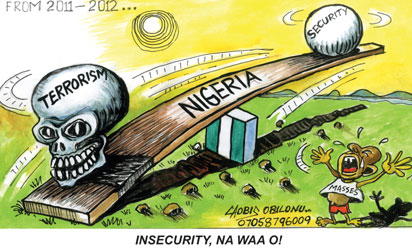
GENERAL Danjuma’s view made on the current security situation in Nigeria on the occasion of the 50th birthday celebration of the publisher of The Leadership, Mr. Sam Nda Isaiah in Abuja, is a summary description.
He said: “I used to tell myself that we shall muddle through but believe me, in the last two months, I began to wonder …our house is on fire. Nigeria is becoming like Somalia.
The Somalization of our country is going on now. We had to sit down and tell ourselves the truth. Our house is on fire, let us not deceive ourselves. We must tell ourselves the truth”. (Vanguard, Wednesday May 2, 2012). Four points are made by the General in the quoted passage, namely:
*Nigeria is becoming like Somalia;
*The Somalization of our country is going on now;
*Our house is on fire;
*We must tell ourselves the truth.
Our house is on fire explains the Somalization of our country. By the above, General Danjuma raises the alarm- our country is becoming like Somalia. This is the truth about the current insecurity of Nigeria. Many lamentations about and explanations of Nigeria’s current insecurity expressed in May 1 Labour Day are reported in the May 2 issue of the Vanguard.
My purpose for this Tuesday is to critique explanation on how Nigeria’s Somalization has come about. For if we can provide relevant explanation on the process of the country’s Somalization, that process can be halted and a de-Somalization policy instituted.
-The President of Nigeria Labour Congress, Comrade Abdulwaheed Omar, explained the centrality of events of national insecurity in the choice of the theme for the May 1 Labour Day.
He said: “Since the last May Day, the escalation of the Boko Haram threat has manifested in several bombings and attacks across the country resulting in the loss of hundreds of lives. But while we have unequivocally condemned these senseless violence and destruction we are nevertheless convinced that the ease with which terrorist ideologues are able to recruit foot-soldiers to carry out their nefarious acts must be seriously addressed if terrorism is to be a thing of the past.
That the terrorist ideologues are able to recruit willing and daring soldiers with ease lies deeply rooted in the decaying social condition in our nation: joblessness, hunger, poverty, lack of electricity, illiteracy and lack of access to education”. Observations, judgements and causal explanation are provided in the above.
Comrade Omar describes the violence of the Boko Haram as senseless and yet affirms that the Boko Haram are foot-soldiers of terrorists ideologues. Precisely because the Boko Haram are foot-soldiers of ideologues the violent course of the terrorist warfare cannot be described as senseless; the warfare has its war aims.
The current insecurity described by Danjuma in the metaphor of Somalia is a means to an end. Omar describes the Boko Haram as willing and daring foot-soldiers. He calls attention to conditions that predispose the Boko Haram towards insurgency, conditions that make them fanatical adherents of the recruiters of the Boko Haram.
The fanaticism of the Boko Haram suggests that these so-called foot-soldiers may themselves be the captain of their own decisions to take up arms against the Nigerian Federal and state governments and the international community in Nigeria. The one hundred buy-in of the insurgent policy of the recruiters of the Boko Haram suggests that we should take a second look at the Boko Haram.
From their conduct they could be a local insurgent group with external support and allies. It becomes important therefore to address the politics of the Boko Haram leadership to explain how they have organised the insurgent army with help of external allies. It is therefore important to develop a comprehensive response that separates the internal from the external phases of the Boko Haram intra-national insurgency.
It is in consideration of this approach to the present insurgency that the appreciation of the cause of support for insurgent courses and armies should be made. Comrade Omar explains support for insurgency in Nigeria in terms of social conditions of incidences of joblessness, hunger, poverty, etc.
These conditions of joblessness, hunger, poverty, etc, are by themselves are neither necessary nor sufficient to explain the policy of insurgency and the various forms of insurgencies in Nigeria. The Omar’s thesis should be able to explain the Niger Delta insurgency as well as the Boko Haram insurgency. Yet it cannot.
That these insurgencies are purposeful and programmatic shows the role of insurgent leaderships in the mounting of wars of insurgencies. Hunger does not explain the emergence of insurgent leaderships, it may explain the skillfulness with which insurgent leaderships develop their strategy and enlist support, internal and external. These insurgent leaderships are the agencies that have to be addressed.
For it is not true that if the government were to create jobs, eliminate hunger, etc, that these insurgent leaderships will be made irrelevant and ineffective. It is not the conditions of social deprivations that keep the Afghanistan Talibans in business, it is interest in power that fuels their ambitions and sustains them in decades of regime imposition warfare.
Prof. Ango Abdullahi, former Vice Chancellor of Ahamdu Bello University, in his paper at The Leadership birthday celebration explained Nigeria’s insecurity situation as a function of bad governance and corrupt governments. He asks: “Have we done enough to resist bad governance? We have been held hostage by corrupt governments, especially since the demise of the First Republic”.
He drew attention to the following events, noting that “the agitation for secession of Scotland and Northern Ireland from the United Kingdom, the world’s oldest democracy, should be a reason for Nigerians not to take for granted current agitations for the breakup of Nigeria.
Disclaimer
Comments expressed here do not reflect the opinions of Vanguard newspapers or any employee thereof.