
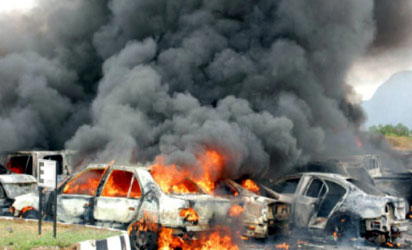
*Kano blasts
By Luka Binniyat
In Rigassa, a dingy, uncharted, crammed suburb about 5 km west of Kaduna State Government House, death lurks on select enemies of some unidentified gunmen, suspected to belong to a rising cell of a militant sect in the area.
Penultimate Saturday, some of the gunmen leaped out from a bush and took on soldiers mounting a check point by the area, and after a gun duel, a soldier and one of the assailants laid dead.
According to the spokesman of 1 Division, Nigerian Army, Kaduna. Col. Sani Kukasheku Usman, the incident happened around 9 pm.
Said Usman: “Some armed men sprang a surprise attack on our troops at a checkpoint in Rigassa last Saturday evening. After repelling the attackers in a fierce exchange of fire, our fire power and gallantry overwhelmed them. One of our soldiers was shot dead. But we also killed one of them and wounded several others. We are still on their trail, as we are collecting useful information from the populace”, he said.
It could be recalled that last Friday night, unknown gunmen in the area also killed one of the traditional rulers and another police man. This would bring to about ten in two months, series of murder carried out by gunmen in the area, almost exclusively Hausa-dominated.
Others were just ordinary folks, including a school teacher who all seemed to have begrudged the sect for one or two reasons. Unfortunately, since there are no links connecting these deaths to Boko Haram, their families are left to mourn alone, with no consolation or any form of compensation from government.
These are the some of the unsung victims of terrorists in Kaduna:
Okada Taxi Riders
The Public Relations Officer, Kaduna Okada Taxi Union told Saturday Vanguard recently that not less than 150,000 riders have registered with the union, out of an estimated 500,000 professional and non professionals okada riders.
According to Saturday Vanguard’s findings, about 200,000 are involved in night business all over the state, making an average of N20,000 per night. 
“I usually sleep when I return from my security work around 4pm”, said Bala Katuga, an Okada rider that resides in Kakuri, Kaduna. The best time for me to start work is by 9pm after taking about four hours’ sleep. I take people to night clubs, churches and hospitals etc. The charges are usually a bit higher. You could make between N2000 and N3,000 depending on the market.
“Every month, I make about N50,000 from my bike. But that is gone now, since we cannot operate after 9pm. It has been tough for us”, he lamented.
All commercial movements of Okada have been banned in Kaduna State from 9pm to 6am. In Rigassa the ban starts from 6pm.
Night life
Kaduna is famous for its exuberant night life. But, with the fear of insecurity, all the major night spots in the town have either been closed or are operating under loses.
From the International NAF Club on Rabah Road, Rose Base night club at Narayi Hight Cost Housing estate, Rampage night club on Obadu Road, Viviana, in Narayi, Sea Breeze at Unguwan Pama, night life has become a shadow of the past.
Even the infamous Maiduguri road, notorious for its scarlet ladies is now scantily attended.
Shops and businesses
Bida road was once a Mecca for stationeries and interior decor. But, all the shops have been closed permanently, cutting off means of livelihoods for thousands. The reason is that it is on the street that Kaduna State Police Command Headquarters is sited. The police have sealed off the street.
In the mammy markets, all shops must close at peak of business, between 6 and 8pm, when those who consume booze are at their best moments. A good number owners of some shops in all the mammy markets have closed shops for lack of patronage.
Big gulf between Christians and Muslims.
While, it may be true that both Christians and most Muslims reject and condemn the tenets of terrorism, there is left a deep suspicion among the two faiths.
Today in Kaduna, there are areas that are exclusive to both Muslims and Christains. Places in the Southern part where Muslims prayers emanate from loudspeakers on minarets are largely gone. Likewise, there are places where no church is found in the northern part of the city. Muslims and Christians seem to have drawn a green line that separate them both physically, spiritually and politically.
Disclaimer
Comments expressed here do not reflect the opinions of Vanguard newspapers or any employee thereof.