
By GBENGA OLARINOYE
What have been your challenges in the National Assembly?
I left the House more than four years ago, May 2007. So my experience in the Senate versus the House of Representatives, first, the challenges are different. When I was in the House of Representatives, we were not facing for example, this issue of oil subsidy, Boko Haram, perhaps the biggest problem we faced at that time was the attempt by the then president to subvert the constitution by his attempt to have a third time for himself.
Issues like Boko Haram are not issues that you can talk about as freely as you wish because security problems are not the issue any one can talk about flippantly.
The whole issue is just shrouded in a crowd of the unknown.As we are talking right now, nobody can say clearly who are the brains behind Boko Haram, even the issue of subsidy, it’s just being defrocked, that is stark naked for us to see what is beneath it. So for that reason, there has been a measure of caution.


*Adeyeye
In fact, before the issue of Boko Haram was discussed for the very first time by the Senate, if you watched the proceeding that day, you will see that the Senate President first called for an executive session and we were warned, and I believe correctly, that this was not a matter people can just plan to play to the gallery because if you misspeak in that kind of place, you might become the target of death.
You remember that the man former President Obasanjo visited to try to negotiate was killed within 24 hours and when we had the debate on Boko Baram, some of our loved ones called me and said Prof., this is not the matter to blow grammar on and I don’t blame them.
Discretion, they say is the better part of valour especially when you don’t know the enemy about whom you are going to be talking about.
Again, When you look at the character of the Senate anywhere in the world, the Senate usually comprises of people who are older than those of the other chamber. I don’t call the House of Representatives the lower chamber because the two chambers are actually co-equal.
The Senate cannot pass any law without the House of Representatives and if there is a deadlock between the House and the Senate, I can assure you there will be a joint session in which the House will always win because in a joint session, it will be one-man, one-woman vote. That is why the state itself is careful not to precipitate a situation where there would be conflict in the House of Representatives.
In fact, when we were in the House of Representatives, we enjoyed it because we knew that we must surely win when it comes to joint session.
However, in the Senate you are older, senators also tend to be less emotional. For example, often times in the House of Reps when I would speak, people will clap and I will enjoy their applauds. You cannot afford that in the Senate, it’s not allowed. So the style is different, the procedure is partly different and the tradition is different despite the fact that even when you look at the rules of the Senate and the House, they are almost the same.
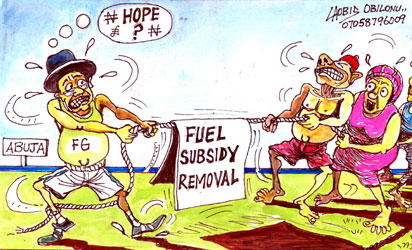
Now, as for the challenges we are facing, the issue of fuel subsidy came because there was a motion by Senator Bukola Saraki to look at the fact that the budget of our republic voted N245 billion a year for oil subsidy and that from investigation we were spending four or five times that amount.
I happened to be one of the principal co-sponsors of that motion, was debated and in the end referred to a committee to look into it. It so happened that the House of Reps later brought the same motion and we couldn’t go into action because right now all that you are seeing is what have come from the House of Reps when in fact the Senate had also met on the same issue.
We read in the newspaper, some explanations from the chairman of the committee on Petroleum on why the Senate has not come out with its own findings. He said they were trying to be sure that everything is sorted out. I am convinced that it is too late for anyone to try to hide anything, I believe nothing will be hidden, now I don’t want to prejudge what the outcome of the Senate finding would be but they may find the same thing that the House of Rep has found, there might be slight differences.
Now, as a Nigeria citizen, I am free to comment on what the National Assembly has found. I have no reason to doubt the integrity of those in the House of Representatives who are in that committee. In any case, how can it be that between one year and the next, the amount that was spent on subsidy was curtipled? Is it because the number of cars and on that account the volume of petrol consumed was curtipled over a 365-day period? I don’t believe so!
I believe that there is no how you are going to get to the bottom of this subsidy issue without finding some rots and I am glad that the National Assembly has done it duty in bringing the facts to the open, we don’t have the power to prosecute, all we can do is to tell the nation what we have found.
It’s up to the executive to prosecute, it’s also up to the citizenry to bring appropriate pressure on the political process to ensure that no one can be a sacred cow in this matter. Once the citizenry is alive to his civic responsibility, we who are your servants have no choice but to bend to your wishes.
I believe that what would happen in the end will not depend on the apathy, indifference, zeal, enthusiasm, whatsoever of politicians alone, to a large extend, it will depend on the Fourth Estate of the realm- the press, the civil society, labour, and the citizenry at large, who must say N1trillion or N2trillion is not a small sum of money.
If we bring that money to capital development, we can create enough jobs that will fast occupy our young people and arrest this orgy of violence from jobless youths who are being misdirected, by organization such as we have found in Boko Haram. It will create infrastructure that will make our lives better, it will create better schools for our children.
Disclaimer
Comments expressed here do not reflect the opinions of Vanguard newspapers or any employee thereof.