
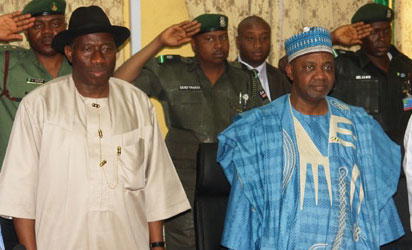
Jonathan and Sambo
BY OCHEREOME NNANNA
Nigeria had a uniform electoral calendar until the landmark case of Mr Peter Obi of the All Progressives Grand Alliance (APGA) and Dr. Chris Ngige of the People’s Democratic Party (PDP) who was initially returned as winner of the 2003 gubernatorial election in Anambra State.

Jonathan: Where is the fresh air?
The Court of Appeal, however, on March 15th 2006 ruled Obi was the winner of the election. From that moment on, a precedent was set whereby states where governorship elections were decided at the Election Tribunals in favour the candidate other than the one in office automatically exited the May 29th date for assumption of gubernatorial power in Nigeria.


As we mark their first year in political power there is a natural impulse to take stock and assess their effectiveness and ability to live up to their campaign promises or the aspirations of their people.
Advanced democracies
In most advanced democracies of the world, effective governance starts almost immediately after the governor is sworn-in. But in Nigeria, the story is not as simple as that.


Fashola: Set his path in his first year
Even those who are resuming after being re-elected still often face stiff hurdles, particularly the spectre of being dragged to the electoral tribunal. Some of these electoral battles can be highly intractable and distracting. One of the most bruising and long-drawn electoral battles at the Tribunal was that of Peter Obi versus Dr.Chris Ngige, which lasted from June 2003 to March 2006.
Also Governor Theodore Orji of Abia State suffered a deadbeat electoral melee at the hands of his PDP counterpart, Dr Onyema Ugochukwu between June 2007 and February 2009. The suit that holds the record as the dirtiest and most ridiculous was that between former Governor Ikedi Ohakim (Progressive People’s Alliance but later decamped to PDP) and Ifeanyi Araraume (factional PDP) and Martin Agbaso (APGA).
The suits went all the way from the Tribunal to the Appeal Court, and pre-electoral matters were picked up and pursued to the Supreme Court and back to the High Court. There were a total of 29 lawsuits! Ohakim only came out of the last of them victorious a few months to his failed quest for re-election in 2011.
Apart from the tension and distraction the election tribunal cases bring, it also occasions massive drain on the public treasury, as governors fight their political battles with public funds in Nigeria.
A governor faced with the more elaborate election tribunal headache finds it difficult to do much within the first year in office, what with the growing uncertainty brought about by the fact that the Court of Appeal has sacked so many governors or sent them back to the polls.
To curtail this problem, the last National Assembly amended the constitution to peg the highest number of days within which cases at the tribunals must be decided at 180 days.


Gov. Al-Makura: Confronting hostile legislators
After that, such cases would be deemed by the courts to have expired. That has accounted for the fact that today, for the first time in Nigeria’s renascent democracy, not a single case is still pending at the tribunals, as all have expired. The new law appears to favour the incumbents, but it has also given them a breathing space to face the work they were elected to do.
Another major challenge of the first year in office has to do with sorting out the sponsors of a governor or even the president. Many governorship candidates get the tickets through the “good graces” of political godfathers, who may be political speculators (financiers) or professional politicians who know how to pull the ropes to get their preferred candidates into office.
Some of the most celebrated godfathers in Nigerian politics include Chief Tony Anenih (PDP Edo State), Chief Chris Uba (PDP Anambra State), Dr Olusola Saraki (PDP Kwara) and Senator Bola Ahmed Tinubu (ACN national leader), among the others.
Since 1999, the first year in office for most governors is often a period to test the viability of the relationship between the usually demanding godfathers and the executive governors. Almost in all cases, the governors use their power of incumbency to turn the table against the godfathers and in most cases render them toothless, as was seen in Edo (Governor Adams Oshiomhole versus Anenih) Enugu (Governor Chimaroke Nnamani versus Chief Jim Nwobodo) Jigawa (Governor Sule Lamido versus Alhaji Saminu Turaki) and Kwara (Dr Olusola Saraki versus his son, Bukola Saraki).
The only clear case where the godfather was able to hold on, survive and expand his empire was in the case of Lagos where after a flare-up between Governor Raji Fashola and his godfather, Tinubu, both settled into a détente.
With the menace of godfathers getting less problematic, Nigeria’s democracy is actually improving gradually, even though not much note has been taken of this positive trend by political analysts.
Another major challenge of first year in office is the rare case of lame-duck governors. In states where electoral


Oshiomohole: Putting godfathers out of work
contests were very close, the party that produces the governor might find itself with a minority of legislators in the House of Assembly. For instance, Governor al-Makura of Nasarawa State is today overwhelmed with a seemingly hostile House of Assembly dominated by the PDP. The PDP caucus in the House at one time even attempted to foist its nominees as commissioners on the governor and only relented because of the strong opposition of the governor.
All these and other challenges contribute in no small measure in whittling down the capacity of a governor or even president to give of his best in his first year of office. Most governors are able to overcome these challenges. But in a few cases, governors have been known to have been swept out in a vortex of, particularly, judiciary hurricanes within the first year.
For instance, Dr Andy Uba set the record as the governor with the shortest tenure ever in the entire history of Nigeria. He lasted only 16 days before the Supreme Court ordered the reinstatement of impeached Governor Peter Obi. Similarly, Sir Celestine Omehia of Rivers State lasted only four and a half months before he was removed by the same Supreme Court in November 2007.
However, in spite of the many challenges that face governors and presidents within their first year in office, this period has always stood out as the most productive for the more enterprising and visionary newcomers.
Within his second one hundred days in 2007, Governor Fashola redesigned the scenery and restored sanity to Oshodi and with it commenced a legacy ofincandescent performance in the state.
The same went for Governors Oshiomhole, Akpabio of Akwa Ibom, Chibuike Amaechi of Rivers, Sule Lamido of Jigawa and (in the current dispensation) Owelle Rochas Okorocha of Imo State. This is the period of zeal and hunger for achievement. For most of these governors, the verve gathered in the first year of office often becomes the threshold upon which the leap into a second term in office – godfather or not – is established.
And in most cases, it is after the first year of office that the politics of second term begins to weigh heavily on the mind of the governor. He begins to look for ways of putting aside the funds to pursue the second term. He begins to put money in schemes other than developmental ones. He begins to “invest” politically.
He begins to irrigate his party, his platform and his followership with “empowerment” which often leads to many socially relevant projects being neglected. The more politics takes the centre stage as from the second year on, the less is devoted to developmental issues.
The first year in office is the period of youth and romance. It is probably the best period in which to catch a politician at work for the public good.
Read more Challenges of one year in office by clicking below
MAY 29 AS DEMOCRACY DAY: What’s in a date?
How leaders battled for office
Disclaimer
Comments expressed here do not reflect the opinions of Vanguard newspapers or any employee thereof.