
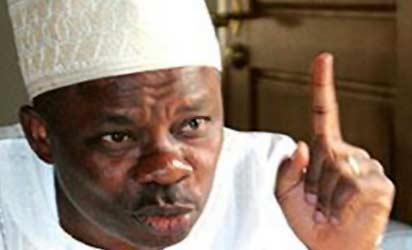
Gov Amosun
BY LEKE ADESERI, South West Regional Editor
THE Judicial Commission of Enquiry on Lands, led by its Chairman, Hon. Justice Abiodun Akinyemi, Monday, presented its final report. Among other things, the Commission recommended outright cancellation and recovery of lands, recovery of monies from companies and individuals as well as baring those involved from public office.
The Commission, according to its Chairman, recommended immediate establishment of a Land Use Committee, upgrading of the Bureau of Lands to a full-fledged ministry and the merger of Gateway City Development Limited with a repositioned Ogun State Property and Investment Corporation. But controversy over government’s real intention for setting up the committee continues to dominate private and public discourse in the state.

Gov Amosun
People are asking questions about why former governor, Otunba Gbenga Daniel, took the decisions he took as regards state land vis a vis Governor Ibikunle Amosun’s decision to adopt some of the ‘unpopular’ steps of granting rebate on lands.
The commission’s findings:
At Monday’s submission of its report, Chairman of the Judicial Commission of Enquiry on Lands, Justice Abiodun Akinyemi, enumerated a few of the findings of the Commission, which included the release of government lands to non-existing beneficiaries, allocation of lands and issuance of C of Os to allottees without evidence of any payments, resulting in enormous loss of revenue to the state government.
Justice Akinyemi said they discovered allocation of lands and assurance of C of Os to unregistered companies, allocation of hundreds of hectares of state’s lands to private companies without payments and under questionable MoUs, and concessions of state’s property to private companies upon terms and conditions contrary to the public interest.
How I administered land in Ogun State, May 2003 to May 2011– Daniel
A statement signed by Mr ‘Sina Kawonise, immediate past Commissioner for Information and Orientation, for and on behalf of the immediate past Otunba Gbenga Daniel-led Administration in Ogun State stated: “On May 29, 2003, when we assumed office, land in Ogun State was worth very little. At that time, the most expensive land allocated in any GRA anywhere in Ogun State was less than N1m. The only exception was the Hilltop in Abeokuta opened up by the Administration before us.
“Although all the available space was already allocated at that time, not a single plot was built up at the Hilltop. It is apt to say that rather than revoke a single plot from all the ones allocated by Osoba administration, we went to a virgin forest and developed what we named Olusegun Obasanjo Hilltop GRA. In other areas such as Ijebu Ode, Sagamu and Ilaro, GRAs existed only in name as there was hardly any infrastructure that defined them as such. The cost of land was between N300,000 and N800,000 per plot and there was very little demand for land in those areas. The usual retort by most people offered land at that time was “what do I do with it?”
“Real estate business was not very viable anywhere in Ogun State. In fact there was not a single real estate development anywhere in the State. That was 2003.
The other major challenge which we met was massive unemployment both at graduate and other levels. It was commonplace to find graduates of six years or more roaming the streets unemployed. To tackle this challenge, we decided that (1) we would not retrench workers in both the civil and teaching services; and (2) we would double the workforce to reduce the level of unemployment.
“We thank God that we kept faith with these resolutions till the very end even in the face of the terrible cash crunch that beset us in the last three years of our government. During our tenure, there was absolute job security because nobody’s job was under any threat whatsoever notwithstanding his/her political or religious persuasion.
Infrastructural development
“In addition to this, we reasoned that another means to engage the tens of thousands of existing and new graduates in our state was through massive infrastructural development and construction in an ingenious way in order to create a multiplier effect on the economy. This is a time tested macroeconomic concept which several developed countries such as Germany and China adopted to jump-start and consolidate their economies. It was on this basis that we promoted and executed several Housing Estates, some through Public Private Partnership (PPP) and others through direct government funding. We added 37 Housing Estates to the three we met on ground.
“Unlike the Ogun State of today which is awash with cash – which we did not have; for example, the total income of the State in the last eight months is approximately what we had in two years prior. The only major revenue source, apart from the allocations from the Federation Accounts, was land, which, again, was not in high demand at the time. Our strategy as a Government was to liberalize Land Administration and make land attractive to would-be investors and potential users who mostly considered only Lagos, Abuja and Port Harcourt as investment destinations.
“We deliberately made land cheap. We were neither stupid nor foolish. Neither too were we oblivious of what could immediately come into the purse of the government if we put what is now being referred to as the “real value” on the land. Our strategy was very simple: attract the developer first, no matter what he/she wished to build – residential, commercial, industrial, religious etc. – with cheap land, and then recover the initial concession multiple fold with taxes, tenement rates and levies after the investor must have constructed immovable properties in the State.
“We were well aware that the income would not be immediate but we were certain that in the medium and long terms, the State would bountifully reap the dividends. We feel gratified and fulfilled that this strategy worked wonderfully well, as confirmed by the significant increment in the Internally Generated Revenue, IGR, of the State in recent times. The tool for carrying through that innovative policy was the prerogative of the governor conferred on him by the Land Use Act which gave authority to him to grant generous rebates, discounts and waivers on land charges and costs. It must be stated that despite these rebates, discounts and waivers, which, unfortunately, are now being presented as crime against the state, the monthly IGR of the state from land administration actually tripled on the pre-2003 levels.”
Amosun’s land incentives for investors
In his address delivered at the Ogun State Investors’ Forum tagged, “Ogun State-Open for Business”,held on Monday, March 26, 2012, Governor Ibikunle Amosun said: “We recognise the role of land as a key factor of production. We are supporting our various policy initiatives with easy access to land. We have reviewed the cumbersome and outdated processes relating to land allocation. Indeed, we have begun the process of clearing the backlog of issuing Certificates of Occupancy which saw some property owners waiting many years to obtain their land titles.
“Ogun State being open for business is not a catchy slogan. We truly are open for business and in that regard, we want to be a catalyst to jump start development in certain key areas. Since our location is our key competitive advantage, we want to announce some incentives that will convince you that Ogun State is the best place for you to invest. I am delighted and very excited to announce that effective from today the following discounts shall be applicable for the purchase of land in Ogun State:
Land Use Category Discount Applicable
Agricultural 80 per cent
Manufacturing 60 per cent
Commercial e.g. tank farms, real estate, logistics 40per cent
Community Organisations- including religious educational institutions 75 per cent
“Of course these incentives are structured to supply immediate impetus to our development drive and to that end are applicable when qualifying conditions are met.”
Disclaimer
Comments expressed here do not reflect the opinions of Vanguard newspapers or any employee thereof.