
By Victoria Ojeme
From a community once dominated by military heads of state, majority of whom came to power through the usurpation of constitutional order, the Economic Community of West Africa States (ECOWAS) is fast gaining a reputation of intolerance of undemocratic succession to power.
From mere rhetoric and handling of military and undemocratic usurpers with kid gloves, ECOWAS has indeed transformed into a community that is ready to go to war to restore constitutional order.
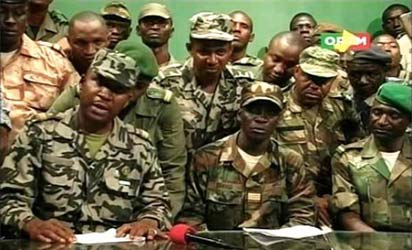
Barely weeks after sustained pressure, including threat of military intervention, caused a reversal of the forceful take over of government in Mali by elements of its military, the sub-regional body once again bared its fangs against the military junta in Guinea Bissau, which forced its way into power penultimate week.
Reacting to the new development, newly elected President of the ECOWAS Commission, Désiré Kadré OUEDRAOGO, reiterated the community’s opposition to the military coup and its determination to see to the restoration of constitutional order in the beleaguered country as soon as possible.
In a statement on April 12, 2012, in Abidjan , the capital of Ivory Coast and current seat of the Chairman of ECOWAS, OUEDRAOGO said, “ The ECOWAS Commission has just learnt with great concern about the on-going attempt by the military to overthrow the Government of Guinea Bissau. ECOWAS is particularly disappointed with the timing of the coup attempt, coming just days after a joint ECOWAS-AU-UN mission met with the military hierarchy to warn against any temptation to disrupt the on-going electoral process.
“The Commission firmly denounces this latest incursion by the military into politics and unreservedly condemns the irresponsible act, which has once more demonstrated their penchant to maintain Guinea Bissau as a failed state. ECOWAS demands the immediate restoration of constitutional order to allow for the completion of the on-going electoral process.
This flagrant defiance of the Community’s principle of Zero Tolerance for power obtained by unconstitutional means, as enshrined in the Supplementary Protocol on Democracy and Good Governance cannot go unpunished as, by their action, the military have willfully and knowingly outlawed Guinea Bissau from the ECOWAS Community” the ECOWAS Commission President said.
The African Union to which ECOWAS member states belonged also took a queue from the sub-regional body to denounce the junta, with threats of further action against the coupists.
On April 16, 2012, as a follow up, ECOWAS dispatched a delegation to Guinea Bissau to meet with the junta and demand immediate restoration of constructional order.
The ECOWAS delegation led by the President of the ECOWAS Commission, reportedly met with the junta to deliver a special message from the Chairman of the Authority of Heads of State and Government, reiterating the principled position of ECOWAS rejecting the military take-over of power on 12th April and insisting on the immediate restoration of constitutional order.
The delegation comprised, among others, the Minister of Foreign Affairs of Cote d’Ivoire, Nigeria’s Minister of State for Foreign Affairs and the Chiefs of Defence Staff of Benin, Burkina Faso, Cote d’Ivoire, Guinea, Nigeria and Senegal.
There were also representatives of the African Union and the United Nations, political officers from ECOWAS Member States and officials of the Commission.
The ECOWAS Mediation and Security Council, which met at the ministerial level, on April 12, 2012, to find solutions to the Mali and Guinea Bissau political imbroglio, before dispatching the delegation to meet with the junta had among others agreed on the dispatch of a mixed civilian-military delegation to Guinea Bissau under the auspices of the regional mediator, President Alpha Conde of Guinea, to meet with key stakeholders within the political class and the military so as to douse the political tension arising from the inconclusive first round of presidential election of March 18, 2012, in the country.
The refusal of the junta in Guinea Bissau to heed the advice of the community to go back to the barracks has so far attracted economic sanctions from ECOWAS and AU, the sort of action that forced the hand of the Malian coupists to relinquish power to the new civilian transition government led by the Country’s Speaker of Parliament. The tough stance of the community against the junta in Mali for many was indeed proof positive of the commitment of ECOWAS against unconstitutional usurpation of power in recent times.
Hours after the coup in Mali, the Nigerian government, as had become traditional in the last decade, was among the first countries to condemn the forceful seizure of power with very strong words of condemnation by President Goodluck Jonathan.
Jonathan, in a statement by his spokesman, Dr. Rueben Abati, said, “The coup plotters have only embarked on a fruitless mission of supplanting a constitutional government by other means which goes against the current global grain of constitutionalism. Nigerian Government would never recognize any unconstitutional regime”.
The Nigerian Ministry of Foreign Affairs in a statement also added that, , “The Government of the Federal Republic of Nigeria condemns unequivocally this unfortunate development in Mali as it constitutes a gross violation of the ECOWAS Protocol on Democracy and Good Governance to which all the States of the sub-region, including Mali, are parties”.
Taking a queue from the Nigerian government, President of the ECOWAS Commission said, “By this unconstitutional act, the junta has automatically alienated and outlawed itself from the community.
“ECOWAS calls on it to immediately relinquish power to the rightful government so that the country could return to constitutional normality.”
He added that he was in contact with the ECOWAS chairman, “with a view to taking urgent action to ensure the rapid restoration of constitutional order in Mali”.
The actions that bent the will of the junta in Mali included a cocktail of sanctions, including, travel and economic restrictions imposed by the community, AU as well as the United States government, among other international players.
One of the significant sanctions specifically targeting the leaders of the junta include, travel ban, as well as diplomatic restriction, denying them the opportunity to travel through the sub-region to sell their coup, as had always being the practice, where coup leaders visit sub-regional and regional governments to secure support for their forceful intervention through cutting individual back door deals.
The AU also slammed its own sanctions, including asset freeze, among others.
Dismissing any hope of negotiating its way out of the tight corner it has boxed itself into, the ECOWAS Chairman said, “All diplomatic, economic, financial measures and others are applicable from today and will not be lifted until the re-establishment of constitutional order”.
Hours after ECOWAS’ announcement, the U.S. Department of State also announced that it was imposing sanctions on travel to the United States on those people “who block Mali’s return to civilian rule and a democratically elected government” and on their immediate relatives.
Those targeted by the US actions according to the statement include, “those who actively promote Captain Amadou Sanogo and the National Committee for the Restoration of Democracy, who seized power from democratically elected President Amadou Toumani Toure on March 21”.
Thanks to the resolve of ECOWAS not to tolerate usurpation of power, Mali is gradually on the march back to constitutional order and the junta in Guinea Bissau no doubt will soon come to its senses.
It is instructive to note that the first time ECOWAS took a strong position against military seizure of power was against the Johnny Paul Koroma-led Armed Forces Revolutionary Council (AFRC) junta in Sierra Leone in May 1997.
Sanctions and embargos were imposed followed by an ECOMOG intervention that toppled the regime in February 1998. The democratically elected government of President Tejan Kabbah, who was in exile in Conakry, was then reinstated.
Sanctions were also used against Charles Taylor in Liberia though under the auspices of the United Nations. However, the first time ECOWAS sanctions and embargos became very instrumental against an unconstitutional regime was the Armed Forces Revolutionary Council (AFRC) junta in Sierra Leone in 1997.
The junta became very unpopular as a result of shortage of basic essential commodities such as fuel, rice, cooking oil, etc, which had to be smuggled from neighbouring Guinea. To a large extent development helped to create public opprobrium against the military regime and was largely responsible for their defeat by the ECOMOG forces.
It has been argued in some quarters that the new stance of ECOWAS to readily intervene in any member state by whatever means to restore constitutional order offends the principle of territorial sovereignty.
The recent examples, successes recorded by piling pressure on the junta in Mali to recant and now Guinea Bissau on the contrary, contributes to the enforcement of the protocols.
Member States, for instance, bear primary responsibility for peace and security within the context of state sovereignty. The ECOWAS Vision 2020 is people-focused, a milestone from the once-labeled “ECOWAS of States”.
This new Vision automatically settles any arguments of state sovereignty and supranationality as matters are judged in favour of supranationality. It is in this same context that sanctions have been imposed on erring Member States such as Mali and Guinea in 2012.
Various ECOWAS protocols , specifically Chapter V, Article 25 (e) of the 1999 Protocol Relating to the Mechanism for Conflict Prevention, Management, Resolution, Peace-keeping and Security, which states that the Mechanism can be applied in any of the following circumstances: “(e) In the event of an overthrow or attempted overthrow of a democratically elected government” have been relied upon by member states to stand against military coupists in the sub-region.
The 2001 ECOWAS Supplementary Protocol on Democracy and Good Governance (A/SP1/12/01) in Article 1b states that “Every accession to power must be made through free, fair and transparent elections”.
And Article 1c which has “zero tolerance for power obtained or maintained by unconstitutional means”, is also an instrument relied on by member states to check mate military intervention in the sub-region.
Disclaimer
Comments expressed here do not reflect the opinions of Vanguard newspapers or any employee thereof.