
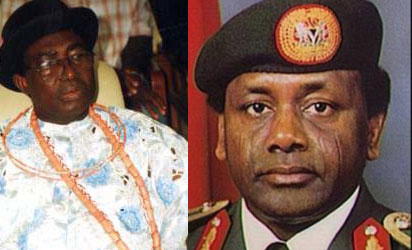
Chief Wellingon Okrika…fought for 13 per cent derivation and Gen. Abacha…okayed 13 per cent derivation
BY EMMA AMAIZE, Regional Editor, S-South; SAM OYADONGHA & AKPOKONA OMAFUAIRE
FOR the oil communities in the Niger-Delta, there is a misconception by both the Northern governors and Niger-Delta on what the 13 per cent derivation is all about. While the northern governors see it as booty for their southern counterparts and want it reduced, some South-south governors, indeed, think it is booty for them and have hijacked the fund from the oil communities, which it is meant for.
Some of the leaders of the oil communities, who fought for 13 per cent derivation, spoke to Vanguard on their disappointment and joy since former Head of State, the late General Sani Abacha of blessed memory, who they described as a hero approved 13 per cent derivation fund for oil communities. They spoke on how former President Olusegun Obasanjo tried to make the governors of the oil states comply with the original agreement that led to the approval of 13 per cent derivation by northern leaders at that time, the states that complied and those that blatantly refused.
The oil communities are spoiling for a show down, they want to draw a battle line – with whom and why? Find out from the lips of the man who co-ordinated events for the oil states in the 1994 Constitutional Conference, Chief Wellington Okirika, former national chairman of the Traditional Rulers of Oil Minerals Producing Communities of Nigeria, TROMPCON, HRM, Charles Ayemi-Botu, Pere of Siembiri kingdom in Delta State, chairman Host Communities of Nigeria, HOSCOM, Oil and Gas, Bayelsa state, Chief Bob Nabena and a host of others.

Chief Wellingon Okrika...fought for 13 per cent derivation and Gen. Abacha...okayed 13 per cent derivation
HOW did the 13 per cent derivation come about?
As Mr. 13 per cent, I should be in position to tell you how it came about. It was during the military administration of General Sani Abacha – that was during the constitutional conference of 1994/1995, where it was decided that all the issues that were militating the Nigerian state should be brought to the front burner for discussion. We, the oil producing communities in Nigeria assembled together, traditional rulers, leaders and elders all came together, along with women, we all joined forces and made a case for increase in derivation, from three per cent to 25 per cent and we submitted papers, stating our demands in the constitutional conference with all the documentation and figures.
I was coordinating all the activities involving our demands at the conference. I know what happened, at that time, there was no civilian state government, it was a military regime, it is all the oil producing areas that came together, and we led several delegations for increase to 25 per cent. We did documentation because at the end of the conference, they set up committee to look into our demands for the increase from three per cent to 25 per cent. The late Ikemba of Nnewi, Dim Odimegwu Ojukwu of blessed memory was a member of the committee along with other prominent Nigerians. It was a really difficult battle, but at the end, we got 13 per cent derivation.
13 per cent derivation not for govs: The facts were make bare, it was agreed that if oil communities who produce the wealth of this country should not be docile in the participation of the oil industry. That it is necessary that they participate actively in the management and be part of the oil money that was the basis of the committee report, they recommended 12.5 per cent, which was made 13 per cent so this struggle was fought exclusively by the oil communities and the money was meant to be given to the people directly through the oil commission in each of the producing states.
Govs hijacked derivation fund: There were no state governors then, so we got this resolution and it was submitted to the late General Abacha. Despite what you say about Abacha today, 13 per cent derivation was one of the major decisions the General took in favour of oil communities. He approved and accepted that the oil communities should get 13 per cent derivation, but it was never implemented until politicians came on board. When they came, they hijacked the fund and insisted that the funds pass through the governors, but with the understanding the governors would transmit these funds through oil commissions to the oil communities. But the Governors got attracted by the funds and started using the funds directly.
Govs flouted Obasanjo’s order on derivation: However, those of us who are the founders of 13 per cent derivation, we did not rest on our oars, so during the period of former President Olusegun Obasanjo, we mounted pressure and he set up a council, made up of oil-producing states, where the governors and people of these oil producing states came together for the first time to discuss the way forward, and in the meeting we presented our final documentation papers that this money is not for the governors but should be paid directly to the people via oil commissions. At the end of the discussion, it was agreed during the presidency of Obasanjo that the money should be sent through the commission to the communities. He then directed that all the governors should create oil commissions in all the oil-bearing states to access these funds to the people. But the order was not carried out by all the affected governors. Delta, Ondo and Edo states complied, but the three major states, Bayelsa, Rivers and Akwa-Ibom have refused to inaugurate oil commissions.
RMFAC recommended derivation should be given directly to communities: So, really, this money is not meant for the consolation of state governors, it is meant for the oil communities, and I know that since that coastal meeting in Abuja, at the meeting, the Revenue Mobilization Allocation and Fiscal Commission, RMFAC, gave evidence that the fund is not part of any state government allocation but should be given to oil commission through oil commission. Till today, I even hear that they submitted the report to the National Assembly that it should not be part of state allocations but to channeled to the communities.
You said the 13 per cent is not getting to oil communities in some states and you people kept quiet?
No, we initially wanted 25 per cent, and then when we were given 13 per cent, we thought that the money will get to our people. We had another battle because of that. Since the approval the money has not got to the oil communities, not in all the states though. In some states, we have the oil commission where 50 per cent of 13 per cent of the fund go to the oil communities. That is not bad, but in some other states, the money does not get to the people.
Talking about an increase
This is the problem we faced with the politicians and we wanted to resolve it before talking about an increase, though we actually asked for 25 per cent, so that issue is still there.
In view of the road that you people travelled to arrive at 13 per cent derivation, what is your response to the call by the Northern Governors, Central Bank Governor, Sanusi, and Arewa Consultative Forum that the 13 per cent be reviewed downward?
I think there is a misconception here. First, the money is not getting to the people. In the 1994/1995 Constitutional conference, we had the support of the northern leaders during Abacha era, they believed that yes, this money should be given to the people via an oil commission. I think what is happening is that they want the governors to let the money get to the people for what it is intended for. It is because the money is still being used by the governors that we have having this misinformation. They have not been properly informed that this money is not part of governors’ allocation. It is meant for ameliorating the pains of the oil communities, so that we can have a sense of belonging. For those whose place is bringing the wealth, that is all the northern leaders want and till tomorrow, they will support the derivation getting to the source. We were at the conference with them. Let the governors let go of these monies and let the money go to the oil communities via the oil commission, they know that the money is not meant for the governors but for the people.
What if the northern governors succeed in getting 13 per cent derivation slashed?
Well, there will be renewed advocacy again, but the advocacy has be stunted, when you fight for something, you must realize what you fought for, but when someone else who has political will takes over what you fought, as a human being, you become disillusioned. We are not happy that our state governors are not letting go of this money. Yes, they may be part of the producing communities but the 13 per cent derivation is the common wealth of our people, we insist that the governors might be part of the oil-producing communities, but the wealth of the people cannot be spent by only one person. It is spent by a group of people when you have the oil commission, commissioners will come from the oil producing communities, then you see a lot of persons being involved in the management of the money, but the governors cling to it.
Management of derivation fund
This money is not meant to be politicized; the management of derivation fund is through the setting up of commission as it has been in Delta State. There is relative peace in those areas where they are managing the money through a commission. It is let for the communities to rise up to the new advocacy and inform the world that this is what they fought for, this money is not getting to us, and this money is not part of the allocation.
What is your view on the submission that oil well 200 Isobaths is a common patrimony and belongs to the entire country?
You know what has happened is that the water and the land are joined together. The principle of derivation is because the producing communities are deprived of their basic amenities. For instance in some of these communities, their basic occupation is fishing, but there is no fishing going on now, oil activities has destroyed the environment, so if you are talking of 200 Isobaths, that is our fishing zone, it is our fishing ground, that is where we do our fishing activities.
So where the water is polluted, so if your fishing ground is destroyed, that is the basis for compensation and the derivation fund, we are being deprived of the use of the fishing ground, just as we are being deprived of our farming land.
So, there is no reason for anyone to say that we are getting compensation for land that we are being deprived of us, then we cannot get compensation for water, I mean that there is something wrong, it is our river that is being polluted and we need compensation for the use and despoliation of the water. It is the source of our livelihood, so no one can just come and say they want to fish in our water, won’t they cross our villages and lands? Will they fly into the water or what, as long as the water is joined to the land, it is our fishing ground and compensation should be paid as a result of destroying the floral and despoliation of our land, we must get the benefit from it.
The oil communities have made a lot of sacrifice to keep the country one by accepting 13 per cent derivation all these while. You know very well that the degradation of our environment and unemployment led to militancy and you know how people have died from air pollution and water pollution. In fact, it is unimaginable to talk about it, that we continue to make sacrifices to this country and this country, instead of being thankful to us and see how we can survive are saying that the very little bit we got, they will take it from us. It is misinformation, they are not properly informed.
What do you think is responsible for this sudden backtracking by the northern governors?
I think the problem is that this money is in wrong quarters, it is in wrong hands, the northerners expected this money to go to the commission, it was not intended for state governors, and when you pass this money through someone, it will bring problem. When we were at the conference, we did not say the money should pass through any state government. We said the money should be sent through oil commissions and we repeated this advocacy again in the political arrangement under Obasanjo, he ordered that the governors should let go and set up the commissions, but because of what you know they are still holding the money.
So, are we going to fight the governors, the Nigerian state has said give the money to the people, it was intended for. And we expect the northerners to tell our governors to send the money to the people the money is meant for, when that happens, I think they will stop this agitation.
Does derivation go only to the South-South States alone as also to the other parts?
Right now, I heard that a state in the north has found oil, so, they will get their oil derivation and derivation is not meant for oil alone. It is meant for all mineral resources that can be exported, because I know that very soon, many other states will become oil-producing. Lagos now has oil, some northern states will have oil, it is not only for the South-south, it t is for anywhere that a mineral is being exploited, it is for the despoliation of the land.
What’s you riposte to the north?
My call to the north is that when Abacha was met on the issue and being a northern leader, he approved the 13 per cent derivation fund and most of the northern leaders crying now were part of the constitutional conference, I believed that before he took the decision, he had wide consultation with northern leaders and it was agreed that these oil communities have suffered so much for this country and, therefore, let them be given this money to manage to ensure peace, security and development. They appealed, however, that the money must get to the communities, but the truth is that money is yet to get to the oil communities, so they should help us to tell them to release the money. That said, the call that the money, which was approved, should be reduced is insulting because the oil communities are entitled to it for their contributions to the country.
How do you describe Abacha in view of his role on 13 per cent derivation?
Abacha was a great leader, I mean, to us, he is our hero because he created a state for the Ijaws, i.e. Bayelsa and he created 13 per cent which is more than a state. I mean, this is something nobody would have done if not Abacha. He is our hero, he has created the 13 per cent derivation, but after 17 years, the money is yet to get to the oil communities, which it was approved for. So, I think he is a hero; may his soul rest in perfect peace and his spirit also direct the leaders of this country to implement the decision, Amen?
But the recent lists of allottes of oil blocs show a preponderance of northerners?
It is amazing, it is amazing that this country has been bought by few individuals, it has been bought. For instance, I am a leader of an oil producing community; I come from a community where we have eight flow stations, five for SPDC and three for Chevron. But I don’t even have AGO supply to Chevron, not to talk of oil licence, oil bloc or oil allocation, that is impossible. As the traditional prime minister of Gbaramatu kingdom, an oil producing kingdom, I have no single contract with SPDC and Chevron, which is why they should appreciate the fact that we accepted 13 per cent because all those advantages that come to people never come to us.
Let’s share oil on regional basis: So I am indeed amazed that few persons have bought this country and if we are going to restructure, if we can share ministerial appointments on regional basis, why can’t we share oil blocs, oil licence, crude oil licence on those basis, for equity and fairness, for the fact that we produce the wealth of this country. How can we produce the wealth of this country and be deprived by our leaders and by the nation? The revelation is baffling but that is the truth of the matter.
Oil blocs and oil licences
The little benefit we got, the politicians came and hijacked, what do you want us to do, but to resign ourselves to God. They have oil blocs and oil licences, they import crude oil, they import refine products, it is amazing. Not just from this, what about the fuel subsidy probe, we found out that nobody from the South-south benefits from the subsidy. Here I am, a major oil producer – who will give me fuel importation licence, who will give me crude oil licence, who will give me oil blocs?
Crux of the matter: We are praying that God should touch the minds of our governors to let go and let the people manage the money for their welfare so that they can feel a sense of belonging. In the places where the commissions are on, for instance in Delta State, we have a chairman of the commission, we have about eight commissioners, we have about 4,000 workers, we have infrastructural developments, we have agricultural centres, you can see that the people are managing themselves and the governor of Delta State has done very well by maintaining and sustaining the oil commission.
Disclaimer
Comments expressed here do not reflect the opinions of Vanguard newspapers or any employee thereof.