
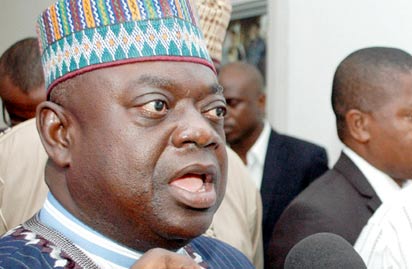
Aliyu Babangida
By Obi Nwakanma
Niger State governor, Dr. Babangida Aliyu unleashed the bag of storms in his statements recently calling for a more equitable or balanced revenue formula. In his assertion, there is great injustice in the current revenue structure and sharing formula in Nigeria.
He laments the situation by which an oil producing state in the Niger delta region of Nigeria might get N24 billion a month of fiscal allotment, while a state in the North collects, “just N4 billion.”
To put matters in even sharper highlight, Governor Aliyu links the poverty in the north to this imbalance. First I should say, it is curious to me as it should be to any interlocutor of national news why Dr. Babangida Aliyu chooses to fog up the issues of poverty in the north with the situation of current revenue distribution.
Poverty in the north of Nigeria is a social dilemma with roots far deeper and longer than the current revenue distribution formula. But we shall come back to this point. Let’s simply say that Dr. Aliyu is full of shaving cream on this matter.
But it is also true that as current Chair of the Northern governors forum, the governor is obligated to“speak for the north” whose political agenda seems to be to “restore” a status quo of binge and privilege to which it seems as a region it became used from 1970 until quite recently with the changes in national revenue allocation that granted 13% of derivation to the oil-producing areas.

*Gov Aliyu Babangida
This matter is pure kite-chasing on the part of Governor Aliyu and a category of Northern intellectuals who jumped unto that wagon with him. But we must pay attention to this evolving debate. It has very deep political hues.
It was first developed in the Daily Trust which began to call attention to what it considered the lop-sided and in its estimation unfair level of revenue investment in the Niger delta compared with the North in general. The general problem however is that in making these claims for a change in the revenue structure, Governor Aliyu, now publicly supported by the Arewa Consultative Forum (ACF) is not just opening still fresh wounds but doing so in a political environment that is more charged with ethnic and regional bias, religious and political violence, and of course, deep suspicion.
It is of course true that national revenue, even as Governor Aliyu suggests, is “national patrimony;” what remains however is how we are to formulate the meaning of the patria. There are those in Nigeria who feel that as a region, the North of Nigeria has been unfairly pampered, over-indulged, and over-compensated to the detriment of the South, particularly the region in Nigeria where much of the oil wealth is derived.
The hue and cry over the years about a return to “fiscal federalism” is anchored on the premise that much of Nigeria’s national revenue, particularly under the military, had been lopsided in favour of the North to the detriment of the South-East and South-South, those areas of Nigeria both devastated by war and by political neglect. It was in the fierce anger to correct the neglect and pressure the nation for justice that the various defiance movements began in Nigeria.
Here is not the place to begin to articulate in detail the impulses behind the Niger Delta resistance and its armed struggle. The debate over equitable pay of derivation accruable to the producers of national wealth – that is the oil revenue on which Nigeria seems to solely depend – continues.
There are many who are not satisfied with the current 13% derivative, preferring to return to the pre-war derivation formula of 50% which would give each region the right to its natural resources and wealth, and by which a national tax formula may be designed for the coffers of the central government.
At the roots of the current agitation for a Sovereign National Conference is the deep sense of injustice on current revenue distribution and allocation, and on the skewing of what many call “fiscal federalism” in the Nigerian formula.
Governor Aliyu’s statement reopens that debate. But let me therefore quickly go to the point of the governor’s claim of insufficiency of national revenue based on the current formula that leads to the poverty in the north. I wish to point to the basic contradiction in Aliyu’s claim.
Northern poverty is not the result of unfair national revenue distribution, it is the result of unfair levels of acquisition in a tradition-bound and hegemonic order, in which the Northern rich corners the wealth of the region for their own use without making investments in the development of the ordinary lives of the so-called ordinary northerner.
The traditional stratification in the north permits that kind of impunity that has created a massive level of poverty of the underclass, and a massive concentration of wealthin the few hands of individually privileged northerners.
The question that we must ask Dr. Babangida Aliyu and his cohorts in the north is, what do they do with the federal grants allocated to states in the north? How much of it goes to public education, public health, public infrastructural development, and so on?
From a basic history of revenue distribution in Nigeria from 1970, any critical interlocutor of Nigeria’s public finance will testify that more resources has been poured into Northern Nigeria from Nigeria’s public fund than in any other region of Nigeria in the vertical and horizontal distribution system.
The federal investmentsin the North testify to this. If any part of Nigeria should complain, it must be the South-East of Nigeria. As we have continued to point out, in the distribution of revenue to the local government, which accounts for about 21% of the national revenue allocation, Kano state alone has local governments more or equal in number to the entire South East of Nigeria. Basically, Kano receives far heavier federal allocations than the entire South East.
In terms of the basic facts, Imo state alone has a school enrollment figure higher than the entire north of Nigeria, which means that, even though Imo state is an oil-producing state and has a school population higher than the entire north, and therefore expends a proportion of expenditure in public education, higher than the entire north, it still gets federal grants lower by a great degree than Kano!
We must measure the index of allocation on its human impact not merely on putative proportion. This is the point that I think escapes Dr. Aliyu. I think it is time that the northern leadership is forced to account for all the resources that have been sent up North with scant result and which still leaves a terrifying level of poverty among its indigenous human population.
It is also high time that the North began to talk more in terms of local revenue generation capacity, and the development of a vital tax base that would fund its more sustainable development, rather than maintaining a serious dependency habit formed on this drug called“federal allocation” made from the blood money called “Oil.”
The north is not poor, it is simply poorly led by those who are too frightened of the scrutiny of an empowered and an enlightened population. It has always been in the interest of the elite of the north to keep its population poor and ignorant. That is the larger, unaddressed problem. And it is of course, a Nigerian problem.
Disclaimer
Comments expressed here do not reflect the opinions of Vanguard newspapers or any employee thereof.