
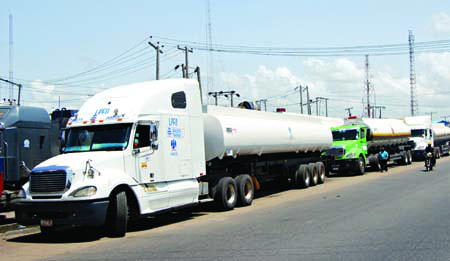
Some of the tankers parked by the road side
Clara Nwachukwu
Change, they say, is the only permanent thing in life. And one thing Nigerians should expect from the downstream operations ahead of full deregulation s constant changes that will usher in a seamless delivery and supply of petroleum products.
This is one of the resolutions of the Petroleum Products Pricing Regulatory Agency, PPPRA, as being spearheaded by its Executive Secretary, Mr. Reginald Stanley.
In line with the above, the PPPRA scribe has promised operators and consumers alike that it will no longer be business as usual as far as products distribution and supply are concerned.

*Petrol tankers
Accordingly, Stanley assured downstream operators in a recent meeting with them in Abuja that “There will be a periodic review of operations with a view to improving the process of supply and distribution.”
To achieve this, he also gave the assurance that there will be a level playing field for all to operate as opposed to the politicking that trailed products importation in the past, leading to the high level of corruption that trailed the subsidy regime being managed by the PPPRA.’
A tip of what is to come was witnessed in the recent award of import licences to 42 downstream operators including depot operators, major and independents marketers to bring in 4.8 billion litres of refined products.
Marketers’ observations
According to the majors, “The fact that it was released early before the end of the quarter means there is already a very big improvement.”
They added that, “This way we can plan properly on how to bring in the products as opposed to the past when licences were awarded at the beginning of a new quarter, and this causes a lot of delay before the products can come in.”
Indeed, the PPPRA became popular on account of subsidy administration through the Petroleum Support Fund, PSF, which was instituted by former President Olusegun Obasanjo. The PSF was used to reimburse marketers on the price differential between the landing cost and the pump prices for petrol and kerosene, which were regulated by the Federal Government.
But the policy, which was meant to cushion the impact of high oil prices on local consumption, went from being a palliative to a big burden, in view of the sleazing that trailed the system, as uncovered by recent legislative probe into the payment of over N1.74trillion on subsidy in 2011 alone.
Being in the eyes of the storm, called for a change in the norm, where briefcase operators were reimbursed for bringing in products, which were eventually diverted to neighbouring countries at higher costs.
The operators, including depot operators and independent marketers, also noted that there is now a conscious effort on the leadership of the PPPRA, to follow due process in the award of import permits.
According to the major marketers, whose members including, Mobil, Total, and Oando, benefitted from the recent import licence award, “The process is now better, and we will continue to give our support by way of advice on how to improve on the system.”
Furthermore, operators noted that the import permits were awarded based on performance, because, “We looked at the process and we noticed that mostly depot and retail outlets owners were given permit.”
They argued that given his wealth of experience in the industry, downstream operations are heading for better days ahead.
This, they added, is because Stanley also promised to “review performance on quarterly basis to monitor what operators are doing with the permits given to them.”
The operators, who spoke on conditions of anonymity, said the PPPRA boss executed the import permits “in a most transparent manner,” thus weakening the stranglehold of the sector cabals, who had hitherto, held the subsidy regime to ransom.
According to one of the independent operators, “The petroleum sector had over the years witnessed widespread corruption, ranging from petroleum products diversion, fuel imports manipulation and allocation of products to ‘paper companies’.
Marketers who had no facility were mostly favoured in the fuel import allocation. From what we are seeing today, it appears there is no more room for the import cabals.
Going forward, the operators however, insisted that those who benefitted criminally in the subsidy regime must be brought to the book and sanctioned appropriately by the relevant authorities.
They added, “The role of the regulator is to ensure that cartels are broken and sanctioned so that Nigerians are not short-changed. There is also the need to ensure that marketers adhered to laid down operational guidelines.
In this regard, Stanley has performed creditably well in these areas. We really need more people like him in top positions in the oil and gas sector.”
It would be recalled that Stanley was appointed in a desperate move to purge the system, in line with ongoing reforms being promoted by the Minister of Petroleum Resources, Mrs. Diezani Alison-Madueke.
Given the high incidence of products diversion and other illicit acts in the sector, she said that government was poised to address these anomalies ahead of the passage of the Petroleum Industry Bill, PIB and the take off full deregulation.
Agenda for reform
Accordingly, on assumption of office Stanley declared his determination to institute global best practices in the affairs of the PPPRA, in order to deliver value for money to all Nigerians.
He noted, “When I assumed duty here as executive secretary, I realised there was a dire need for reforms. I initiated a process that took a second look at the list of participants in the downstream business; I carried out a beauty parade and went on to prune the number to manageable proportion.
I also took a look at the inspection agencies and chose the best, which include Saybolt, SGS, Inspectorate and GMO. I strengthened my field operations staff with a three-tier system check on importers.
Our truck out system from these facilities involves the monitoring of the loading of products to ensure that what goes out gets to the public. These activities are monitored and directly transported to the agency independent of the owners of the facilities and the processes on ground are aligned with the best global practices.”
He said his staff audit also took into consideration a clear-cut job description, which was not properly defined on inception of duty.
“What I did was to embark on an aggressive staff development programme tailored toward career path growth engaging human resources professionals to identify skill and competency gaps, with the mandate to design the right course to help fill these gaps. I also addressed the issue of indiscipline to the level of zero tolerance,” he said.
Disclaimer
Comments expressed here do not reflect the opinions of Vanguard newspapers or any employee thereof.