
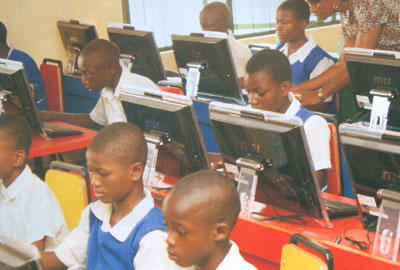
ICT compliant schools
By LAJU ARENYEKA
Life must have begun with the advent of information and communication technology. Surely people didn’t actually travel half way across the country to visit someone before calling to inform them! Could it be possible that there was a time when there were only about 7,000 phone lines in Nigeria? Was there really a time when university students did their assignments without access to the computer? How did anyone survive a university education without downloading information?
Any child born in this and subsequent decades will be in wide eyed disbelief at the answers to the questions asked above – and with good reason too. On the surface, the advent of the internet and its popularity on Nigerian campuses seem to be paradise for students and lecturers alike.
But a closer look at assignment scripts will reveal blue underlined fonts, carelessly edited, practically unread, most likely misunderstood, least likely original, hurriedly submitted by students.
The use of online resources as learning material in institutions of higher learning begs for attention.
Does the simple “Copy and Paste” format guarantee actual assimilation? What about its impact on students’ reading culture? If any Ada, Akin or Ibrahim can post anything on the net, how can academics guarantee the credibility of internet sources? How can anyone protect copyright in a market that suffers from information overload? Does the internet promote plagiarism?

ICT compliant schools
Vanguard Learning took these questions to the two major players in academia – lecturers and students. Dr. Amuni Olayinka, a lecturer of Arabic Studies said: “A lot of times, we ask students to go online because there are a lot of materials on the web. What they are doing online is not new; they’ve done it to books before. These issues have been there, but any good lecturer would know when his student’s work is not original.”
A student of English Education, Ife Abidakunoluwa said: “I get practically 30 per cent of the information I use for my assignment from books. I even get less from my own intellectual base, and much more from the internet. If lecturers give you something that you’re expected to research, of course, you should go online. But copying and pasting is not what is expected. I’m sure that about 99 per cent of students, including myself, do our assignments that way.”
By Ife’s assessment, Sola Lafakemi must be part of the remnant 1 per cent. He told Vanguard Learning: “I get about 85 per cent of the information I need from books, and then I go online to source for the rest.” This final year student of English Language did not begin his academic journey that way.
“In my first year in school,” he said, “all we knew was to go on the internet, copy and give to the typist to retype it. In my second year, one of my lecturers told me that lecturers get angry when they give an assignment and everyone is writing the same thing.
Ninety-five per cent of students in class use the internet, and when lecturers see that they are repeating one another, they end up giving everyone the same low marks. But if your own is distinct, and shows proper research, you will score higher marks.”
Dr Henry Hunjo, who lectures at Lagos State University, said: “Most of the things put on the internet are not necessarily credible. There are no ways to check which one is well written, and which isn’t. A 200 level student in Britain can write an essay and a 400 level student here in Nigeria who believes that everything he sees on the internet is standard, will download it and sees it as coming from a professional.”
Olayinka, however, seems to have another viewpoint as to the veracity of internet sources: “Some sources on the internet are academic. Sources like journals and articles written by academics are reliable, from the references you would know.”
Hunjo’s beef lies with situations where students want to have nothing to with reference lists. He said: “There is nothing wrong with going on the internet for reference materials. However, we as lecturers have issues with students plagiarizing. This is theft of other people’s original work and such a theft is not pardonable. So if somebody uses anything from the internet and acknowledges the source, there is no problem with it.”
Lafakemi said: “In my 100 level, we didn’t even bother ourselves with referencing. All we had to do was add our bio data to the front page.”
Disclaimer
Comments expressed here do not reflect the opinions of Vanguard newspapers or any employee thereof.