
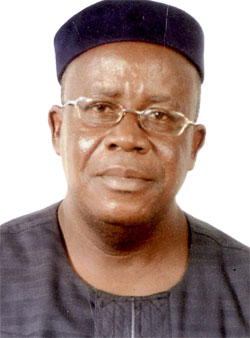
Omolehinwa
By Moses Nosike
Eddy Olajide Omolehinwa is a Professor of Accounting, former Dean, Faculty of Business Administration, University of Lagos. He was at Manchester Business School, England for his Ph.D specialising in Budgeting. He was the Financial Secretary of University of Lagos Students’ Union and the Secretary, University of Lagos Chapter of Academic Staff Union of University (ASUU). In this interview with SATURDAY VANGUARD, he is of the opinion that reckless spending and improper budgeting system are responsible for insecurity, unemployment, infrastructural breakdown, corruption, economic stagnancy etc. in the country. Excerpts:
Recently,you delivered an inaugural lecture titled, “Accounting for people’s money”, what is the motive behind this?
Yes. What is happening in Nigeria of today is unimaginable. When I was younger in my secondary school days at King’s College, I was there during the civil war.

Omolehinwa
At that time even before we had oil, everything was working fine in Nigeria and during my seven years in the school, there was no single day we didn’t have power supply, except one time when we heard that Biafra soldiers wanted to bomb Lagos and because of that NEPA switched off power.
The same thing on water, if I say we didn’t have water then it means we had to come down stairs from our dormitory to fetch water. So, the issue of not having water didn’t arise. These things we had working normal before the oil wealth.
However, between the 1970 after the war and now, Nigeria has earned more than US$755 billion from the oil wealth, what did they do with the money. If you look at the different index of countries’ performance either Ibrahim index of governance or United Nations Human Development index, Nigeria is nowhere. In 2010, our neighbouring countries, Ghana, Togo, Cameroun, Benin Republic all rated higher than us in human development index. If you look at governance and what people are benefitting, out of 54 or 56 countries in Africa, Nigeria was third to the last and yet we claim to be giant of Africa. How can you explain this?
Obviously people are saying corruption and all that but you will note that since we returned to civil rule, and brought about some measures to reduce corruption in the country but in spite of this Transparency International Corruption Perception index has it that for the last 15 years, Nigeria came last three times, second to the last four times and third to the last once.
In half of the 15 years we’ve maintained high ranking, making us giant of African corruption if you want to call it. And because of it, things are not functioning well in the country.
I’m worried about this because I don’t have any other country than Nigeria. That is the reason why I started drawing attention of government and Nigerians to this issue; that it’s time for Nigeria to take its rightful place in the comity of nations and at the same time start promoting public accountability so that our country could work again so that we could leave a legacy for our children, a legacy that they could be proud of.
In line with what you are saying, Nigeria’s annual budgets now read in trillions, yet such huge sums are not reflecting in the economy, as an expert in budgeting, what do you think could be responsible for this?
If you look at the structure of the budget, people are complaining that the capital budget takes about 25% and the remaining percentage goes to take care of other projects. But when it comes to implementing what is proposed in the budget for capital project is less than two third of that which is budgeted, so in actual fact, the money we are spending on capital project is not up to 20% of the government’s total expenditure.
How can a country develop if you have to spend your money that way? You will only use it to pay salaries; you can see that the country is not producing, even the oil refineries that were working before are not working. If they are working jobs will be created and there would be a multiplier effect in the economy.
Electricity supply is dead, most of the private sectors are relying on generators to produce and that is forcing cost of production high and because of high cost of production, our products cannot compete internationally.
Therefore a lot of them are going out of business gradually and it is affecting every aspect of the economy. This is the reason why I said we have to put our house in order. Government said it’s doing something on the electricity supply, maybe they are trying but a lot of people are yet to see this one.
But if we can fix infrastructure and the cost of doing business is reduced, then we can look into the question of security. If we have electricity, water and other things and there is no security, nobody would like to invest here. Investors would like to take their money where they feel it will be safe when they invest. If government would address these issues, I think we will be back on course.
We heard it from a reliable source that unemployment rate is about 23%, which goes to say that about 30 million people are unemployed in Nigeria; this is almost the population in Ghana and other West African countries. It’s even more than what we have in Lagos state. What can be done to reduce unemployment in the country?
I have said it, we must prepare a society that is functioning well. If our society is not functioning well, there will be no portfolio for business and it will create a security problem. Now government is talking about budgeting a lot of money to tackle security issues. Why do we have security issues? because people who are willing to work are not given the opportunity.
We should put in place infrastructural facilities to enable people create jobs for themselves since government can’t employ everybody that needs a job. It will also help government in our budget and also help in creating more employment for the people, so that we will not be talking about bringing products from America or other country saying they are cheaper. If they are cheaper what about employment?
Government should consider that before they spend money on contracts it should think how it can promote employment. More to that importantly, government should help private sector to provide enabling environment for them to operate so that our economy will bounce back.
These days, some employers are alleging that university authorities are graduating unemployeable graduates, what is your take on this?
I don’t understand what they mean by unemployeable graduates, because there are many of our students that graduated here in UNILAG that went abroad and performed well and they are there today working. May be the people they are referring could be some people that ought to have come to the university first in hand but because of the problem of election process they were able to smuggle their way into the university system without being properly educated. May be these are the ones they are contacting and say university graduates are unemployeable.
Even if it’s true, what effort are they making to help the universities. Universities are complaining of not having enough facilities to operate, and even find it difficult to pay salaries. Some of these students need to be trained properly on the use of computers, information system so that they can know how to practice and that could even help them get materials online that could help them take some of these IT exams and compete globally.
When the money is not there and government will have enough money to pay salaries, where will they get all these to put university system in order. We must help our universities to perform well academically. Private sectors have a role to play and should not leave it alone for government.
They can donate learning tools like computers to universities even some experts operating in the private sector can volunteer to come and impart some of these IT knowledge to university students for a better future. But most of these experts when you asked to come and help out they always tell you they don’t have time. I’m not saying this because Nigerian university students are not doing well, they are doing well but they don’t have enough facilities to excel. But when they go abroad they do very well because of the facilities available to excel.
Having being in the university system for years now, what do you think will bring a lasting solution toFG, ASUU face-off?
Let’s be realistic about all these things. Several times, ASUU will ask government to spend 26% of the budget on education, people on the top and others will come up with different percentages and so on and so forth. Personally, I think what we should be concerned with in the university and I have always been saying it even when I was the secretary of ASUU, University of Lagos, I had problem with my colleagues at the national level because I suggested that we should introduce payment of school fees but the argument came that if we introduce payment of school fees, you don’t want the children of the poor to attend schools, no that is not what I said.
My argument is that anybody that is entitled to university must not be denied the opportunity of coming to university. What I’m saying there shall be loan board where you can take loan to finance your education because you don’t have to come and beginning to feed once in a day because you want to be a university graduate.
There must be loan facility provided so that if your school fees is for instance N100,000.00 you can get that money and plus your maintenance allowance to live on comfortably so that when you graduate and start working, you can gradually repay back. But if the government doesn’t do enough to create employment for you so that you can repay back the loan, that is the business of government. At the same time, government can not do it alone, but government has other commitments.
Disclaimer
Comments expressed here do not reflect the opinions of Vanguard newspapers or any employee thereof.