
By Favour Nnabugwu
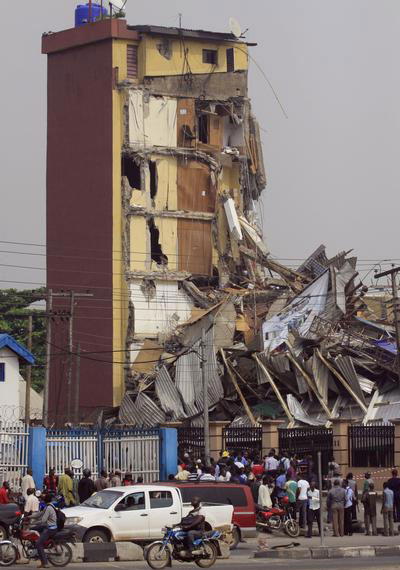
The incidence of building collapses which had claimed lives all over the country has assumed an alarming proportion and it would be understandable for many to assume that little is being done to arrest this even as regulatory authorities’ trade blames over which controls what.
Recent in the league of collapsed buildings in this country was a two storey building belonging to the Nigeria Navy which collapsed on seven labourers, killing two and trapping three others in Abuja on penultimate Saturday.
The collapsed building located on 45 Road, Gwarinpa Estate was being demolished when it collapsed on the workers.
Arc Terver Gemade, Managing Director of Federal Housing Authority, FHA said the Authority is peopled by the finest professionals the nation’s building environment can boast of, all of who are registered with the relevant professional bodies both at home and abroad. FHA buildings meet with the highest professional standards and are built to last several life times.
He said FHA is committed to maintaining this high standard and will continue to insist on the strictest development control codes in its estates.
The MD said the two storey block of six flats on block 1, 45 Road, Gwarinpa Estate, Abuja acquired by the Nigerian Navy from the Federal Housing Authority in 2002, was being demolished by persons hired by Nigerian Navy Holding Ltd for an unauthorised renovation collapsed at about 10 am on Saturday, January 28, 2012.

As contained in the letter of allocation of Federal Housing Authority, FHA houses, the Authority said it requires customers seeking to carry out any alteration on buildings acquired from it to seek approval in writing and duly conveyed to the customer.
However, FHA said before the integrity of the building would be probed and approval granted (or otherwise) to the Navy, the Authority’s Development Control personnel on routine inspection noticed some demolition activity on the site in the evening of Thursday, January 26, 2012.
Following that development, the Authority said it issued a ‘stop work notice’ the following morning and the building concerned was duly marked. However, those engaged to carry out the unapproved demolition ignored the notice and continued with undue haste on Saturday apparently to take advantage of the weekend. The result was the collapse of the building and the unfortunate loss of lives.
President of Nigerian Institute of Builders, NIB, Chuks Omeife, said the government is not helping matters in stemming the menace of collapsed building in the country, else there would have been a law in place by now.
“The remedy to collapsed building is the enactment of enabling law to back up building code which has been at the national assembly since 2008. It would have been a great punitive measure for those that get in involved in collapsed buildings.
“The way it is now, there is no law that says if a building collapses, the person involved should be jailed or fined. National building code was passed by National executive council and the council of states and it was sent to the national assembly for them to make it an enabling law that will provide punitive measure for anybody that erected a building that collapsed.”
He said, “Nigerian Institute of Building’s mandate is to produce builders that can manage places of construction and if there is a problem, we can track it down immediately. We know that people are involved in the collapsed building because nobody could have entrusted its building project to a faceless human being but they disappear at the point of building collapse.
“Buildings are becoming more complicated in design and it is not about bringing someone who claims to have been in the building business for decades, so you need and expert and professionals in that field. An engineer is not a builder, an architect is not a builder we might have gone to the same school, same faculty but different departments.” The President of the Nigerian Society of Engineers, Engr. Olumuyiwa Ajibola had advised the Federal government and Nigerians to patronize real professional Engineers if they want an end to incessant collapse of buildings.
.“We will continue to have collapsed buildings in this country as long as the government and Nigerians themselves do not do the right things by engaging the right professionals and taking their expert advices” he said.
Ajibola said there is incessant collapse of buildings because “all kinds of anonymous people including quacks have invaded our ranks”, expressing dismay that even big firms and seemingly responsible people who want to cut corners patronize them.
“They do not know that doing so has terrible consequences and at the end they find that it is costly compared with if they had patronized the real professional engineers, and we have quality and experienced engineers in NSE”, he said.
He however advised that what the country needs now is to refocus on quality technical education and equip the technical colleges, saying this will help ensure construction of solid buildings and rapid development in the country.
Stressing that NSE no longer tolerates quacks and professional incompetence, he asked that engineers that indulge in substandard jobs be reported, stressing that violators of NSE standards are usually prosecuted and deregistered.
Each collapse carries along with it tremendous effects that cannot be easily forgotten by any of its victims. These include loss of human lives, economic wastage in terms of loss of properties, jobs, incomes, loss of trust, dignity and exasperation of crises among the stake holder and environmental disaster. It can be rightly said that any pursuit of human endeavour has its cost, but the cost being paid in the Nigerian building industry cannot be justified. The fact that Nigeria is undergoing a tremendous transformation in the building environment cannot be over emphasized. This is in line with the growth that is being experience in the infrastructural and building industries all over the world for the effects of technological breakthroughs and consequently the ICT flattened world
But the causes of building collapse in Nigeria can be traced to abnormal factors not obtainable in many other nations. The Lagos State Government identified the principle causes of collapse within the Lagos area as: deficient foundations, inadequate steel reinforcement, poor materials and workmanship and inexperienced professionals, hasty construction, no soil test, greed, poor supervision and non-adherence to the building codes.
The highest figure was recorded on July 18, 2006, when 28 people died in a four-storey building known as ‘Titanic’ which collapsed in Ebute Meta area of the state . Lagos is quickly followed by Port – Harcourt and Abuja.
Other causes of building collapse in the country can be traced to abnormal factors not obtainable in many other developing nations include deficient structural drawing; absence of proper supervision; alteration of approved drawings; building without approved building drawings; approval of technically deficient drawings; illegal alteration to existing buildings; absence of town planning inspection or monitoring of sites; clients penchant to cut corners; use of substandard materials; inefficient workmanship; use of acidic and salty water.
Disclaimer
Comments expressed here do not reflect the opinions of Vanguard newspapers or any employee thereof.