
By Obi Nwankanma
The president flew out to South Africa just as the streets became hot last week and not before he dropped a bombshell. In a church service at Abuja, Dr. Jonathan had declared that his cabinet, Nigeria’s National Assembly, the Nigerian Armed Forces and the Nigerian Intelligence Services have all been infiltrated by the terrorist group, the Boko Haram.
These institutions now harbor active cells of a subversive organization that has, to all intents and purpose, declared war on the Federal Republic of Nigeria. The president’s admission is startling for more than one reason. The more startling element of the president’s open admission nonetheless is this sneaky hint at helplessness and confusion. Is this president really in charge? That is the question.
Nigerians expect that by now he must be in possession of real names and faces. Who are these Boko Haramites using the coverage of his administration and the entire structure of the Federal Government of Nigeria to foment trouble for Nigeria?
The President must have cleared all the doubts, all the possibilities of misinformation; secured the highest assurances from his National security staff that the Nigerian secret services have done their homework, put their quarries under tail or surveillance, completed their investigations, and are possibly now in the process, following the president’s order to arrest these Boko haram subverts, long before the President informed Nigerians.
And yet, Mr. President has shared nothing but platitudes; given no hard facts. Howbeit, it is now a matter of national security that the president must name names, and order the police to place these suspects under the appropriate countermand for prosecution. I am particularly against the death penalty, but I won’t oppose life sentences for any suspect found guilty of subverting the Federal government. But I am movingahead of myself.
One week since this startling announcement of a discovery of secret Boko Haram cells right within government, nothing seems to have been done about it. It feels as if the trail grew suddenly cold, and it feels creepy, the kind of endgame that seems to me going within this government.
Nigerians want to trust President Jonathan; they see the real challenges before him; they understand that he is buffeted by all kinds weird and dangerous interests; and they know governing Nigeria is tough on the soul. But as a friend of mine said, this president seems like a man whose luck is fast running out.
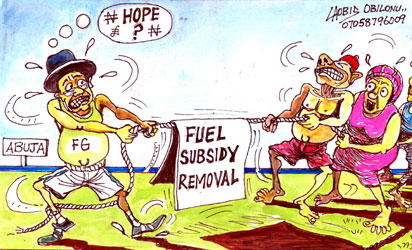
Nothing has shaken the confidence of Nigerians about the Jonathan presidency quite as much yet as the oil subsidy policy which ignited nation-wide protests last week.
It feels almost pointless, but the Finance minister, Mrs. Ngozi Okonjo-Iweala’s power point defense, which sought to rally support for ending the “oil subsidies,”rests on the key points that Nigeria is a poor country of 165 million people with low GDP bla bla bla, and needs funds to invest in infrastructure, and all that good stuff.
As Colin Powell demonstrated once on live TV at the United Nations, statistics and power point presentations can be quite an elegant game of lies. And minister Okonjo-Iweala was dissembling on behalf of the Jonathan administration on this matter of oil subsidies.
Nigerians are skeptical. If the Government were so poor, how come the president runs his current bloated cabinet of forty-one ministers running thirty-ministries and each with a retinue of personal staff? It is quite true that the president in a symbolic act cut 25% of the salary of his appointees as a cost-saving measure in solidarity with Nigerians. But Nigeria still runs the most expensive government in the world; and it is a government which is far too busy doing nothing.
The federal government is borrowing money merely to administer an empty shell. Nigeria’s public investments are in great decay; no new schools have been built; no new hospitals; no roads – just a government administering itself: buying cars, changing bedsheets and curtains, and shopping for new furniture and going on pointless international conventions and signing travel allowances: that is what the Nigerian government says it borrows money to fund.
These certainly have no bearing on Nigerians and their real welfare. And Nigerians in the streets this week are saying, Hell no!We have a ministry of police Affairs, which could possibly merge either with the ministry of Justice or Ministry of the Interior, yet crime is still high. Duplications of functions in government was just to spread preferment to party and special interests.
Writing however in a New York Times OP-ED last week, Dr. Jeffery D. Sachs says,“The government ended the subsidies to redeploy the 4 percent of G.D.P. toward long-term development needs, including health, roads and power.
The reform logic is sound. Using the 4 percent of G.D.P. in a strategic manner can do far more for Nigeria’s poor and the country’s long-term growth than haphazard giveaways of cheap oil.” Sachs, and this government, fails to appreciate the direct impact of high energy costs on the poor population. Small businesses will buckle under the strain.
Unemployment figures will spike. Deregulation will create new monopolies. To put it quite simply: Nigerians are tired of the lies about subsidy-removal; they are pissed with the fat hogs putting their snouts in the communal pond; they are sick of poverty and corruption, and insecurity.
Many Nigerians have cautioned that current national public anger might snowball and give more ammunition to the Boko Haram insurgency. But Boko Haram continues to operate because of a failed policy of appeasement which began with the Niger Delta Militia.
President Jonathan has been particularly unable to summon the chutzpah to finish that business of reining-in terror. He has not taken responsibility. And talking about taking responsibility, the Minister for the Police as well as the National Security Adviser should by now have resigned in the light of the continued menace of terrorism under their watch – a situation which Wole Soyinka this past week warned is pushing Nigeria towards a civil war.
The president needs to urgently sit down to the real business of governing Nigeria: redesign and upgrade Nigeria’s national security system; withdraw the fuel subsidy policy and stop listening to the advice of the likes of Jeffery D. Sachs, of whom Naomi Klein has much to say in her book, The Shock doctrine: The Rise of disaster Capitalism, otherwise the current baying in the street would most certainly become the road to either a civil war or turn towards Nigeria’s Green Revolution.
Disclaimer
Comments expressed here do not reflect the opinions of Vanguard newspapers or any employee thereof.