
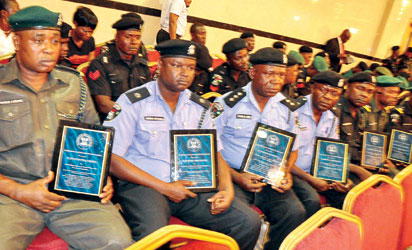
Cross section of Police officers
By Obi Nwakanma
The United States of America gets it most of the time. As a federal state, it has developed a highly organized and systematic administrative federalism that permits it to function like a smooth, well-oiled machine. I have always said that Nigeria could learn and incorporate some of the finest attributes of the US system, while of course learning from its equally deep flaws, and thus not re-invent the wheel either way.
One of the great areas that Nigeria could learn a bit from the US is in the area of law enforcement and in the administration of justice. At the core of an organized society is the capacity to establish and enforce laws; to create just and visible sanctions, and to do so without fear or favor.
The weakest link in Nigeria’s administrative system is its judicial branch. A part of that weakness comes from the fact that the courts are poorly served particularly in more recent years with the selection and employment of a certain quality of judicial officers to the bench, but more so, by the great gap between interpretation and enforcement of the law. Nigeria has had a very corrupt police system for as long as I have been alive, and that is to say, for quite a while now.
Most Nigerians alive today are likely to make the same claim as I have made above. That is to say, that anybody alive today in Nigeria has never believed, or seen, or felt the truth in the statement, “the police are your friends.” The police have never been our friends in Nigeria.
They have harassed, intimidated, blackmailed, extorted, shot at, and on many occasions killed many innocent Nigerians. The fact of this needs no further rehashing, but of an equally important point that needs no more adumbration, but which ought to be clear to any Nigerian is that the Nigerian police we inherited from the colonial system was not designed to be civil or to be our friends.
It was a constabulary system. That much has been said. It was a police system created to serve a colonial system which was inherently and necessarily regimental and autocratic. Its police system reflected its aims and its attitudes, as well as the place of the governed in the colonial panopticon. I think to understand the penal system that emerged out of colonialism we must read the French Philosopher, Michel Foucault’s quite intimidating book, Discipline and Punish.
In the upshot, at independence in 1960, Nigeria’s postcolonial civilian administration did not settle down long enough to transform a colonial police system into a civil system undergirded by a civil society of free citizens with secure rights. Besides, the police system seemed to have suited the politicians well enough, in the enormous protective and manipulative power it gave them. Many did not have the long view of things; the fact that the impermanence of power made it necessary to create a just and egalitarian system.
But just six years into independence, to complicate matters, the military upstaged national government, and quickly transformed the police to reflect and assume the emergency appurtenant that further corrupted it, and made it even worse than its colonial forebear. It did seem for a while that the finest criterium for recruitment into the Nigerian Police Force was to be a certified dreg of society. There was slow infrastructural build-up. In fact rigor mortis set in the infrastructure. Any attempts to reposition the police must begin from a full re-assessment of its human capital.
This past week, the president accepted the resignation of Mr. Hafiz Ringim as Nigeria’s Inspector-General of Police, and appointed as Acting Inspector-General, Mr. MD Abubakar. Ringim’s last days had been marred by controversy: the inability to quell or bring to heel the activities of the Boko Haram which had launched a violent internal campaign in Nigeria. To add the clichéd salt to injury, a key suspect in the Christmas day bombing escaped while in police custody. The bombing campaign in Kano happened under Ringim’s watch, and it was clear that the Nigerian police have no answer to the internal domestic subversion of Nigeria by a criminal, faceless, fundamentalist group.
This is what Nigerians know of Boko Haram because in fact they know nothing else: whether Boko Haram is a “black-op” group staged by rogue elements within the Nigerian security services or highly trained militants with local and international backing is yet to be clear. Anyway, out goes Ringim, in comes Abubakar, and he, not without some controversy, especially the accusations that led to an administrative indictment following his activities as Police Commissioner in Jos.
The president has, while Abubakar acts as IGP, established a Presidential Commission to review the Nigerian Police. Recently, the National Assembly voted to remove the “Force” from its description to read, presumably, the Nigerian Police Service. Whatever. What is clear nonetheless is that the Nigerian Police system needs urgent and immediate re-engineering. The limiting of its powers through the military era is as central to its weakness, as the ambiguity of its current mission.
Police powers have been utterly reduced with the establishment of the EFCC as an independent body for investigating and prosecuting corrupt criminal activity, and the creation of an Independent State Security Service, as an independent organ, which takes away the police power to act as the federal criminal investigative body and the internal or domestic intelligence and counter-intelligence agency.
The reduction of the power and jurisdiction of the police must be restored to start with, by merging the EFCC and the SSS into the Nigerian police Services. I think that the National Assembly must review the Police Act, and re-design a legislation that would establish a new, civil police organization, with a new structure of management and training.
I recommend the structure of the American Federal Bureau of Investigations, and the creation, and empowerment of District Prosecutors office whose office must be fully established and empowered for effective coordination with the Federal Police field offices. The Office of the Attorney-General must be made more effective, and must be empowered to appoint the Head of the Nigeria Police after due parliamentary accession.
A police and legal system that cannot operate with enough authority and independenceto investigate, if need be, and by the mandate of the National Assembly, even the office of the president is not worth its salt. I think that the presidential commission on the review of the police has its work cut for it, but ultimately, its future lies with the National Assembly and a review of the Police Act.
Nigeria needs a new police system – highly trained; well-motivated;well equipped with the brightest university graduates in the land, the latest technology, and above all, the will and the mandate to provide Nigeria with 21st century service given 21st century realities.
Disclaimer
Comments expressed here do not reflect the opinions of Vanguard newspapers or any employee thereof.