
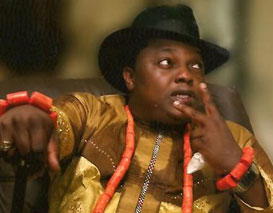
Ekewenu…the level of corruption in the downstream sector has reached a grotesque dimension
Ambassador Karo Ekewenu is the UN Ambassador on Millennium Development Goals (MDGs) meant to drive various economics in this millennium. The ambassador speaks with Gab Ejuwa at a forum where he sheds light on the fuel subsidy. Excerpts…
What is your opinion on the new petrol pump price of President Jonathan?
First and foremost, I commend the Federal Government for once again demonstrating that the Jonathan administration is a listening government that has the interest of this country at heart. I’m sure that Labour will agree with me that a marginal incremental deregulation rather than deregulation at zero subsidy is a win-win compromise.
Do you see anything wrong with the civil protest?
I wish to emphasise that although civil protests are an integral part of the democratic culture, policy actors are essentially elected to formulate policies for the country; thus despite the unrest, the decision to remove fuel subsidy is a correct and timely one.
At various fora, the Nigerian people – both experts and non-experts alike – have agreed that on the whole, the demerits of subsidising fuel far outweigh its apparent benefits and should, therefore, be removed.

Ekewenu...the level of corruption in the downstream sector has reached a grotesque dimension
However, the policy discourse did not get to the uninformed masses, which perhaps suggested why they were easily misled by some protesters with parochial interests. I wish to use this medium to employ the government to find a way of getting information across to the ordinary folks before implementing seemingly controversial policies.
What in simple language is subsidy?
For the sake of those who still dont understand the issue, let me quickly provide a brief insight. The amount paid by government to keep the price of fuel below the free market price is called subsidy. The initial aim of subsidies on petroleum products was to keep down the cost of fuel at an affordable price for all Nigerians since it is our most important natural endorwment. However, today, there is a diagnostic consensus among economists that subsidy has become an infection on our economy; why is this so?
What would you say was the rationale for subsidy removal?
Revelations from various sources, government and non-government, show that the level of corruption in the downstream sector has reached a grotesque dimension! We are aware that a sizeable percentage of PMS imported into Nigeria are resold to neighbouring countries with higher official price such as in Benin and Cameroon. Subsidy related corruption in the downstream sector has grown so exponentially that it can no longer be supported via serviceable debt. It is clear that only when we stop borrowing serviceable debt to subsidise and block fund leakages due to market distortion would we make significant savings. It is a good idea that proceeds saved from the removal of fuel subsidy will be used to invest in production rather than consumption through the SURE-P. SURE-P is also expected to accelerate economic growth through investments in critically-needed infastructure.
What is the present cost of landing and distribution of fuel per litre?
At the moment, we are told by Honourable Minister of Petroleum, Mrs. Deziani Alison- Madueke that the cost of landing and distribution of PMS comes to N139 per litre and the government is unable to sustain the N74 subsidy per litre, which it pays via lending. And of course market distortions (such as fraud) continue to increase the amount for subsidy at an unsustainable exponential rate. So what do we do?
Do you think government has no business with business, forgive the pun?
As an entrepreneur, I have no doubt in my mind, that government intervention in the affairs of society should be limited to supplementing the market by enforcing and creating proprietary rights where they are weak or non-existent so that market forces can operate, and allocate resources in a manner beneficial to the whole society. I believe that this is the driving philosophy of Mr. President’s deregulation policy.
Where is this practised?
The example of Chile is instructive. Chile is currently the 11th most economically free nation in the world and the most free in Latin America (in terms of liberal economic policies such as subsidy removal). The resulting effect of deregulation policies on the Chilean economy is the growth of GDP per capita since the 1973 overthrow of Salvador Allende and his socialist government by Pinnochet. Currently, Chile is the most economically prosperous nation in Latin America according to GDP per capita. Other countries like Iran, have also successfully deregulated fuel pomp price. We owe our own government a duty to support deregulation of the downstream sector. Other African countries like Ghana, Guinea, Cameroon and Chad have all removed their fuel subsidy and I see no sense in allowing an economic virus to destroy us.
What other strategies can be put in place to complement the present refineries?
Supporting the government to build new refineries and revamping the existing ones is the way to go.
What is your last message to Nigerians?
In conclusion, I call on Nigerians to brace up for a future period of removals: corruption removal, mismanagement removal, non-performing politicians/hypocrites removal. We must support the government of Goodluck Ebele Jonathan and the governments at the state and local government levels to pursue these removals. I also commend Messrs Abdulwaheed Omar and Mr. Peter Esele, the leaders of NLC and TUC respectively for suspending the strike. Let us get back to work!!! Once again, I commend the good people of Nigeria for resolving our domestic issues as a family. Particular praise goes to Governor Emmanuel Uduaghan for the way he managed the situation in my home state, Delta State of Nigeria. I pray that God will continue to “guide our leaders right and help our youth the truth to know.”
Disclaimer
Comments expressed here do not reflect the opinions of Vanguard newspapers or any employee thereof.