
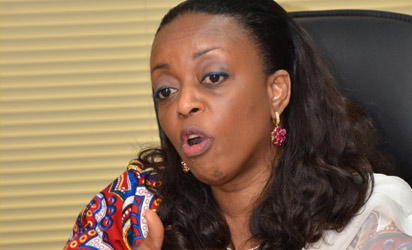
Petroleum Minister, Diezani Aliso-Madueke
IN the face of impassioned arguments surrounding the removal or otherwise of petroleum products subsidy, the Nigerian government has come up with an ambitious scheme tagged Subsidy Re-investment and Empowerment Programme, SURE, to replace the current fuel subsidy regime.
The total projected subsidy re-investible fund per annum is N1.134 trillion based on average crude oil price of US$90 per barrel.
Out of this, N478.49 billion accrues to Federal Government, N411.03 billion to State Governments, N203.23 billion to Local Governments, N9.86 billion to the Federal Capital Territory (FCT) and N31.37 billion as Transfers to Derivation and Ecology, Development of Natural Resources and Stabilization Funds.
The federal government had last year given a January, 2012 target date for removal of fuel subsidy pleading it was not targeted at the right segment of the populace; abuse of the processes by the operatives; impediments to enthronement of an environment conducive for investment in the mid-stream to thrive; inability to keep up with mounting costs; smuggling as a result of price disparity; among others. But organized labour, civil society, other groups and individuals have been quick to join the argument for and against governmentfs intentions.
Organised labour represented by the Nigeria Labour Congress, NLC, and the Trade Union Congress, TUC, in particular have been very vociferous in their opposition to governmentes proposal noting that the removal of subsidy is anti-masses.
SURE Programme:
The SURE programme is focused on utilization of Federal Governmentfs share of the subsidy, projected at N478.9 billion, while every State and Local Government is expected to design its own programmes utilizing its portion of the subsidy reinvestment funds.
The subsidy reinvestment funds from the discontinuation of the fuel subsidy will be used for the implementation of the programme and to reduce governmentfs borrowing needs.
Under the programme, the Federal government plans to channel its own share of the resources into a combination of programmes to stimulate the economy and alleviate poverty through critical infrastructure and safety net projects.
gTo transform the economy and in line with the Vision 20:2020 objectives, critical infrastructure projects in the power, roads, transportation, water and downstream petroleum sectors will be executed.
The potential impact of the discontinuation of the subsidy regime on the poor can be mitigated through properly targeted safety net programmes including public works and employment schemes, maternal and child health, mass transit programmes and vocational training and skill acquisition schemes,h a SURE Programme document obtained from the presidency outlined.
The entire project will be overseen by a Board to be constituted by Mr. President and consulting firms with international reputation will be appointed to provide technical assistance to the Board in financial and project management.
Relevant MDAs will set up Project Implementation Units (one for each project sector) to drive implementation and an independent body will be responsible for monitoring and evaluating the implementation and will report directly to the Board.


President Jonathan
The SURE programme focuses on the portion of these resources that the Federal Government is responsible for administering and 7 components: A – H are targeted for intervention and improvement over the next 3 to 4 years.
These components includes‚ Social Safety Net Programmes; Maternal and Child Health Services; Public Works/Women And Youth Employment Programme; Urban Mass Transit Scheme; Vocational Training Schemes.
The component deals with Niger Delta Development Projects. This component will focus on a developmental project aimed at improving the lives of residents in the Niger Delta region and promoting economic growth in the region, by providing access to the refineries, seaports as well as access to agricultural areas of the Niger Delta.
The component deals with roads infrastructure projects across the country and this component will focus on the completion of core road projects that will enhance transportation of passengers and goods in the country to enhance economic activities and social integration as tangible benefits of the subsidy gains. The roads that are to be completed under this programme will cover a total distance of 1,326 km.
The component of the programme deals with rail transportation projects and this component of the programme will entail the rehabilitation and restoration of Nigeria’s abandoned railway infrastructure and the construction of new standard gauge railway lines, thereby providing alternative means of transportation of people and goods across the country.
It is expected that the rail routes will open up the hinterlands of the country to the coast, facilitating trade by improving access to markets by those in remote rural areas. This will facilitate increased tonnage of goods through ease of haulage and reduction in costs of transportation.
The eEf component of the programme deals with water and agriculture. This programme component will harness Nigeria’s abundant water resources for national development through sustainable food production and water conservation.
Specifically, this component will actualize the current policy thrust towards self-reliance for rice and other food crop production and enable the agricultural value chain transformation to be achieved. Specifically earmarked under this component are irrigation projects and rural and urban water supply projects.
The eFf component of the programme deals with selected power projects. This component will contribute towards the power sector reforms by improving the generation capacity through hydro and coal power plants.
The programme will provide counterpart funding for the construction of the large Mambilla hydropower project that will generate an additional 2,600 Megawatts of electric power. The programme will also provide funding to complete a total of 17 Small and medium hydroelectric power projects with a cumulative capacity of 140.275 MW.

Petroleum Minister, Diezani Aliso-Madueke
Given the small size of these projects, they will be isolated and embedded in agricultural development economic corridors, which will contribute to enhancing the agricultural value chains for increased production, in line with the Transformation Agenda. The programme will provide counterpart funding for PPPs with the private sector for the development of Coal Power projects in Enugu, Benue, Kogi and Gombe, with a potential to generate 1000 MWs of power.
The eGf component of this programme deals with petroleum/NNPC projects and the main objective here is to restore and improve domestic refining capacity and prevent shortfalls in supply of petroleum products. The integrity of the petroleum pipeline system will also be enhanced through additional investments and protective security. The targeted projects under this component are Greenfield refineries and pipeline reinstatements.
Three new refineries will be built under a counterpart funding arrangement with the private sector in Bayelsa, Kogi and Lagos States with a combined processing capacity of 400,000 barrels per day.
The SURE programme anticipates that thousands of workers will be employed at each of these locations, the refineries will be completed 3 years after contract award and upon completion, the refineries will contribute about 30 million liters of PMS to the domestic market, thereby making Nigeria a net exporter of value added petroleum products.
In addition, approximately 2,500km of petroleum products pipelines have been heavily vandalized in the southern, north central and north eastern parts of the country. This has resulted in the need to move products by truck from the south to the north. Approximately 1,500 trucks convey these products on the highways on a daily basis, causing severe damage to the already bad roads.
The re-instatement of these pipelines will improve availability of petroleum products across the country, eliminate bridging and reduce highway maintenance costs. During the pipeline repair works, employment will be generated for youth from communities that are traversed by the pipelines Right of Way.
The component deals with ICT projects targeted at supporting the Federal Ministry of Communications Technology to facilitate the build out of a critical aspect of ICT infrastructure in the country.
The fund will be used specifically to boost broadband connectivity at the transmission layer of the national infrastructure using fiber, which unlike microwave delivers higher bandwidth and enable higher broadband speeds at the access networks. This will lead to more affordable and better quality of communications services and increase the use of such services to bring about economic and social development.
This component also anticipates the extension of ICT connectivity to all tertiary institutions in the country through the establishment of e-teaching and e-learning platforms and the initiative can potentially generate 70,000 new jobs spread across the country and create another 350,000 spin off jobs over the next 4 to 5 years. Seventy percent (70%) of the jobs are low skill and whilst these job opportunities will be experienced in all geopolitical zones, over 60% will be concentrated in the Northern parts of the country that has higher connectivity disadvantage.
Labour threatens showdown:
The NLC and TUC have at different forum stated and restated their opposition to government’s planned removal of petroleum subsidy and indications are that member bodies such as the National Union of Petroleum and Natural Gas workers may have adopted a middle of the road approach towards opposition to the move.
In a statement recent statement outlining its position, the NLC advised the Presidency to learn from the October 15 Global Day of action against corporate greed and cut in social spending, rather than orchestrate endorsement of its fuel subsidy removal gambit.
The statement noted protests in October is a red card for the ruinous programme of subsidy removal and cuts in social spending and an indication that the North African uprising is spreading.
gThe Federal Government should face this reality and address growing poverty, hunger and anger amongst the masses.
Hijacking the private sector forum and smuggling a fake endorsement removal will not make Nigerians accept such a calamity. Save beneficiaries of government largesse, no employers utilizing petroleum products will endorse subsidy removal.h
Speaking also on deregulation, National President of the National Union of Petroleum and Natural Gas, NUPENG, Comrade Igwe Achese, said the timing for deregulation was wrong in view of the fact that the Petroleum Industry Bill, PIB, which embraces all activities of the oil sector had not been passed into law.
He said the union would vehemently resist any form of deregulation that was import driven, stressing the need for government to come up with specifics on how to ensure that the local refining capacity was increased over a period of time.
He also stressed the need for government to engage all stakeholders in the economy and state categorically how it intends to use the proceeds from the removal of fuel subsidy and how that decision would reduce poverty and unemployment.
NUPENG is not against deregulation; our position is that if government must deregulate, it should not be import-driven. What we are against is import-driven deregulation. We have already given government conditions for deregulation and part of it is that the refineries must work optimally; government must make the depots to function properly.
Currently, we are still moving products by truck when we have depots but because of pipeline vandalism the depots are not functioning. Before government comes up with deregulation policy, it must first pass the PIB which is all encompassing into law, he said.
N/A rejects subsidy removal:
Information at Sweetcrude disposal indicates that months of intensive lobbying by the presidency may have failed to sway members of the national assembly, prompting the federal government to move the target date for subsidy removal from January 2012, to April 2012.
In a report submitted to a committee of the whole, three Senate standing committees mandated to review the President’s proposal on petroleum subsidy removal, rejected the move. The three committees, which worked on the 2012-2015 Medium Term Fiscal Framework (MTFF) and Fiscal Strategy Paper (FSP), warned against removal of fuel subsidy, while other members of the Senate Committees on Finance, National Planning and Appropriation, which worked on the document, equally urged the Presidency to jettison petroleum subsidy removal..
The Senate has still not subjected the committeesf recommendations on the MTFF to debate and indications are that whenever it does, it might get downright heated and disruptive given the impassioned arguments making the rounds.
Sweetcrude checks revealed that the presidency may have sort the endorsement of the national assembly as a courtesy and not a constitutional requirement, especially since funds for subsidy are taken from the Consolidated Revenue Fund.
Disclaimer
Comments expressed here do not reflect the opinions of Vanguard newspapers or any employee thereof.