
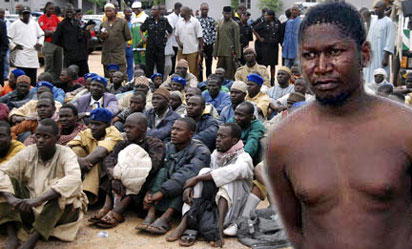
Alledged Boko Haram members and their late leader, Yusuf
By Jide Ajani
But for the absurdity of the idea, Boko Haram was it. And that would have meant the celebration of evil.
However, the decision to place THE SCOURGE OF BOKO HARAM as the first runner up in this year’s issue/man of the year chosen by Vanguard came with its own haram.
The word haram in Islam means forbidden!
Therefore, when the nominations were being made for the man/issue of the year, the atmosphere in the editorial room was one of justifiable anxiety: Would a sane editorial team choose a body that delights in promoting mayhem as its issue of the year? The atmosphere was charged and justifiably so in this democratic environment.
Even before this piece was ready, Boko Haram sent another evil reminder why it mattered very much in the year 2011. Just as it ended the year 2010 for Nigerians on a very tragic note, bombing a market on the periphery of an Abuja military barrack, Boko Haram is again ending this year for many families on a mournful note with its Christmas day bombing in some States in the North, bombings that claimed scores of lives.
Here was a terror organisation that succeeded in forcing the presidency to stay put in Aso Rock Presidential Villa and celebrate the nation’s independence day anniversary because of its fear of the usual venue of the celebration being targeted; here was a group that demonstrated such daring audacity in bombing the United Nations’ building in Nigeria’s Federal Capital Territory, FCT, Abuja; here was a group that said it would inflict psychological torture on the populace and its government and appears to be succeeding in doing so; now, here is a group that has forced the Federal Government to allocate almost 20 pre cent of its national budget to security; here is a group that appears invisible yet leaves sadness and sorrow as grim reminders of its seeming omnipresence; even a senator of the federal republic, Mohammed Ali Ndume, has just been let off on bail on account of his alleged involvement with the group.
The questions are: What is Boko Haram? What does it represent? Who are its members? How did it grow to become this deadly?

Alledged Boko Haram members and their late leader, Yusuf
The story starts mid-way. Surprised? Should not be because with the spate of bombings and maximum damage Boko Haram has inflicted on Nigeria, many would not want to be bothered about its membership and origin but on how to end the menace.
Led by late Mohammed Yusuf, the major uprising actually began in Bauchi State on 26 July 2009 when hundreds of Boko Haram adherents launched an attack on the Dutsen Tanshi police station. This attack failed, with reports of at least 50 people killed.
In the next four days, the group carried out further attacks, with gun battles between the sect and the police reported throughout Bauchi, Kano, Yobe, and Borno States. The worst of the violence occurred in Maiduguri, where the group had relocated from its Kanamma base, Yobe State, aptly named Afghanistan.
Prior to July 2009 when the sect’s notoriety waxed strong, its members had been involved in dastardly incidents in Yobe in 2003 and in Kano in 2004. In April 2007, 10 policemen and a divisional commander’s wife were killed in an attack on the police headquarters in Kano.
On 13 November 2008, Yusuf was arrested following an attack on a police station in Maiduguri, in which, 17 of his followers were killed. On 20 January 2009, an Abuja high court granted him bail. This was to be an error, a fatal one.
On 7 October 2010, the sect stormed a prison in Bauchi, set free hundreds of their members and other inmates, and threatened reprisals against those they accused of persecuting their members. Obviously, the military did not defeat Boko Haram in 2009 when a five-day long clash ended with the death of Yusuf in police custody. Even then, the authorities did not take the sect’s threat with any seriousness.
Although scores of the militants were killed or rounded up, several also escaped, simply melting into the environs. It was not until late last year that the authorities began the arraignment of the alleged killers of Yusuf.
The group sent out some six members to Algeria to learn making of Improvised Explosive Devices, IEDs. The students appear to have learnt well in the light of the group’s bombing raids.
To catalogue its raids would be to remind many of the group’s evil acts. But the bombings claimed the lives of a governorship candidate, the Shehu of Borno’s brother, and countless others.
For instance, in January 2010, the group struck again in Borno State, killing four people in Maiduguri. In September, Boko Haram freed over 700 inmates from a prison in Bauchi State and torched the prison. By December 2010, the police arrested 92 of its members after a market bombing.
An ANPP chieftain was killed barely four hours after some unknown assassins shot and wounded Sergeant Isa Omale and a corporal of the Nigerian Security and Civil Defence Corps, both attached to the Speaker, Borno State House of Assembly, Honourable Goni Ali Modu.
One of the most dastardly acts of the Boko Haram earlier in the year came on 28 January 2011, when a gubernatorial candidate of the All Nigeria People’s Party, ANPP, Alhaji Modu Fannami Gubio, was assassinated along with Alhaji Goni Sheriff and four police officers. Gubio was executed at his family residence in Maiduguri, after performing Friday Juma’at prayer.
A 31 December 2010, bomb blast in Abuja killed many.
The sect’s terrorist activities during the last elections were equally disturbing. On 29 March, police “thwarted a plot to bomb an ANPP election rally” in Maiduguri, and on 1 April, suspected members of the sect attacked a police station in Bauchi.
On 9 April, a polling centre in Maiduguri was bombed and on 15 April, the Maiduguri office of the Independent National Electoral Commission, INEC, was also bombed, and several people shot in separate incidents that same day.
On 20 April, Boko Haram killed a Muslim cleric and ambushed several police officers in Maiduguri; two days later, the group freed 14 prisoners during a jailbreak in Yola, Adamawa State. Unknown gunmen killed a former state chairman of the ANPP Borno State chapter, until his death the national vice chairman, North East of the party, Alhaji Awagana Ali Ngala, at his residence in Maiduguri on 6 October 2010.
Shortly after his funeral, the remains of a brother of Governor Ali Sheriff, Alhaji Goni Sheriff Ngala, the former Chairman of Ngala Local Government Area, who was also killed at the same place along side other six persons by the assailants were buried on that Saturday.
Also killed were senior police officers, prison warders, and some soldiers, during the gun battle with the sect members. Security agencies were victims of several bomb blasts that rocked the Borno State almost on daily basis.
Numerous innocent people were also killed by stray bullets in some of the encounters between the sect members and the security agencies on the streets of Maiduguri.
A bomb-making factory in Maiduguri exploded just two weeks ago. Last week the Joint Task Force, JTF, engaged members of the sect in a gun duel, which lasted five days. Fifty members of the sect were reportedly killed. The Christmas day bombing in some States in the North just shows how Boko Haram has affected Nigerians in 2011 and will be a factor in 2012.
Also read: Man of the year 2011: An Amazon from the skies (2nd runner up)
Disclaimer
Comments expressed here do not reflect the opinions of Vanguard newspapers or any employee thereof.