
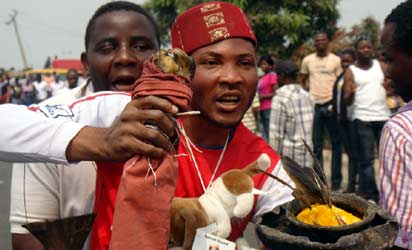
Protesters on the 5th day of protest against fuel subsidy removal at Gani Fawehinmi park, Ojota, Lagos.
BY VICTOR AHIUMA-YOUNG
THE nationwide strike and street protests called off by Organised Labour and its civil society allies, under the banner of Labour and Civil Society Coalition, LASCO, have come and gone, but echoes of the industrial action may remain with Nigeria for a long time to come.
To start with, the current crisis of confidence confronting labour can be traced to misplaced expectations from labour by Nigerians after it indirectly took over the job of opposition parties as part of its advocacy assignments since the advent of democracy when the opposition parties went to sleep.
If the opposition parties were alive to their responsibilities, labour would have been restricted to its traditional role of fighting for and protecting the welfare of its members.
However, when labour under the leadership of Comrade Adams Oshiomhole, took over the battle to check the rate President Olusegun Obasanjo’s government was inflicting pains and hardship on Nigerians especially the working class, Nigerians came to identify with labour to the extent that most preferred to obey labour than the government.
Comrade Oshiomhole, now Edo State Governor, reached out to a cross section of civil society groups with sympathy for labour, which gave birth to LASCO.
The civil society groups instead of relating with labour, (Nigeria Labour Congress, NLC and Trade Union Congress of Nigeria, TUC), on individual basis, decided to come under one umbrella; Joint Action Forum, JAF, which metamorphosed into Joint Action Front, JAF, late last year.
Ever since, labour and JAF have had a cordial relationship.
However, there are several other civil society groups that are not affiliated to JAF and are not part of LASCO.
During the debate over planned subsidy removal, JAF in December 2011, gave notice that it would stage a protest rally in Lagos against the planned policy on January 3, 2012.
When the Federal Government decided to welcome Nigerians into the New Year on January 1, 2012, with over 150 percent hike in the pump price of petrol, JAF in its reaction, insisted that it would go ahead with its planned protest.
On January 3, JAF made good its threat to protest. Leaders of the protesters included Dr. Dipo Fashina, Chairman of JAF; Mrs Ganiat Fwehinmi, widow of late Chief Gani Fawehinmi; Femi Falana; Comrade Issa Aremu, Vice President NLC; Secretary-General of TUC, Chief John Kolawole; Vice Chairman of Lagos Council of NLC, Comrade Sanni Adeleke; and Comrade Abiodun Aremu, JAF Secretary among others.
A day later, labour announced that on Monday January, 9, 2012, with its civil society allies (JAF members), it would begin an indefinite strike and street protests to force President Goodluck Jonathan to revert fuel price to N65.
Two days preceding the strike, leaders of LASCO met at the Lagos office of NLC, announced that the strike and protest would be coordinated by LASCO and gave details of how the protest, especially in Lagos, would go.
Comrade Aremu, while giving details on how the protests would be handled across the country, said Lagos was sub-divided into five zones to coordinate the mass action, with the late Gani Fawehimi Park in Ojota as the central terminal point for all protesters on major streets in the metropolis.
LASCO directed all state chairmen of both the NLC and TUC to set up monitoring units in all the sub-divided zones to ensure that all offices, work places, air ports and sea ports were effectively closed to business as the strike lasted.
However, on January 9, when the strike commenced, before the LASCO-led protesters got to Ojota, the Save Nigeria Group (SNG), Occupy Nigeria and others, had taken over the park.
Leaders of LASCO decided to address the protesters and journalists on the road and instructed their sub-divisional and unit leaders to disperse to prepare for the following day. From there, they proceeded to Airport on enforcement.
After Monday, LASCO avoided Ojota as one of its leaders claimed those in Ojota had other agenda outside the N65 per litre fuel price.
On Wednesday, it became clearer that LASCO leaders were becoming uncomfortable with the body language of other groups, which appeared to be using the strike to achieve other aims.
During a briefing at the National Secretariat of the Construction union in Iyana Ipaja, after an enforcement and monitoring of the effectiveness of the strike, leaders of LASCO denied any link with perceived failed politicians and said any civil society organization outside JAF, does not belong to LASCO.
Speaking on behalf of LASCO, Deputy President of NLC, Comrade Promise Adewusi, insisted that the only mandate given to LASCO was to force government to revert the pump price of petrol to N65 per litre, saying it neither had any link with failed politicians nor got funds by any individual or groups as being alleged.
LASCO leaders did not hide their feeling that the Ojota group was stealing the show from them because greater attention was being focused on them instead of LASCO that was going round to enforce strike.
At a meeting with President Jonathan on Sunday, NLC President and Acting General Secretary, Comrades Abdulwaheed Omar, and Owei Lakemfa, as well as President-General and Secretary of TUC, Comrade Peter Esele and Chief John Kolawole, respectively, sources said the President presented to the labour leaders, the security reports summarizing that the regime was under serious threat from forces hiding under the strike and mass protest against the hike in the pump price of petrol.
After showing labour leaders the security report, it was gathered that the President asked them to go and call off the strike without addressing reversal of fuel price to N65.
President Jonathan was also said to have told the labour leaders that he was making a national broadcast on the state of the nation and that they should go and listen.
The labour leaders were said to have found the president most frightening that they did not utter any meaningful words until they left.
Bolder unionists would have insisted that the president listened to the voices of Nigerians and revert the pump price of petrol to the pre-January 1, 2012 price of N65 per lite, which in the first place, was the basis for the crisis and tension in the country. This the labour leaders did not do so, but simply left Aso Rock to brief other leaders, who were anxiously waiting.
The leadership of NLC and TUC had on Saturday told other labour leaders that President Jonathan had accepted in principle to the reversal but with a proviso that a team would be constituted to work out the modalities for full blown deregulation in April.
In fact, it was the reason that the Petroleum and Natural Gas Senior Staff Association of Nigeria, PENGASSAN, which had threatened to shut down oil terminals by Sunday morning, was prevailed upon by the leaders of NLC and TUC to hold on.
At the end of the meeting, labour announced the suspension of mass protest and rally, saying “In view of the escalating violence, in order to eliminate casualties, and due to the increased security challenge, Congress has directed that rallies and street protests be stopped across the state and the FCT.”
By Saturday night, it was gathered that intelligent reports indicated some religious leaders and politicians were planning to use the strike to settle both religious and political scores.
At least in two states, (names withheld), it was gathered that houses to be burnt from Monday were being marked.
In fact, it was gathered that some labour leaders in the north had informed the leaders of NLC that they were losing grips of the strike to religious leaders and politicians with other agenda.
Events in some of the states like Kano where there was heavy protest even after the national leaders of labour had called off streets protest and mass rallies, the youths and others still protested with greater fury, pointed to the fact that labour had lost control.
Also, after national leaders called off the strike, labour leaders in Kano insisted that the strike must continue, not because they wanted to, but to save their lives and members of their families from attacks.
It will be recalled that leaders of NLC and TUC while announcing the suspension of the strike, made it “categorically that this new price (N97per litre) was a unilateral one by the Government.

There was no negotiation with government as was the practice. The labour leaders were informed about the new price by President Jonathan like other Nigerians, during his national broadcast to the nation on January 16.
From a labour reporter, point of view it was obvious that in real term that President Jonathan called off the strike after the labour chickened out. It is like in the Bible, it was the voice of Jacob, but the hands of Esau.
Speaking an official of NLC , said on condition of anonymity that the strike was called off because among others, it was getting clearer that some people had other agenda outside the N65 per litre mandate.
According to him, leaders of NLC did according to directives from NEC because the mandate was relapsed for the leaders to be able to discuss with government as the first NEC meeting where the decision to go on strike was taken, tied the leadership hands.
He claimed that if the strike was not called off, it would have resulted to something else as information available suggested that people were out to cause mayhem in the country to get at the government.
The official said even prosecuting the strike was also becoming very difficult because there was no money to drive it.
According to him, as against Comrade Adams Oshiomhole’s regime where affiliates were levied to prosecute national strike, because of the swiftness of the strike, there was no time to mobilize affiliates to finance the strike.
Disclaimer
Comments expressed here do not reflect the opinions of Vanguard newspapers or any employee thereof.