
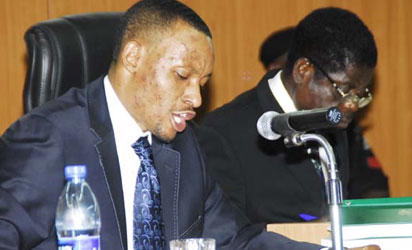
*Justice Danladi Yakubu Umar….Many wondered why the case suddenly became top priority many years after the accused had left office
By Ikechukwu Nnochiri
This is a detailed account of how Justice Danladi Umar of the Code of Conduct Tribunal, CCT, punched holes in the case against Bola Tinubu, brought before it by the Code of Conduct Bureau, CCB; but he also noted that one of Tinubu’s prayers was irrelevant and frivolous
He went, he saw and he conquered! This was the case of the former governor of Lagos State and leader of the Action Congress of Nigeria, ACN, Asiwaju Ahmed Bola Tinubu, who on Tuesday, secured a landmark victory against the federal government of Nigeria.
Though he was summoned like a villain, yet he was discharged like a protagonist!
The arrow rebounded; indeed!
The Code of Conduct Tribunal, CCT, in Abuja, on Tuesday, not only okayed the prosecution (or is it persecution) coffin that was brought against the former governor for burial, it also rendered a legal requiem mass that evoked varying emotions from both spectators that watched the entire proceeding with bated breath and the dramatis-personae himself.
It was like the proverbial judgment day, the courtroom was not only full to capacity before the business of the day commenced, but eventually turned into a Mecca of sorts, as enthusiastic supporters of the accused person took time to felicitate with him and avow their solidarity.

*Justice Danladi Yakubu Umar....Many wondered why the case suddenly became top priority many years after the accused had left office
Momentous frenzy engulfed the auditorium immediately the governors of Lagos and Osun States, Babatunde Raji Fashola, SAN, and Rauf Aregbesola, respectively, stepped into the courtroom.
Whereas Aregbesola sat at the right hand side of the gallery with Tinubu, Fashola on the other hand, being a Senior Advocate of Nigeria, sat with his legal contemporaries in the front row.
Immediately they were seated, the crowd, as if on cue, started trooping out in a single line to pay homage to their political leaders, with camera flashing in different directions.
It took the intervention of the court clerks to bring the ad-hoc procession to a halt at 10:57am when the 3-man panel of presiding justices at the tribunal walked in.
The matter was called up after the tribunal chairman, Justice Danladi Yakubu Umar, had apologized for the late commencement of the matter.
Remarkably, lead counsel to the federal government, Dr Alex Iziyon, SAN, who had ab-initio canvassed reasons why the accused person should face trial, absented from the proceeding, though three lawyers from the Ministry of Justice announced their appearance for the complainant.
On the other hand, Chief Wole Olanipekun, SAN, who had led 15 other SANs to challenge the propriety of the action before the tribunal, on Tuesday, came to court with a total of 27 other legal practitioners that announced appearance for the accused.
Meantime, the federal government specifically alleged that the ex-governor violated section 7 of the Code of Conduct Bureau and Tribunal Act, Cap C15 LFN, 2004, as amended, by operating10 foreign accounts whilst in office between 1999 and 2007.
Many wondered why the case suddenly became top priority many years after the accused had left office.
Though the former governor on September 21, appeared before the tribunal sequel to a summon that was issued against him by the court on September 6, the case was however stalled on that day, owing to decision of the government to withdraw an initial one-count charge it filed against the accused and replace it with an amended 3-count charge dated September 19.
Following that action, Tinubu who had on that very first day mounted the dock, sought time to peruse the new charge, an application that resulted to the adjournment of the matter.
However, at the resumed sitting on the matter on October 26, the former governor declined to either mount the dock or enter his plea to the fresh charge, arguing that he should have been tried in Lagos state where the said offence allegedly occurred.
Arguing through his lawyers, Tinubu told the tribunal that while he was a governor, “some forms for declaration of assets were brought to him from the Code of Conduct Bureau, at its office in Lagos. The said forms were filled, completed and deposed to at the High Court of Lagos Registry and same duly returned to the CCB in Lagos; and that he did not have any personal dealing with the CCB in Abuja”.
Besides, he said he was “being accused and/or charged before a Tribunal which is not known to the constitution of the Federal Republic of Nigeria, 1999, (as amended).
According to him, “the mandatory conditions precedent for the referral of complaints by the CCB to the CCT and the subsequent exercise of jurisdiction by the said Tribunal, have not been complied with.
“The amended charge is an abuse of court/judicial process, as an earlier charge with No:
CCT/NC/ABJ/02/07, dated 5th March, 2007, containing similar particulars like this present one, is still pending.
“The counts contained in the amended charge are vague, ambiguous, unspecific and nebulous. The charge does not link the applicant to the commission of any offence. The counts do not disclose any prima facie case against the applicant.”
Relying on the provisions of sections 36(6) (a) (b), 36(12) and paragraph 15 of the Fifth schedule of the 1999 constitution, section 3 and paragraph 1 of the Third schedule of the Code of Conduct Bureau and Tribunal Act, Tinubu beseeched the tribunal for an order quashing and/or striking out the 3-count charge dated September 19 but filed against him the next day. He listed 10 grounds and attached four exhibits that should be considered by the panel in granting him the reliefs.
However, the federal government vehemently opposed his application, insisting that he must face trial in Abuja.
The prosecuting counsel, Dr Iziyon, SAN, who tendered two exhibits in support of a counter-affidavit he filed in opposition to the suit, said the CCT has the requisite jurisdiction to prosecute the former governor over the charges pending before the court.
According to FG, “the offices of the Code of Conduct Bureau established in the states of the federation are for administrative convenience and do not affect the tribunal’s jurisdiction.
“The accused person/ applicant in this present charge is not protected by the provision of
section 308 of the constitution of the Federal Republic of Nigeria 199 as he is not occupying the office of Governor presently. The accused/applicant knows the case against him and knows how to prepare his defence as he has been aware of same since 2007 when the earlier charge was filed.
“He knows as a fact that this honourable tribunal is one of summary jurisdiction. The CCB invited the accused/ applicant severally regarding the complaint leading to
this charge but the accused refused to appear and was evasive. The counts disclosed in the charge clearly disclose a prima facie case against the applicant, this application is frivolous and should be dismissed”, it added.
Though Tinubu earlier described the case as an abuse of court process since a similar case that was filed against him in respect of the same subject matter was still pending at the Court of Appeal, the FG, however, argued that it had withdrawn that previous suit.
It told the court that the two cases were dissimilar since the one before the appellate court explicitly bothered on the issue of immunity it said the former governor had relied upon to challenge his prosecution over the alleged violation of code of conduct for public officers.
Nevertheless, the tribunal on Tuesday upheld the arguments of the defence team, just as it went ahead and quashed the entire 3-count charge.
In a unanimous ruling of the 3-man panel of justices of the CCT, the ex-governor was discharged on the premise that the charge against him was legally defective. The tribunal not only declined jurisdiction to exercise further jurisdiction in respect of the case, but also accused the federal government of abusing judicial process by dragging the accused person to court without recourse to the rules governing criminal prosecution.
Other members of the 3-man trial panel included Justice Atedze W. Agwadza and Justice Robert I.E Udo, (Rtd).
The panel maintained that the Code of Conduct Bureau, CCB, which recommended the ex-governor for trial, ought to have conducted itself in-line with the Act that established the CCT, granted the accused person the necessary facilities that would enable him to properly defend himself over the allegations, saying the manner in which the 3-count amended charge was brought before the court amounted to “trial by ambush.”
According to Justice Umar who read the ruling, “There is condition precedent before this court that the accused person ought to have been invited by the CCB before this
charge was filed, though the prosecuting counsel tendered the initial one-count charge dated March 22, which it eventually replaced with an amended charge dated September 19 but filed on the 20th, as an exhibit before this court, it however failed to adduce evidence of invitation it extended to the accused person prior to the charge.
“Consequently, it will be proper for me at this stage to seize further exercise of jurisdiction since the condition precedent was not met before the charge was filed.”
On the contention that the charge amounted to an abuse of judicial process, the panel insisted that the federal government circumvented the rules by serving both the tribunal and the accused person a copy of the amended charge right inside the courtroom.
Justice Umar maintained that the prosecution failed to follow the due process, adding that failure to attach a proof of evidence or an affidavit in support of the charge rendered it legally incompetent.
The court held that the leave it earlier granted to the complainant was in respect of the first charge, which was withdrawn, and not on the amended charge.
“To determine whether prima-facie case has been established, this court has to look at the totality of the proof of evidence before it considering that this is a criminal trial where the liberty of the accused person is at stake.
“An amended charge constitutes a fresh matter altogether and is different from the one the court considered before it issued a summon against the accused person on September 6.
“How can this court hold that a proper case has been meted against an accused when there is no proof of evidence before this court? Having looked at the amended charge, there is no reason for this tribunal to proceed with this case. I am of the opinion that the federal government did not follow the proper procedure. It should have submitted copies of the said amended charge to the tribunal for analysis.
“That would have helped us to determine if a prima-facie case has been established or not. The charge here is an abuse, this court has no option than to dismiss it, and it is hereby dismissed”, the tribunal held.
On the substance of the charge itself, the tribunal, noted that the foreign bank accounts the federal government said was operated by the former governor while he was in office, were not opened in his name, stressing that
there was nowhere in the charge that he was accused of operating foreign accounts by proxy or through a trustee or an agent.
“I therefore hold that this tribunal has no jurisdiction to try the accused person on the basis of the amended charge and it is hereby quashed and the accused discharged.
Nevertheless, the tribunal dismissed as irrelevant and frivolous, the contention of the former governor that he ought to have been tried in Lagos State rather than in Abuja, saying the jurisdiction of the CCT is nationwide and not territorially confined.
Meanwhile, the federal government has applied for a certified true copy of the ruling, just as it expressed intention to test its validity at the Court of Appeal.
A chief prosecutor from the federal ministry of justice, Mr Ismaila Abas Rimi, who stated the position of the government shortly after the ruling was delivered, said the complainant was sure the accused person still has a case to answer.
Disclaimer
Comments expressed here do not reflect the opinions of Vanguard newspapers or any employee thereof.