
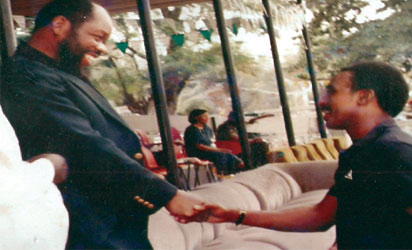
The late Odumegwu Ojukwu in a handshake with Col. Umar Dangiwa
By Uzodinma Nwala
The first time I came closest to Chief Ojukwu was during the National Constitutional Conference of 1994-95. He was a delegate to that controversial Conference that took place during one of the most critical periods in Nigeria’s history. It was a period when a break-up of Nigeria was again looming in the horizon.
Ojukwu, like many other leading patriots, came to that Conference in search of the way forward and how to keep Nigeria together as a united country.
It was there that an incident occurred whose significance opens the door for a deeper understanding of the Ojukwu mystique and the Ojukwu symbolism.
There was a disagreement between him and the rest of the delegates from the Igbo-speaking areas of Nigeria. He was reported to have made a statement which the delegates regarded as a deviation from their mandate.

The late Odumegwu Ojukwu in a handshake with Col. Umar Dangiwa
And consequently a Committee of six was raised, comprising of Chief Alex Ekwueme, the late Chief Austin Egbo from Delta, Dr Josiah Ogbonnaya from Abia State, Dr Joshua Odunna from Imo State, the late Chief Okogbule Wanodi from Rivers State and my humble self (Uzodinma Nwala), as Secretary of the Igbo Delegates Forum to that Conference.
Our mandate was to urge him to refrain from the line he was toeing and to appear at the meeting of the Forum to clarify his position.
Chief Ojukwu did appear at the Forum which, incidentally, he was the official Chairman. However, on that particular day, Dr Sam Onunaka Mbakwe took the Chair.
When we got to the relevant item on the Agenda, the Ikemba was asked to address his brothers and colleagues. He spoke for over twenty-five minutes, arguing that the mandate of the delegates did not prevent them from expressing contrary views. He ended up accusing the delegates of irreverence to him and of behaving in consonance with the historical fallacy that Ndigbo Enwe Eze.
His speech provoked very fierce reactions from the delegates. It is not my intention here to recall the mundane elements of that debate. Rather, I would like us to reflect on the significance of that very event and on some other related critical moments in Ojukwu’s biography (or rather his life and times).That will help us to appreciate more fully Ojukwu’s place in the socio-cultural history of the Igbo nation as well as the political history of the Nigerian Federation.
While some of my colleagues at that Conference, reacted in various ways to his speech, which many considered as not only offensive, but as a sign of one man against the rest, and, therefore, wanted to beat him into line; for me, I saw it as an opportunity to address the historical fallacy that Igbo Enwe Eze. Incidentally, it was a view I had previously and privately discussed with the Ikemba in his Apo Village Residence.
When it was my turn to speak, I said to him, “Sir, remember my private discussions with you on some issues as well as on this historical fallacy – Igbo Enwe Enwe”.
On that day at his residence, our discussion began with the implications of the Ikemba, the Peoples’ General, playing the role of a politician. I had said to him- “Sir, I will like to see you on the campaign trail one of these days, to see how you react to rotten tomato or rotten eggs thrown at you; that will tell how far you are maturing as a politician”. And he laughed.
On the historical fallacy – Igbo Enwe Eze. I had argued that, contrary to that fallacy, Ndigbo are among the greatest hero worshippers in history. “The Ikemba’s life, I said is a testimony to this”.
Then I drew his attention to three episodes in his life. One, as the Leader of Biafra, two, his return from self- exile in Ivory Coast and, three, his membership of the National Party of Nigeria(NPN).
Ojukwu- the Leader of Biafra
I said to him “During the civil war, you were like a demi-god to Ndigbo world-wide. The people were ready to lay their lives so that you might live. The men were ready to abandon their beds for the Peoples’ General. You were like a divinity. Your words were command to the people. You were their Hero, their Eze, their King”.
Disclaimer
Comments expressed here do not reflect the opinions of Vanguard newspapers or any employee thereof.