
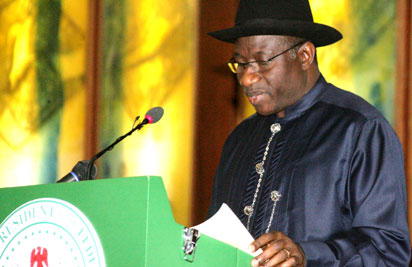
President Jonathan.
By Emmanuel Aziken, Political Editor & Ben Agande
President Goodluck Jonathan’s presentation of the N4.749 trillion 2012 budget proposals yesterday kick-started the official process for the enactment of a budget for the Federal Government. Beyond the ceremony and the accompanying grandeur, yesterday’s ceremony is about the most important in the life of the National Assembly every session.
It is as such not surprising that it is also the one occasion where the President by tradition has to appear before parliament to lay down the spending proposals of the Federal Government.
The constitutional imperative for the presidential presentation of the budget proposals to the National Assembly is underlined by section 80 (3) of the constitution which states to wit that:
No moneys shall be withdrawn from any public fund of the Federation, other than the Consolidated Revenue Fund of the Federation, unless the issue of those moneys has been authorised by an Act of the National Assembly.
Further to that, the constitution in section 81 (1) requires the President to lay before the National Assembly his spending plans for the following year.
The President shall cause to be prepared and laid before each House of the National Assembly at any time in each financial year estimates of the revenues and expenditure of the Federation for the next following financial year.
This particular provision was observed to the letter since the advent of the fourth republic. The only exception was the 2010 spending plan when the ill-health of then President Umaru Yar‘adua made it necessary that the Special Adviser on National Assembly Matters, Senator Mohammed Abba-Aji performed the role in December 2009.

resident Jonathan during the budget presentation to the joint session of the National Assembly.
The process
With the submission of the 2012 budget plan which comes in the way of an Appropriation Bill to the joint session of the National Assembly, the process leading to its passage would commence in earnest almost immediately.
The budget bill is expected to go through the legislative process of each chamber of the National Assembly as any other bill, but with some particular exceptions.
Following yesterday’s presentation of the budget, the budget bill would be read for the first time today. The long title of the bill is read and following this, by tomorrow each chamber of the National Assembly could commence debate on the general principles of the bill.
Debate on the general principles is an opportunity for the lawmakers to make broad comments on the economy and references could be made to proposals in the President’s address on the economy. However, as a rule, specifics on details are normally not allowed during the debate on general principles.
It is also a time during which Senators and members of the House of Representatives use to draw attention both to their constituencies and also to themselves!
The debate on the general principles sometimes could last weeks as allowance is normally made for as many legislators as possible to contribute to the debate.
With the conclusion of the debate on the general principles, the budget bill is read for the second time and the budget bill is then referred to the Committee on Appropriation. This is when the detailed work starts as all the standing committees of the Senate and House temporarily stand down and become sub-committees of the Committees of Appropriation.
Super Appropiation Committee
The Committee of Appropriation now channels to each committee the budgetary proposals relating to the executive arm of government it oversights. The Committees of Education in the Senate and House for example, each receive all proposals concerning education.
The committees of the Senate and the House depending on the working relationship between them sometimes collaborate and consider the proposals jointly. They could also decide to work independently and make linkages as they work.
Ministries, agencies and Departmental heads are afforded the opportunity to defend the votes proposed for their various departments during this period before their oversight committees. The decision on what is included in the budget for the ministry or agency could be dependent on how well the heads of such agencies are able to defend their proposals.
This is also the period when fast thinking legislators also help themselves. They could decide to plant projects into the budget and agree with the relevant officers in the executive on how such projects could be executed.
Friction between the legislators and ministers have sometimes erupted when disagreements over the sharing of the booty or sometimes when new hands come on board either as committee chairmen or as ministers and refuse to play along.
As a result of the serious frown on such practices first expressed by President Obasanjo on such malfeasances a breed of consultants have arisen who act as linkages between ministers and head of agencies on one part and the legislators on the other part. The consultants normally go with a handsome cut of such deals.
The sub-committees (standing committees) at the end of their deliberations submit their reports to the Committee on Appropriation which does the final check on the reports of the sub-committees. Remarkably, the Committee on Appropriation is not bound by the work of the sub-committees as there have been instances in the past when the Committee on Appropriation discarded the work of the sub-committees in articulating the budget.
Few years ago the chairman of the Senate Committee on Appropriation was presenting his report on the budget while a number of committees were still deliberating on the report to be submitted to his committee!
“That is not my report, where did he get the report,” one committee chairman whose committee was at that time hearing the defence of the proposals from a minister said.
Following its articulation of the reports, the committee on Appropriation returns the collated report on the budget to the chamber of the Senate or the House of Representatives.
The Senate or the House receives the report and dissolves itself into the Committee on Supply where the final imprints of the proposals are considered by the whole chamber. Senators or House members who have misgivings on the report presented by the Committee on Appropriation use this opportunity to raise such.
At this point because the Chairman of the Appropriation committee has worked with the presiding officers, it is normally a fait accompli! It is as such no surprise that the chairmanship of the committee on appropriation is reserved for very trustworthy hands in the legislature.
At the end of the deliberations of the committee on supply where the Senate President sits as the Chairman in the Senate and the Deputy Speaker in the House of Representatives, the report is adopted and passed on to the whole House for the third reading. The third reading is final passage of the budget bill.
Where there are no discrepancies in the reports of the Senate and the House, a single budget bill is then passed through the Clerk of the National Assembly to the President for his assent.
Disclaimer
Comments expressed here do not reflect the opinions of Vanguard newspapers or any employee thereof.