
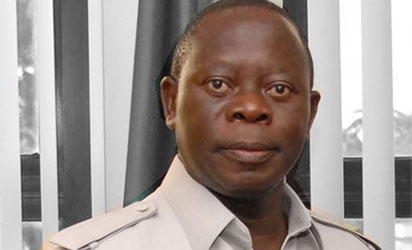
Oshiomhole
By Kassim Afegbua
I watched the punctured imageries of the so-called government induced debate at the Muson Centre in Lagos penultimate week, and I could see how difficult it was for the protagonists of subsidy removal to sell their unpopular motive.
I could summarize the contradictions and the various inconsistencies in terms of drawing parallels about the justification for fuel subsidy removal as strongly argued by government apologists and their collaborators. On the one hand, the Petroleum Minister was talking about deregulation, while on the other hand, she was talking about subsidy removal and the theoretical gains that it is expected to bring to Nigerians.
Who does not know that deregulation is not a synonym for subsidy? Why will government apologists be talking about deregulation as if it were subsidy? It is the same contradiction that was freely advertised in government’s published handbook [widely in circulation] justifying its proposed removal of fuel subsidy. Such inconsistency and lack of discerning understanding of the terms and usage exposes the insincerity of government on this discourse.
Misapplication of terms.
The 7th edition of the Oxford Advanced Learner’s Dictionary defines subsidy thus; “money that is paid by a government or an organization to reduce the costs of services or of producing goods so that their prices can be kept low”, e.g; agriculture subsidies.
Deregulation is defined by the same dictionary as the act to “free a trade, a business activity, etc, from rules and controls”. While one talks about payment of money to keep prices low to serve certain benefits, the other talks about freeing a trade from certain rules and regulations.
That also means that under a deregulated economy, government may still pay certain money to keep prices at the reach of her citizens. In other words, the practice of deregulation does not eliminate subsidy if the government considers it desirable to so do in order to serve certain ends. The agricultural subsidy in Uganda is a ready example.
The gains of deregulation are self-defining, but to make the exercise achieve the objective for which a deregulation is possible, the infrastructure and enabling environment must be provided. If the cost of doing business or production is considered to be too expensive as is often the case with Nigeria for obvious reasons, no amount of propaganda can bring the cost down except the enabling environment is provided or guaranteed.
For cheap labour, the United States of America with all her infrastructure had to shift production to China during the Bush era but today, the impact of that is already telling on the American economy. Therefore, for an infrastructurally-backward society such as Nigeria, production cost will still be as undesirably prohibitive as it will be unrealistic to make quick returns on investment.


Governor Adams Oshiomhole
If the object of deregulation is to open up the market for more investors to come in as easily canvassed by government spokespersons, then who provides the basic infrastructure to drive such incentive? Do you deregulate first before providing the enabling environment or you provide the enabling environment before you deregulate? Which comes first? Where is the energy to drive the plan? Subsidy on diesel was removed and today the prices have sky_rocketed, yet we are yet to see new investments in that stream.
Subsidy, as the common man incentive
Oil is our natural resource. Our oil is situated in the Niger-Delta region and not in another planet. Whatever we do to affect positive development of that sector is our exclusive preserve. Let us ask a simple question; why do governments subsidize production of goods and services? In other words, what is the object of subsidy? It is simply to keep prices low to achieve certain ends for the good of the citizens.
Due to the realization of income disparities, subsidy becomes an incentive applied to lessen the burden on the average poor in order for him to enjoy the utility of that good and service. As an oil producing nation, what benefits accrue to the citizens if the subsidy which helps to keep prices low and affordable is being removed?
What does an average citizen gain from a natural resource that is flowing from his backyard, if he has to pay heavily for its use? If we get our compass right, are we saying our refineries cannot refine crude that could serve our domestic needs? If we remove the subsidy, are refineries going to be built overnight with competitive prices as the motivation for the subsidy removal in the first place? If the subsidy is removed, who bears the burden of pump price increase?
Are we going to eliminate the Petroleum Equalization Fund since the body will become useless as a result of this removal? If the masses are going to pay more for a litre of petrol, are we saying it will not amount to double jeopardy for them because of the multiplier effects this would have on the economy of the nation?
Too many questions, not begging for answers, because the answers are known except that government is not able to come up with transparent and courageous statement as the details of our balance sheet. If there is sincerity and honesty of purpose, what difference does it make if we say all imported or locally refined products would be sold free to the people as an incentive to showcase our oil ownership status?
Why must we draw comparism with other oil producing countries when we do not share a lot of things in common; eating habit, wealth acquisition is different, corruption index is different, our disposable income habit is different, our mores and value systems are different, and other demographic details? Why draw comparism?
What is the purpose of government? Why is President Jonathan “fighting” with the people who are the repository of his power? Majority view points and opinions are against the removal of fuel subsidy but government is hell-bent at saying it will go ahead with the removal. Who then is the government offering to serve? The oil cabal or the mass majority of her citizenry?
Rather than government to come out bare-bone to declare its insolvency and expose the harm that corruption is doing to our national life, it is simply spending millions of naira embarking on propaganda against her own people. It is a ridiculous drama. And the roll call of those who are advertising this falsehood against the Nigerian people is quite disturbing.
Getting prices “right” as a precursor to getting investors is not a plausible argument in trying to re-invent a sector that has been enmeshed in monumental corruption. The root of the decay in the sector must be addressed first and foremost, reinvigorate the weak institutions and infrastructures, develop the capacity, before any clear-cut attempt to open up the market could be undertaken.
Oshiomhole got it wrong
From all the long essays and dissertation theses churned out so far from the angle of government, it is obvious that this government has already gone on recess. Imagine the lazy argument that removal of subsidy will lead to improved services in the areas of infrastructure, health and power generation.
When there was subsidy, didn’t we see signs of development? This is why I pitied the position of Comrade Oshiomhole in suggesting that the country will crash if subsidy is not removed. Nigeria will not crash; it is only those gluttonic business buccaneers that would crash for the country to move on.
On account of his performance in office, why has Edo State not crashed in the last three years that subsidy has been on parade? Why did Nigeria not crash under Chief Obasanjo to the extent that we were able to save for the rainy day in the name of excess crude account and foreign reserves, and most importantly the so-called debt buy back? Where did Obasanjo get all those monies that were deployed in the running of the country?
It is usually very difficult for a man like Oshiomhole to wear two caps; that of labour activist and executive Governor. One has to give, and in this case, his present status as Governor was manifest when he declared his support for removal of subsidy, so that the masses that have given him all the support over the years would now pay through their noses for a resource that is generously in our backyard. Since the Governors were aware that subsidy removal meant more money accruing to their pockets, they sent one of their own [comrade Oshiomhole] to do the talking while they await the proceeds.
And like a good dispatch rider, Oshiomhole went to the Lagos debate to deliver the punches against the Nigerian masses, speaking from both side of his mouth; to be a friend of government and the masses. By the time he delivered the killer punch, Nigerian masses were completely devastated with shock.
Power has a great allure. It makes men blind to their real intentions and for the political undertakings that would form most part of 2012 in Edo State as a result of the re-election contest, it is understandably clear why Comrade Oshiomhole [ACN] chose to be President Jonathan’s [PDP] mouth-piece at the debate.
All these voiced sentiments about our economy crashing and the delusions of global capitalism will pale into insignificance if in the long run countries are able to articulate models that will suit their local peculiarities with the sole purpose of reducing corruption and waste, and making good governance the central focus of truly elected leadership. Nigeria for sure, will not crash.
It should be understood that insisting on removal of subsidy does not make President Jonathan a courageous man with unflinching political will. No. It only exposes the missing link between him and the electorates from where he derived his powers in the first place, and further exposes the weaknesses of whatever leadership credentials his propagandists are brandishing. Haram subsidy.
Disclaimer
Comments expressed here do not reflect the opinions of Vanguard newspapers or any employee thereof.