
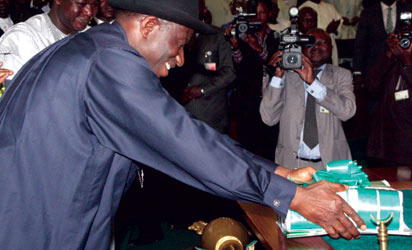
File photo: President Jonathan laying the Budget Proposal before the National Assembly members
*Security, Agric, Education, debt service take lion share
By Omoh Gabriel, Ben Agande, Henry Umoru & Chris Ochayi
ABUJA – President Goodluck Jonathan,yesterday, was silent on the issue of subsidy removal on petroleum products as he presented a budget of N4.749 trillion to the National Assembly with a deficit of N1.105 trillion. He said it would be the start of prudent financial planning.
The President said spending would rise from the N4.48 trillion in 2011, to N4.749 trillion in 2012, but recurrent expenditure would fall to 72 per cent of the budget from 74.4 per cent this year as the government focuses more on capital projects.
According to the President “This budget is a stepping stone to the transformation of our economy … we cannot subject the wellbeing of Nigerians to unnecessary risks, we must therefore protect ourselves by planning our finances prudently”. Jonathan who dressed in his trademark kaftan and fedora hat told lawmakers that the fiscal deficit would be reduced to 2.77 per cent of gross domestic product from 2.96 in the 2011 budget.
President Goodluck Jonathan said that the budget was targeted at not only job creation but ‘to lay a solid foundation for sustainable economic growth which would deliver dividends of democracy to our people’. The President however did not mention the issue of subsidy withdrawal during the presentation of the budget which has a revenue estimate of N3.644 trillion, representing a deficit of N1.105 Trillion.
The capital allocation for the Budget is N1.32 trillion which is an increase of 15 per cent over 2011 budget and 26 per cent of the total Budget while the Recurrent Allocation in the budget is down to 72 per cent as against last year’s allocation of 74.4 per cent.
President Jonathan, who arrived the National Assembly complex at exactly 12:09 pm amidst heavy deployment of security men from all the security apparatus in the country, was accompanied by the vice president, Namadi Sambo and other high ranking government officials including ministers, the Secretary to the government of the Federation and other Party chiefs.


President Jonathan laying the Budget Proposal before the National Assembly yesterday. Photo: State House.
“The robust growth recorded in the first half of 2011 underscores the resilience of the Nigerian economy and the prudence of our economic policies. Our growth in the 2010-2011 period has been broad-based.
“The economy recorded impressive growth of 7.85 percent in 2010 and 7.72 percent as of the second quarter of 2011 compared to 5.2 per cent forecast for sub-Sahara Africa. Medium-term prospects are also bright, with real GDP growth projected to remain strong over the period. Furthermore, we intend to pursue a programme of greater fiscal discipline complemented with appropriate monetary policy in order to help stabilize our declining foreign reserve.
“The non-oil sector continues to be the main driver of growth with increased crop production, growth in wholesale and retail trade and increased financial sector activities backed by the banking sector reforms. Contributions by the oil sector continue to improve as average daily oil production rose to 2.45 million barrels per day in the second quarter of 2011 compared to 2.35 million barrels per day in the corresponding period in 2010.
“At the same time, food inflation has been on a downward trend from 14.1 per cent in October 2010 to 9.7 per cent in October 2011, but it is still a matter of concern as our objective is to move to low or mid-single digit inflation” the president noted.
He pointed out that ‘oil receipts achieve the targeted levels as a result of a higher oil prices and production levels while non-oil receipts are also tending towards the set targetd of 2011.
“As of Mid-November, about 67 per cent of the released funds had been utilized and we expect to reach 70 per cent by the end of December which is fairly good considering the circumstances. With the support of the National Assembly, the government is determined to pursue a programme of far-reaching fiscal consolidation so as to reduce our deficit and domestic borrowing to a more manageable level” the president said.
The president noted that even with the global economic challenges, the outlook on Nigeria was recently upgraded from negative to stable by Fitch ratings; an achievement the he said was recorded because of new economic programme introduced by his government as well as the successful political transition following the 2011 elections.
In order to maintain this rating, President Jonathan said government would invest resources in key areas of priority like security, Infrastructural renewal and development, human Capital Development and food security to give a more inclusive growth and attention to job creation.
While promising that the government would pursue policies that will ensure stable macroeconomic environment through prudent Fiscal Policy, manageable deficits and sustainable debt-GDP ratio of not more than 30 per cent, President Jonathan reiterated that the recent increase in domestic debt to about 16.4 per cent of the GDP ‘cannot be allowed to continue and become a burden on our children.
“In this regard, we have initiated steps to increase revenues by blocking leakages from various sources, improve corporate tax collection, and boost internally generated revenue. We also believe that we should be able to earn a lot more revenue from the maritime sector.
As part of the on-going port reforms, government will work vigorously to increase our revenue from maritime and related activities. Starting in 2012 for the medium term, we shall focus on cutting recurrent expenditure to sustainable levels through reducing waste, inefficiency, corruption and duplication in government.
Recent reviews of public expenditures provide a basis for taking such measures. In order to make capital spending more effective, government is introducing a new template for analyzing the financial and other factors including the economic rates of return, job creation, and environmental sustainability.
“Similarly, Government will continue to prioritize its expenditures while focus will be on the completion of viable on-going capital projects. It is our intention to fund and bring the large portfolio of on-going projects to completion in the next few years while also taking on flagship projects already identified in the Transformation Agenda.
From 2012, there will also be a robust programme to strengthen our oil reserves base, and increase oil exploration activities in identified inland sedimentary basins, outside the Niger Delta, with the requisite potential for the production of oil and gas, particularly the Chad Basin” he said.
Disclaimer
Comments expressed here do not reflect the opinions of Vanguard newspapers or any employee thereof.