
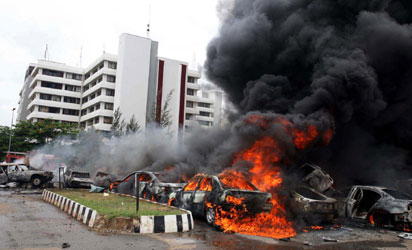
*The Nigeria Police Force Headquarters’ suicide bomb attack
CHARLES KUMOLU & BOSEDE ADELAJA
*Governance suffered neglect— Commoners *Year of confusion —Cleric
*Nig must unite to defeat terrorism —Human rights activist
IF turning back the hands of the time, was a possibility, many Nigerians would not be in a hurry to turn back the time to 2011. This is why there is a hurry to see this year gone with history in this part of the world. But even as the New year is ushered in within the next 48 hours, there are palpable fears that events of 2011, especially the spate of bomb blasts would spillover to 2012.
“TUOMO Community in Burutu area of Delta State was on Christmas eve thrown into confusion as a middle aged man murdered his 70 year-old father, saying he did it in self defense, the suspect Mr. Ekuemene Kosin was said to have had several scuffles with his father over issues that were unclear over a period of time,” this was how the murder of Pa George Kosin was widely reported on December 27, 2011.
And stories of this nature, almost passed for every day news in 2011, as there was hardly any period that Nigerians were not confronted with depressing accounts about people, issues and places.
Whether it is on the domestic or work front, religious or government circles, it is one tale of absurdity or the other.
This is why Vanguard can authoritatively state that for the first time since the crises that trailed the June 12 Presidential Elections, the year under review will go down as a year of misery, grief and uncertainty for Nigeria.
Consider this; numerous lives were lost to preventable religious crises, road accidents, armed robbery attacks, kidnapping, domestic violence, post-election violence,among other controversies.
Perhaps, this accounts for why rather than singing joyful songs as the year is winding up, Nigerians are chanting songs of sorrow–reminding many of Kofi Awonor’s poem, Songs of Sorrow, which dwelt on how bundles of disappointment could unleash a state of helplessness.
Insecurity
Therefore, saying that the flurry of absurdities that shaped this year, have left Nigerians in a hapless and confused state, is as good as saying the obvious.
From the volatile states of the North, to serene cities of the South, many would not be in a hurry to forget 2011 with its litany of woes.
To a lot of people, these 12 months of doom is a fallout of inept leadership, especially the inability of the political leadership over the years to give the country the full benefit of its rich human and natural resources.
Amid these gory events that shaped the year, some stand out because of their magnitude.
Particularly, the rate of insecurity, which ultimately led to the collapse of the security system in Nigeria, is so alarming among the many tragedies of 2011.
This was so disturbing that an article published in a Ghanaian online paper, described the country as a ‘Federal Republic of Insecurity’.
According to the article, “if any of the President’s 100 advisers has the polite courage for the extraordinary task of reminding His Excellency of his foremost, sworn, constitutional obligation to the national interest about security and safety of Nigerians and all who sojourn in Nigeria, please whisper clearly to Mr. President that I said, respectfully: Nigerians, at home and abroad, are still concerned and afraid for living in what I call Nigeria’s Federal Republic of


Alledged Boko Haram members and their late leader, Yusuf
Insecurity! Nigeria.”
It further said, “As the year 2011 draws down and we embrace the promise of 2012, a recurring concern for Nigerians and the international communities remains: are we safe going about our every day lives or investing to do business in most parts of Nigeria? amidst all the palaver, Nigerians continue to wonder if their federal state of insecurity would continue into 2012, despite the fact of a whopping federal government budget of N4.749 trillion — the equivalent of $30.64 billion — with the security and defense allocation bagging the lion’s share of N921.21 billion— the equivalent of $5.9478 billion.”
Mixed fortunes/govt incompetence
To many observers, this lamentation from a foreign journal, says load about the murky mood of Nigerians ahead 2012.
And it has also raised questions on whether the government is capable enough of getting it acts right in the new year.
Already, investigations by Vanguard confirmed that people from all sections, faiths and economic status, are not comfortable with the incapacity of government at all levels to perform the most basic function of providing security.
“The government has also showed a lot of incompetence in the area of protection of lives and properties. Over the years, the Nigerian people thought that they had a security system and network with the capacity, sophistication, equipment and courage to protect them.
“The cases of kidnapping, high profile robberies, mindless assassinations and terrorist attacks have shown clearly that the country is vulnerable and unprotected, Physical security has been emphasised and Nigerians did not know that it was just show business. This incompetence is polarising the country giving the impression of a serious religious divide and tension,” a Human rights activist, Mr. Festus Okoye noted.
Okoye, who is also the Executive Director of Human Rights Monitor said, “the year 2011 was challenging for the Nigerian people. It was a year of mixed fortunes in all spheres of life. It was a year that the Nigerian people showed that they could take their destiny into their hands and determine the direction of the Nigerian society. The year showed that in the midst of great challenges the Nigerian people can show great resilience and courage.”
Continuing, he said, “the Nigerian people held a general election that showed remarkable organisational improvement
from previous flawed efforts. The election produced results that somehow reflected the votes of the people.
“The Nigerian people defied the machinations of the political elite and trooped out to vote and at the end stayed behind to defend the integrity of their votes. The political elite were surprised and knew that with better organisation and sensitization, the era of electoral fraud will be a thing of the past.”
In addition, Okoye said, “However, the achievements in this area pale into insignificance as most of the office holders helped themselves to the commonwealth of the Nigerian people to run their campaigns and election. It is the mindless profligacy and theft from the public purse by the political elite that has left the economy prostrate resulting in the fixation on fuel subsidy removal.”
Still regretting the plethora of mess that characterised life in Nigeria in 2011, he said, “ what the Nigerian people hear are platitudes and empty declarations of action by the government. Given government’s inability to protect them, the Nigerian people no longer believe the government and what it says.
“The government must be accountable to the Nigerian people. Any government unable to protect its citizens does not have the right to their loyalty. The incompetence of government has invariably energized merchants of ethnic and religious bigotry.
“While stoking the fire of religion and ethnicity, the government still runs to them for the solution to the problem. We must unite as a people and a country to defeat terrorism. We must unite to chase away merchants of bigotry. We must unite and demand for accountability and transparency in governance.”


The Nigeria Police Force Headquarters' suicide bomb attack
Year of confusion
While corroborating this stand a Lagos resident, Ibrahim Falade, told this reporter, that, “we are leaving in terrible times, Nigerians are alone in this state of anarchy because we don’t have a government, rather than focusing on Boko Haram, they are busy chasing subsidy, we are not sure about what the new year will be for this country.”
Similarly, Founder, Soul Winning Chapel and former President of Cycling Federation of Nigeria, Dr. Moses Iloh said the year was controlled by confusion.
‘’Year 2011 is a year that was controlled by confusion and lack f direction. The result is that the system has been corrupted, we are even fortunate that we are able to stand as at the moment,” he added.
Subsidy
Trailing insecurity, is the issue of removal subsidies, which experts had argued would be more controversial in 2012 than it was in 2011.
In the last quarter of this year, an already bewildered nation, was shocked by the announcement of a proposed removal of subsidy on petroleum products.
Expectedly, the news triggered off another round of controversy, which is still raging.
While the government, was(is) busy trying to sell the idea to Nigerians, who had opposed it on the grounds that it would unleash hardship on the nation, other businesses of governance suffered neglect
The result today, analysts argued, is the unchecked wave of violence holding the nation to ransom.
Though, the Federal Government, had stressed that fuel subsidy removal would strengthen the country’s economy and as well avert grave consequences for the country in 2011 and subsequent years, the fear of the impending takeoff of this policy in April 2012, is indeed darkening the prospects of a happy new year.
Political elites penetrated the judiciary
Nonetheless, the judiciary also had its share of the ugly sides of 2011, as there was sudden loss of respect for the third arm of government.
This was a fallout of the faceoff between its two principal leaders, immediate past Chief Justice of Nigeria (CJN), Justice Aloysius Katsina-Alu and retired President of Court of Appeal (PCA), Justice Ayo Salami.
And Okoye had this to say on the issue; “The year 2011 showed that the political elite have finally entered the judiciary and are attempting to capture it. The judicial officers they cannot capture they blackmail. It is therefore unfortunate that some senior members of the Bar are assisting the political class in this mindless attempt at humiliating and destroying the


President Jonathan
judiciary.
Fortunately, the judiciary especially at the higher echelon is still the bastion of the rule of law and due process and has guarded the constitution jealously.
“The conditions of living of the ordinary continued to deteriorate throughout the year. The few gains that were made in terms of the minimum wage will soon be extinguished with the imminent increase in the pump price of petroleum products.
“The end result of all these things is that Nigeria may soon degenerate into a state of lawlessness. We will unite to defend democracy and its ideals but cannot guarantee the defence of an incompetent government when the anger of the people manifests itself.” He added.”
Promises amid growing darkness
The outgoing also recorded promise of improved power generation by December 2011. President Jonathan, who said this during a conference on the power sector roadmap in Lagos in August 2011, pledged that electricity supply would be raised to 5,000 megawatts from 2,800 megawatts in May.
Accordingly, the Federal Government announced that the electricity supply has increased from the 2,800 megawatts in May to about 4,000 megawatts as at September 2011, leaving a shortfall of 1,000 megawatts.
This is however an indication that the industry within 2011 was characterised with issues which did not make for easy consumption by many Nigerians.
Timeline of ups and downs
January 1
A bomb blast occurred at Mogadishu Army Barracks Abuja, killing scores.
April 7
An explosion hit a polling booth at Unguwar Doki, Maiduguri, Borno State, injuring more than ten people.
April 8
Bomb explosion at the Independent Electoral Commission, INEC, office in Suleja, leaving 11 people dead.
April 15
Youths riding on a motorcycle threw a locally made bomb into the premises of the Maiduguri council office of the INEC.
April 21
Two suspected bomb-makers died in a blast in Kaduna.
April 25
Three bomb blasts ripped through Tudu Palace Hotel and Kano Motor Park in Maidugri, Borno State.
April 27
A bomb blast was averted at an INEC collation centre in Oron, Akwa-Ibom State several hours before the commencement of voting in the state.
May 28
13 people died and 40 were injured after a blast occurred at the mammy market of Shandawanka Barracks in Bauchi, the Bauchi State capital.
May 29
Eight victims lost their legs after an explosion occurred at Zuba, a suburb of Kubwa in Abuja.
June 16:
A massive explosion at the National Police Headquarters building in Abuja.
August 26:
Bomb blast rocked the UN building in Abuja, killing many.
December 7:
A heavy explosion occurred at Oria Apata along Katsina Road by Ogbosho Street, opposite the former Scala Cinema at about 9:30 am.
December 25
A suicide bomber detonated explosives at Saint Theressa ’s Catholic Church Madalla, Abuja, killing over two dozens of worshipers.
Others
February 26
Former Deputy National Chairman of Peoples Democratic Party, PDP, Chief Olabode George, regained freedom after serving out two years imprisonment alongside four others for contract-splitting when he was Chairman of Nigeria Ports Authority, NPA.
February 2011
Convicted former Chief Executive Officer of Oceanic Bank International Plc, Cecilia Ibru, regained freedom.
April 9
National Assembly elections held across the nation.
April 16
The presidential polls won by President Goodluck Jonathan were held.
April 26
The governorship and House of Assembly elections were held across the Nigerian state.
May 28
Nigeria’s president, Goodluck Jonathan, signed into law the Freedom of Information Act as passed by the National Assembly.
June 5
Former Speaker of the House of Representatives, Dimeji Bankole, was arrested by the Economic and Financial Crimes Commission, EFCC, in Abuja.
July 10
Lagos recorded a fifteen -hour downpour that sacked and rendered many Lagosians homeless.
August 17
Nigeria launched Sat-X (the first Nigerian-built satellite) into space.
August 26
Another flooding ravaged Ibadan, killing hundreds and leaving many homeless. It was a deluge of rage as volume of rain that poured on the largest West African city shot up, leaving rivers and streams overflowing their banks. The Red Cross Society put the casualty at over 100, but the indigenes believe that it could be more than the figure. Many states in the eastern and northern parts of Nigeria were also affected by flooding at one time or the other leaving a sad tale behind
October 6
EFCC arrested the former governor of Ogun, Otunba Gbenga Daniel, as well as his Oyo and Nasarawa State counterparts, Chief Adebayo Alao-Akala and Alhaji Akwe Doma, respectively, over allegations of fraud to the tune of N101 billion.
October 10
Former governor of Gombe State, Danjuma Goje, surrendered himself to the EFCC in Abuja.
October 12:
Nollywood actor and veteran comedian, Alhaji King Babatunde Ayinla Nurudeen Olasunkanmi Omidina, a.k.a. Baba Suwe, was arrested for alleged possession of substances suspected to be cocaine by the officials of the National Drug Law Enforcement Agency, NDLEA. He was later freed after a protracted detention without excreting the suspected substance.
November 21
Senator Ali Ndume was arrested following allegations that he was one of the sponsors of the dreaded Islamist group, Boko Haram.
November 22
Ali Umar Konduga (a.k.a Al-Zawahiri), former spokesperson of Boko Haram, was convicted for felony after he pleaded guilty to the one-count charge against him.
November 23
President Goodluck Jonathan sacked the Chairman of the EFCC, 65 year-old Farida Waziri, and appointed Ibrahim Lamorde as the Acting Chairman of the Anti-graft outfit.
Disclaimer
Comments expressed here do not reflect the opinions of Vanguard newspapers or any employee thereof.