
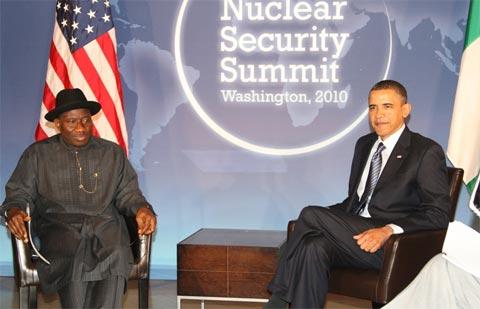
President Jonathan and US President, Obama
The Security Subcommittee on Counterterrorism and Intelligence of the United States House of Representatives Committee on Homeland Security recently had a hearing on emerging threats to the United States posed by Boko Haram, the Islamic group originating from Northeast Nigeria. The report of the hearing dated November 30, 2011 as endorsed by sub-committee chairman Rep. Patrick Meehan and the ranking Democrat member, Rep. Jackie Speier is serialized.
Origins and history of Uprising
“Boko Haram,” which in the local Hausa language means “Western education is forbidden,” officially calls itself “Jama’atul Alhul Sunnah Lidda’wati wal Jihad,” which means “people committed to the propagation of the Prophet’s teachings and jihad.” Though the origins of Boko Haram are murky, the group was not founded as a violent insurgency bent on overthrowing the Nigerian government.
Founded in the mid-1990s as a religious study group, Boko Haram did not begin to transform into the insurgent group it is today until a young and charismatic Nigerian civil service employee named Mohammed Yusuf assumed control. Calling themselves the Nigerian Taliban, Boko Haram adopted a “live-off-the land” lifestyle and established a camp in a remote area of northeast Nigeria, which the group dubbed “Afghanistan.”
Local police forces
From 2002-2009, Boko Haram engaged in low-level conflict with local police forces and non-compliant villagers. In 2009, a crackdown on Boko Haram members from Nigerian police forces in Borno state erupted into fighting. On July 26, 2009, sect members launched an attack against a police station in Bauchi state, resulting in the death of 39 Boko Haram members, two police officers, and one soldier.
This ignited a five day stand-off between Boko Haram and security personnel that saw violent attacks and battles spread across four northern Nigerian states: Bauchi, Kano, and Yobe, culminating in a final battle in the city of Maiduguri in Borno state.
On July 30, 2009, the battle of Maiduguri ended when Nigerian security forces captured and killed Boko Haram’s leader, Mohammed Yusuf, in what human rights groups have deemed an extrajudicial killing. Yusuf’s execution was videotaped by soldiers and later broadcast on television.


President Jonathan and US President, Obama
In total, nearly 700 people were killed in the uprising. The death of Yusuf marked a turning point for the Boko Haram. It was forced underground and many of its leaders reportedly fled to other parts of Nigeria, including Bauchi state, as well as neighboring countries.
Radical Re-emergence
In 2010, Boko Haram re-emerged radically more violent and determined to seek vengeance against the Nigerian state for executing its leader. Under the leadership of Imam Abubakar Shekau, who claimed to have assumed control of the sect following the death of Mohammed Yusuf, Boko Haram militants carried out violent operations against government targets in the north.
The most notable include an assault on a Maiduguri prison that resulted in the release of 700 prisoners, including Boko Haram members, and a bombing in the city of Jos that killed more than 80 people.Significantly, the targeting of the Nigerian capital city of Abuja represented an evolving target set outside of Northern Nigeria. In June 2011, Boko Haram militants bombed the police headquarters in Abuja, and finally, carried out the suicide attack against the Abuja U.N. headquarters two months later.
Factors
A number of factors have been attributed to fueling Boko Haram’s violence and fanaticism, including a feeling of alienation from the wealthier, Christian, oil-producing, southern Nigeria, pervasive poverty, rampant government corruption, heavy-handed security measures, and the belief that relations with the West are a corrupting influence. These grievances have led to sympathy among the local Muslim population despite Boko Haram’s violent tactics.
Residents in northern Nigeria live in extreme poverty. In Maiduguri, most residents live on less than two dollars a day. Shettima Khalifa Dikwa, chairman of the Voters Forum at the University of Maiduguri, blamed the government and heavy security practices for the growing public sympathy toward Boko Haram.
“If it escalates it is the fault of the government and JTF (Joint Task Force). You can’t have JTF searching your house, invading your privacy, mistreating people without you having sympathy for Boko Haram.” These grievances and the failure of the government to effectively address them serve as a key recruiting tool for Boko Haram.
Boko Haram’s desire to rid northern Nigeria of these problems serves as the primary motives behind their stated ambition to implement Sharia Law and establish an Islamic state. Sharia Law currently exists in 12 out of 36 Nigerian states as the result of a grassroots movement that coincided with Nigeria’s transition to democracy in 1999.
A consistent lack of reliable reporting on Boko Haram has contributed to the difficulty in assessing its size, makeup, and goals. Boko Haram operates out of Maiduguri, the capital city of Borno state in northeast Nigeria bordered by Chad, Cameroon, and Niger. The group’s membership is elusive.
Some describe the “core Boko Haram” as the immediate followers of the late sect leader Mohammed Yusuf. However, others consider Boko Haram to be more of a “grassroots insurrection,” or an “amorphous cloud” that has emerged from the larger context of Muslim grievances and frustration with the government.
From aspiration to the US Homeland
Boko Haram’s activities over the last two years mark an escalation in the frequency and violence of its attacks. On February 10, 2011, Director of National Intelligence (DNI) James Clapper delivered the Worldwide Threat Assessment of the U.S. Intelligence Community and stated that Boko Haram was “focused on local issues… [and] may be pursuing interests it shares with AQIM.” Boko Haram’s activities since then mark an escalation in the frequency and violence of its attacks and an emboldened Boko Haram should warrant enhanced scrutiny from the U.S. Intelligence Community.
An emboldened Boko Haram should warrant enhanced scrutiny from the U.S. Intelligence Community. In order to properly gauge the true threat Boko Haram will pose to U.S. interests and potentially the U.S. Homeland in the future, it may be useful to examine two other groups whose rapid expansion in capabilities and apparent evolution in targeting and goals took the United States by surprise.
Al Qaeda in the Arabian Peninsula (AQAP) and Tehrik-i-Taliban Pakistan (TTP), both newly formed groups, were viewed by the U.S. Intelligence Community and outside experts as regionally focused and content to launch strikes against their home governments and Western interests in the region.
In both cases, the Intelligence Community – and the country – were caught off guard when attacks were launched by AQAP and TTP against the U.S. Homeland. The rapid evolution of Boko Haram as a threat shares certain characteristics with AQAP and TTP; an examination of the rise of these two groups may be useful in projecting the future threat of Boko Haram.
Al Qaeda in the Arabian Peninsula (AQAP)
In January 2009, the al- Qaeda branches in Saudi Arabia and Yemen merged into al Qaeda in the Arabian Peninsula. The creation of AQAP concerned U.S. intelligence officials, but the widely held assessment was that AQAP intended to target the Saudi Arabian monarchy, the Yemeni government, and U.S. interests in the Gulf region. Twice in the months prior to the merger that created AQAP, the U.S. Embassy in Sana’a was attacked. Still, the U.S. Intelligence Community did not assess there was serious intent nor capability to launch attacks on American soil.
In August 2009, a suicide bomber detonated an explosive device hidden inside his body in an attempt to assassinate the Saudi Arabian Assistant Interior Minister Muhammad bin Nayef. It was a brazen plot that came close to killing a top U.S. terrorism ally, and represented AQAP’s boldest terrorist attempt since the merger.
Disclaimer
Comments expressed here do not reflect the opinions of Vanguard newspapers or any employee thereof.