
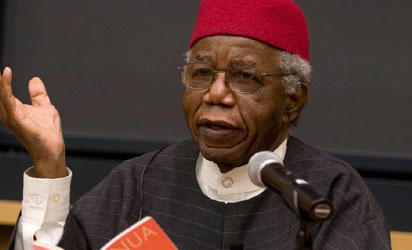
Chinua Achebe
By Ochereome Nnanna
PROFESSOR Chinua Achebe was not the first prominent Nigerian (nor the only one) to reject the now controversial National Honours.
He must, however, be among the very few who said no to it twice when the same category – Commander of the Federal Republic, CFR, the third highest of the lot – was offered by two different regimes. Incidentally, he cited the same problems as his reasons.
When he turned the offer down in 2004 under the President Olusegun Obasanjo regime, he justified it on the grounds that Obasanjo’s regime was sponsoring the destruction of his home state, Anambra, through the activities of roguish local agents.
Then he added in his rejection letter to Obasanjo: “Nigeria under your watch, however, is too dangerous for silence. I must register my disappointment and protest by declining to accept the high honour awarded me in the 2004 Honours list”.
This time in his response to President Goodluck Jonathan’s offer, he simply said: “The reasons for rejecting the offer of ‘national honour’ when it was first made have not been addressed let alone solved. It is inappropriate to offer it again to me. I must therefore regretfully decline the offer again”.
Obasanjo is a man who will not bypass an opportunity for a verbal exchange. He summoned an aide hired for his track record in the art, Femi Fani-Kayode. After a brief meeting, Kayode was mandated to fire back at Achebe.
He told the Things Fall Apart author that the rejection was not a slap on the face of Obasanjo or his government but the Nigerian people. According to him, it was a pity he would be yearning for the Nobel Prize in Literature (“quests for foreign and international awards in places like Sweden and elsewhere”) while rejecting an honour done him at home.
The statement went on: “No matter how brilliant and gifted an individual you are, if you feel that your country does not deserve to honour you, then we believe that you certainly do not deserve your country”.
Curiously, incumbent President Goodluck Jonathan did not bother to do his homework before renewing offer on Achebe. A more careful person would want to know if Achebe is now more disposed to it rather than run the risk of another rejection with its attendant embarrassment for the regime.
The first instinct, when Achebe’s name was forwarded to the President, should be to put out feelers into the other man’s camp to find out how he would react. GEJ had to pay for his presumption that all is now rosy with him in the saddle. He reacted just like Obasanjo, sending his media assistant, Reuben Abati, to do to Achebe what Fani-Kayode was sent to do way back then.
Between the repartees authored by Fani-Kayode and Abati, I think Abati’s was more appropriately worded. Bearing in mind that both aides are merely the voices of their masters, it is safe to put it more appropriately thus: Jonathan’s response was more fitting than Obasanjo’s.
I don’t think it is proper to say the conditions which Achebe complained about in 2004 are still as they were. Obasanjo’s local agents have been uprooted by the Anambra electorate and his PDP thrown out of power. In fact, the Nigerian Judiciary put icing on the cake by flushing Andy Uba, whom Obasanjo imposed on the state from office 16 days after he was sworn-in in 2007.
An attempt by the PDP through the candidacy of former Central Bank of Nigeria, CBN, Governor, Charles Soludo, was blocked in the February 6, 2010 governorship election, which was controversially won by the All Progressives Grand Alliance, APGA, candidate, Governor Peter Obi.
At the national level, all the “flaws” that the Congress for Progressive Change, CPC, complained about notwithstanding, the general elections of April 2011 conceived and delivered by President Jonathan was generally accepted both by Nigerians and the international community. There is no ground for saying the political problems that Obasanjo and his do-or-die political machine foisted on this country with Anambra State being the prime target is still there under Jonathan.
That is not to say that Jonathan has made any useful dent on the rest of “The Trouble With Nigeria” as enumerated in Achebe’s tiny testament published in 1983. Nigeria’s condition is still “ too dangerous” under Jonathan, with the terror attacks in the North where innocent Nigerians are being killed and maimed.
The regime’s “transformational agenda”, which might unfold in its fullest spate come 2012, promises to start with tears, sorrow and blood if fuel subsidy is removed, Naira devalued, higher electricity rates approved and the toll plazas returned to our potholes-infested federal highways.
You must have been wondering why both regimes of Obasanjo and Jonathan went to the elaborate lengths they did in replying Achebe. After all, Achebe has the right to say no to a gift, especially if he thinks it is a Greek gift.
Funny. Gifts keep coming to those who reject them, while those hungry for them can’t find anyone to give them anything! Just a month ago, Curtis James Jackson III, also known as 50 Cent, offered to keep the title “Things Fall Apart” he gave to a film project of his when he learned Achebe’s world-famous novel already had a patent on that title. To do this, he offered one million US Dollars to Achebe, who promptly turned it down, thus forcing 50 Cent to change (or alter) the title.
The fact is that when Achebe (who is now rated as the most influential African celebrity after beating a 40-man field in a Forbes October 2011 survey) speaks, the world listens.
It is people like Achebe and Professor Wole Soyinka that help to shape perceptions in a world dominated by Western mindsets.
For Obasanjo to deploy Fani-Kayode to reply Achebe, you should know that Achebe’s censure through rejection of Obasanjo’s awards truly hurt. It was a slap on Obasanjo’s face, probably deliberately delivered in retaliation for what OBJ did to Anambra State.
I am not so sure if the rejection of Jonathan’s was meant as a slap. For me, it is just a reminder that GEJ still has a long way to go in tackling the “Trouble With Nigeria”. He should see it as a wake-up call. GEJ needs it.
Disclaimer
Comments expressed here do not reflect the opinions of Vanguard newspapers or any employee thereof.