
By John Amoda
SATURDAY Vanguard, October 8, 2011 carried excerpts of the interview with General Don Idada E Ikponmwen, former Provost Marshall of the Nigerian Army and one time Director of Army Legal Services. The highlight of the interview was titled: “It’s sad, government can’t guarantee security Ikponmwen”.
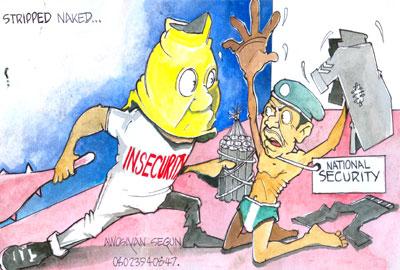
Of the many views espoused by the General, we focus on one, viz- his recommendation for reform of the command and control of the security agencies. We quote the relevant section of this recommendation.
According to General Ikponmwen: “The central government must act immediately, especially as we have all the security agencies, including the law enforcement, defense agencies, intelligent agencies centralized; there is need to revisit the structures and duties of our security agencies so as to ensure that the laws establishing these agencies are clear on who does what.
There is at the moment too much duplication of roles; there must also be a supervisory authority backed by law such that the supervisory power of this authority will not be left to mere conjecture. A situation where different organs are tasked with the same responsibility cannot lead to any efficiency, more so when there is no organ that can efficiently coordinate the activities of these organs.
I don’t think that, given the present or extant laws, the office of the National Security Adviser, NSA, which was only given a casual mention in the National Security Act, can effectively coordinate the security agencies because even if other things are in place, the truth remains that by the authority and status of the various law enforcement agencies- defence, law enforcement and intelligence units, each has direct access to the President.
Thus, it cannot be taken, hook and sinker, that the various heads of the services are practically amendable to the authority of the NSA. The Service Chiefs would hardly be expected to attend coordinating periodic meetings with the NSA; they would at best send representatives.
The President himself, who is both executive and ceremonial head of the country, is too busy on his own to effectively coordinate all the numerous security agencies. Thus, the effectiveness in terms of coordination of the office of the NSA must remain doubtful.
There ought, therefore, to be an individual, an office that would ensure effective coordination of these agencies within the ambit of unambiguous laws. In a system fraught with ambiguity and duplication of roles you certainly cannot expect efficiency.
This is a large part of our problem today in the area of security. Furthermore, both the constitution and the Armed Forces Act merely paint a picture of a Chief of Defence Staff, CDS. So in practice the CDS remains a mere figure head, a primus inter pares, without visible authority over the Service Chiefs of the Army, Navy and Air-Force that ought to be his subordinates. This situation cannot promote discipline and efficiency and is to that extent a structural lapse or minus for the defence/security system”.
We have quoted in extenso, for General Ikponmwen provides a participant observer information and analysis of the laws and the structures of defense and security they establish. He shows why the recent open quarrels and disagreements on issues of jurisdiction, responsibility and culpability for security lapses are inevitable being the result of the established autonomy of each service, be such defence, security or intelligence. The question is whether the coordination reform the General proposes will work. We do not think it would work.
Why? Because the coordinating office would be just another tree amongst a copse of other trees. Such an office would suffer from the same disability as the offices of the NSA, CDS and the C-in-C. The problem is that the laws and constitution establishing the components of the defence and security sector merely endorse and legitimize the autonomy of each service units.
This is the source of the conflicts between services for authority and their refusal of coordination which is only possible with a command and control implying a hierarchy of services rather than the present confederal structure of the defence and security system.
Another Act creating a coordination office will be informed by the logic of formal assignment of duties and detailing of functions- it would only enlarge the sector of defence and security by addition with minimal impact of such addition on the effectiveness of the defence and security sector.
If reform will not result in greater effectiveness, it follows it will not result in improved efficiency of the sector. We must address the root cause of the lack of coordination, synergy and effectiveness of Nigeria defence and security sector. The root cause is that Nigeria’s security and defence sector is a bureaucratic sector and not a system of security and defence.
A system exhibits internal differentiation of structures on the basis of internal specificity of functions. The security system is a unity and not an agglomerations of units each with its own character. What is critiqued by General Ikponmwen can be illustrated by what was the case with the Nigerian Army under the late President Sani Abacha.
That Army had a differentiation of functions and offices that imply hierarchy of authority. The Service Chiefs and the CDS were all Major Generals which was the highest rank in the Nigerian Army. The Office of the Chief Defense Staff was occupied by a Major General who was organisationally to coordinate the Service Chiefs. No such coordination was possible.
The reform in the post-Abacha Armed Forces where functions and rank are matched- so that every Service Chief is a three-star official and the Chief of Defence Staff is a four-star official has not produced the subordination that is the prerequisite for effective coordination. It is, then this post-Abacha organisation of the armed and security forces that General Ikponmwen has critiqued.
The formal reform of the Post-Abacha Military and Security Forces has not transformed a sector of autonomous services into a Defence and Security System. Thus the sector remains a composite of so many independent services. The pressing question is how our country’s security sector is to be transformed into a Nigerian security and defence system. This question will be addressed in the next Tuesday column.
Disclaimer
Comments expressed here do not reflect the opinions of Vanguard newspapers or any employee thereof.