
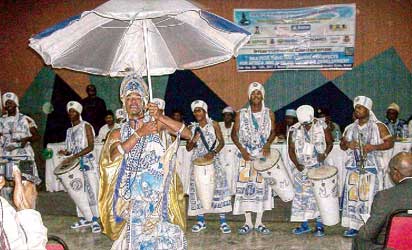
The cultural performance by Cultural Bahia Arts Council, Brazil at the occasion
By MCPHILIPS NWACHUKWU, who was in Salvador, Brazil
THE commitment of Centre for Black African Arts and Civilisation, CBAAC, to harnessing for positive Africa’s development the continent’s multicultural status is not only ambitious but also a very commending effort. However, one such attempt at realizing this vision by the leadership of the parastatal’s director, Tunde Babawale was penultimate week fraught with serious logistic challenges.
It was billed to take place at the State University of Bahia, Salvdor Bahia, Brazil, the Centre intended to organize a three day international conference on the theme; Multiculturalism and the Prospect for Africa and African Diaspora Development.

The cultural performance by Cultural Bahia Arts Council, Brazil at the occasion
The conference, which of course, drew participants from Africa, North America, Haiti, Brazil and the Caribbean had its first regrettable blow in Lagos when members of the Nigerian contingent, who planned to make the trip through South African Airways via Murtala Muhammed International Airport on November 7 had their flight cancelled as a result of what the airline officials attributed to “operational reasons.”
Shortly after boarding and ready to take off, it was discovered that some names of the planned travellers including a member of House of the Representatives, a royal father, a university professor and two journalists were missing from the airline’s travel manifest.
The omission of the House of Representative member and royal father from the manifest would have amounted to a serious embarrassment if not for the intervention of Taiwo Oladokun and Akin Onipede, two CBAAC’s staff, who ran around to correct the anomaly with staff of South African Airways.
Asked to know what happens with the omitted names, Oladokun said the airline officials explained that the names were deleted by their computers because after the cancellation of the flight the previous day, while the systems went ahead the following morning to reconfirm the names of the passengers for the trip, they incidentally deleted some of the names.
The harrowing experience did not end in Lagos as some of the passengers including this reporter were subjected to another round of pressure at Johannesburg International Airport, where the aircraft landed for a connecting flight to Sao Paulo.
In Johannesburg, we were told that our tickets, which were booked Lagos- Johannesburg- Sao Paulo had terminated in Johannesburg. Feelers had it that because of the change in the original time for departure from Lagos end of the trip, the whole time sequence in the ticket was altered to the detriment of the affected passengers.
As a result we were left with little or no time in Joburg since we were forced to reconfirm our tickets again if we were to proceed on the trip. When we eventually landed in Sao Paulo, from where we were to be flown to Guru/Salvador, another three hour flight, there was another hicuup!
Here again, it was discovered that the airline’s flight was not proceeding, but would rather hand us over to TAM airline to fly us to Gur/Salvador. It was while we waited to board that flight that it was again noticed that some of the passenger’s luggage were not lifted from South Africa.
The discovery caused a lot of inconveniences for some of the paper presenters, artists and CBAAC, as the affected people could not have access to some of the things brought for the conference. While the airline tried hard to sooth the pain of passengers by paying some allowances, it still did not help matters when some people did not collect their luggage until their return to Nigeria on November11.
Recounting this ugly experience, a senior government official ( names withheld) said: “this kind of experience is uncalled for. CBAAC is indeed doing a laudable project and we know that there is a lot to be gained from this Africa/Diaspora project, but this can hardly be achieved now given this kind of logistic problems.
Tell me, why Nigerians should be subjected to harrowing 19 hours to Brazil for a programme, when the journey could be made in six hours if we have a national carrier. The government should do something urgently to address this problem of owning a national carrier if the country should take advantage of the pioneering work of CBAAC.”
Theme of the conference
Despite all of these, the conference, however, held in grand style. At the event, and working on the theme of conference, scholars identified the inability of the continent to forge a united regional and continental force as the basis of her underdevelopment.
This united force, though buried in the continent’s multicultural essence, these scholars argued does not challenge the continent’s ethno pluralistic characters, but rather go long way in deepening progress, democratic values and norms across the regions of the black world.
Leading this argument was the chief host of the event, High Chief Edem Duke, Minister of Tourism, Culture and National Orientation ably represented by Mr. Augustus Ajibola.
High Chief Edem argued that regional affiliations to religion, race, gender and tribalism remain the main impediments against the developmental efforts of the continent.
He said: ”Despite the advantages derivable from multicultural society, it is sad to note that people have been torn apart by cleavages such as ethnic loyalty, tribalism, religious intolerance, race and gender discrimination. For diversity to work, we must promote the culture of dialogue in settling difference and eschew all forms of divisions.”
In the same vein, Professor of Political Economy and chief executive officer of the Centre for Black African Arts and Civilisation, Tunde Babawale, also attributed the inability of Africa and the entire black race in solving its multifarious problems to religious differences and insolence.
He said: “Many of the intractable problems of nation building and national development in Africa have often been linked to the inability of African States to accommodate and manage ethno-religious differences.”
During the three day event, scholars looked at various ways in which the multicultural essence of the black world could be exploited for the development of the black man. Such sub themes like Polydevotionality: An Orisa Source for Theory of Multiculturalism in Trinidad and Tobago, Understanding and Celebrating Diversity!
An Organisation and Relation Systems Coaching Experience, African Diaspora and Ghettoisation: explaining the new forms of racism in Millennial Globalisation, Multiculturalism and Education as Instruments for Africa and African Development, Multiculturalism and the Challenges of African Diaspora Dramatists among other topics were discussed.
Disclaimer
Comments expressed here do not reflect the opinions of Vanguard newspapers or any employee thereof.