
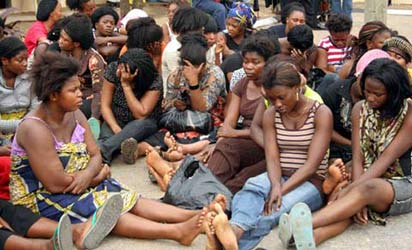
*Some trafficked girls… hiding their faces out of shame
By Nnamdi Ojiego
ALTHOUGH slave trade was abolished decades ago, from indications, the practice seems to remain with us. Human trafficking is a modern form of slavery that involves displacing a person for the purpose of exploitation. This modern day slavery comes in many guises such as forced prostitution, forced labour, child labour, among others.
Human trafficking has become so entrenched in Nigeria and has taken such dimensions that the nation has been dubbed an endemic country in the trafficking of human beings.

*Some trafficked girls... hiding their faces out of shame
According to Trafficking in Persons Reports 2011, by the Office To Monitor and Combat Trafficking in Persons, US Department of State, “Nigeria is a source, transit, and destination country for women and children subjected to forced labor and sex trafficking.”
The reports said trafficked Nigerian women and children are recruited from rural, and to a lesser extent urban areas within the country’s borders. “Women and girls for domestic servitude and sex trafficking, and boys for forced labor in street vending, domestic servitude, mining, stone quarries, agriculture, and begging.
“Nigerian women and children are taken from Nigeria to other West and Central African countries, including Gabon, Cameroon, Ghana, Chad, Benin, Togo, Niger, Burkina Faso, as well as South Africa, and other parts of the world for the same purposes.”
This ugly trend forced the Federal Government to enact the Trafficking in Persons (Prohibition) Law Enforcement and Administration Act, 2003, which also created the National Agency for the Prohibition of Trafficking in Persons and Other Related Matters, NAPTIP.
Since its establishment, NAPTIP, in collaboration with other law enforcement agencies, international agencies, the Italian and Belgian governments, have been working towards reducing the incidence of this illicit phenomenon.
According to NAPTIP, an estimated 4.5 million persons are trafficked internationally, while about 10,000 are trafficked from Nigeria annually. A UNICEF report on the phenomenon revealed that four per cent of repatriated victims of international trafficking in Nigeria are children. The female/male ratio is seven to three.
NAPTIP said it has been difficult obtaining accurate statistics on the trafficking situation in Africa because of the nature of the illicit trade – those involved in the illegal occupation conduct it in a seemingly decent manner and ease that their victims do not suspect any foul play.
They get the support of family members of their victims under the pretext that they aimed to upgrade the financial status of such impoverished homes. Often times, the act is perpetrated by someone known to the victims or their families.
The pioneer Executive Secretary of the agency, Mrs. Caroline Ndaguba, said the inadequate statistics illustrate the magnitude of human trafficking in Nigeria and efforts that need to be made to combat it. According to her, NAPTIP’s interventions have been in prosecuting traffickers, rehabilitating victims, collaborating with nations and agencies to fight the scourge and generally creating awareness in the public about the menace.
It is in the light of this, and to complement the efforts of NAPTIP, that Religious Sisters of Charity, a non-governmental but a religious organisation working for the abolition of human trafficking, has decided to take the campaign to schools. This time, to Loral International Schools, Festac Campus, Lagos.
The coordinator of the organisation, Sister Justina Nelson, was invited by the management of Loral Schools to speak on human trafficking and its implications, during the induction of new students.
Nelson explained that the aim of going to schools was to create awareness and sensitize school children about the dangers of such evil acts and the antics of supposedly benefactors who come in various guises to deceive them and their parents in order to take them away. “When we educate the children about human trafficking, it is expected that they will share their knowledge with the members of their families, friends and so on”, she stated.
According to her, “every ten minutes, a woman or child is trafficked in and out of Nigeria for prostitution or child labour. Many children are trafficked locally and enslaved in various homes.This is a very profitable industry. It is the second largest criminal industry in the world”. Nelson called on parents to beware of those who promise them heaven and earth just to take their wards away to exploit them.
Earlier in her speech, the Headmistress, Primary, Mrs Elendu, said the school management has provided adequate learning environment for ideal teaching and learning, and encouraged the students to afford themselves of the opportunity and take their studies seriously.
Disclaimer
Comments expressed here do not reflect the opinions of Vanguard newspapers or any employee thereof.