
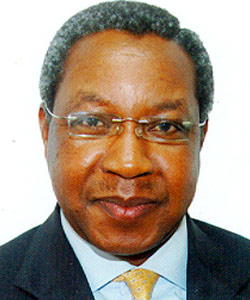
*Mr.Olorunsola
SINCE 2009, the one of the major occurrence that has become almost a recurring development in the Petroleum Sector is change in leadership. As the new helmsman Department of Petroleum Resources, DPR; Mr. Augustine Olorunsola prepares for his role as an industry regulator, Clara Nwachukwu writes that the challenges are many, as industry operators spell out their expectations to set agenda for him.
Analysts also expressed the hope that Olorunshola’s stay will be long enough for him to add value to the regulatory agency, as the frequent changes in units heads since President Goodluck Ebele Jonthan’s administration, have become anti-progressive for those concerned – the Nigerian National petroleum Corporation, NNPC and its subsidiaries; the Department of Petroleum Resources, DPR; the Petroleum Pricing Regulatory Agency, PPPRA, and a host of others.

*Mr.Olorunsola
In particular, the NNPC has had five Group Managing Directors, with the incumbent, Mr. Austin Oniwon, being the third since 2010. But he also became lucky to get service elongation, after the expiration of his retirement in April last year. But the reverse is the case with DPR and PPPRA, which have regulatory roles over the industry. The two agencies have also witnessed three leaderships respectively, since 2009.
Continuity and policy stability
Such developments are at variance with the administration’s claim of continuity and policy stability, on which platform the majority of the serving ministers were returned to their ministries.
Worse still, there are usually no explanations given for the removals, and more often than not, when demanded, explanations offered are usually not satisfactory enough.
For instance, in the removals of the former Director of DPR, Mr. Andrew Obaje, and the former Executive Secretary, PPPRA, Mr. Goody Chike Egbuji, on November 15, no particular reasons were offered by Presidential aide, Dr. Reuben Abati, who announced their immediate replacements in a statement.
But the NNPC spokesman, Dr. Levi Ajuonuma, who also doubles as spokesman for the Ministry of Petroleum Resources, told Vanguard in a telephone interview that “they were retired.” While this may be plausible in the case Agbaje, the same could not be said of Egbuji.
DPR on the spot
The DPR has had a chequered history in Nigeria, and until the setting up of the PPPRA, the Department was in charge of all regulatory, monitoring, operational and commercial frameworks that governed operations in both the upstream and downstream oil and gas sectors.
Its functions include supervising all petroleum industry operations, issuing of licences, permits and leases as well enforcing safety and environmental regulations. Others are:
• Keeping and updating records on petroleum industry operations, particularly on matters relating to petroleum reserves, production and exports of crude oil, gas and condensate
• Advising Government and relevant Agencies on technical matters and policies which may have impact on the administration and control of petroleum.
• Ensuring timely and adequate payments of all rents and royalties as at when due and a host of others.
But upon the advent of the PPPRA in 2003, some of the DPR’s commercial functions in the downstream were ceded to the former, to “monitor and regulate the supply and distribution, and determine the prices of petroleum products in Nigeria.”
Going back, the present day DPR as posted on the agency’s website took off as a Hydrocarbon Section of the Ministry of Lagos Affairs in the early 50s. It is the first statutory agency set up to supervise and regulate the petroleum industry in the country.
Since then, the department has served under several other ministries, including, the then Ministry of Mines and Power as a Petroleum Division in 1970. But it earned its current status as DPR In 1971, under the then Nigerian National Oil Corporation, NNOC, or present day NNPC.
Again, it was conscripted into the Ministry of Petroleum Resources in 1975. It continued to play its roles even on the merger of the Ministry and NNPC in 1977, until their subsequent separation in 1985, when it became the Petroleum Inspectorate, under the NNPC , where it remained until its commercialisation in1988, after which it was sent back to the Ministry, and has remained there ever since.
Against this backdrop, industry analysts believe that these flip sides of the DPR have impacted on its operations over the years, seeing as it has always operated under one unit or another.
It never had the much desired it required to execute its roles efficiently and effectively; and correspondingly, it never also had the financial independence to fund such operations. However, these are among the issues that the Petroleum Industry Bill, PIB, is expected to resolve after it becomes a law.
Industry expectations
Professionalism, effective and efficient industry monitoring, respect for agreements, strengthening of human capacity, support for operators, and a host of others, are some of the major operators’ expectations from Olorunsola.
Commercial gas and power business
A statement from the Public Affairs Unit of the DPR, said, Olorunsola was before this appointment, the Vice President, Shell Upstream International Commercial Gas and Power Businesses for Sub-Sahara Africa.
Some operators, who spoke to Vanguard on the telephone, said it was high time the regulator earned its pride of place by not compromising or shirking its responsibilities.
The Managing Director/Chief Executive, International Energy Services, Dr. Diran Fawibe, one of the pioneers of indigenous service operations, charged the new helmsman to “transform the agency to be more effective in the discharge of its functions.”
He noted that since Olorunsola’s responsibilities cuts across both the upstream sector, and the downstream, which interfaces with the public, he “should work closely with the operators to ensure that global best practice and good housekeeping in order to meet the needs of stakeholders promptly, as delays hold up activities,” which affect the well being and economic activities.
Accordingly, upstream operators, also want the new DPR boss to “fast track decision making for enhanced industry operations.”
The President-elect, Nigerian Association of Petroleum Explorationists, Mr. Afe Mayowa, however, expressed the association’s confidence in the man because of his decades of private practice.
According to Mayowa, “The Olorunsola we know is a sound professional and will bring this into play at DPR. He is very efficient, very detailed and well-respected in the industry.”
But he equally expected him to “continue in the line of probity, transparency, accountability and respect for agreements because Nigeria is reputed for not respecting agreements.”
Downstream operators also tasked him to play the game according to laid down rules. The spokesman for the Independent Petroleum Marketers Association of Nigeria, IPMAN, Mr. Mike said downstream players expected “a high level of cooperation between the regulator and the operators.”
He urged Olorunshogo to bring his wealth of experience from Shell to bear by “adding value to the reform process for the benefit of all.”
In particular, some operators expressed the hope that “he will not be messed up like all the others, especially as he is the third man on that seat since the present minister came into power.”
Others argued that he should use his relationship with the minster as ex-Shell staff, “to strengthen the man power resources because if he is to perform his job effectively, he needs well-trained staff, and in the right number too and not one person doing the work of three.”
This group further argued that he could maximize the relationship by getting the much needed funds to facilitate the works of the DPR to “procure facilities and logistics to effectively monitor the industry. It is a shame that the regulator depend on the operators for the basic tools it needs for monitoring, how can you be effective under such circumstances?” they wonder.
“Let him use his relationship with the minister to get quick approvals for the department budgets,” they added.
However, some other operators are a bit sceptical about the Shell relationship, saying, “The minister is an ex-Shell, the regulator is an ex-Shell, and many other units too in the ministry re ex-Shells, we hope they don’t shell the industry.”
This group’s scepticism might have been derived from the WikiLeaks cables revelations of last December on, “Shell’s grip on Nigerian state revealed,” as carried in The Guardian of UK on December 8, 2010.
Anglo Dutch Shell claimed “it had inserted staff into all the main ministries of the Nigerian government, giving it access to politicians’ every move in the oil-rich Niger Delta,” according to a leaked US diplomatic cable.
The report also added that the company’s top executive in Nigeria told US diplomats that Shell had seconded employees to every relevant department and so knew “everything that was being done in those ministries.” But Shell never denied or confirmed any of the Wikileaks reports.
The man Olorunshogo
He was also a former Strategic Business Adviser to a former Minister of State for Petroleum, Odein Ajumogobia (2008 – 2009), where he created and led a think tank that supported the development of holistic, integrated strategies and polices for effectively managing the Nigerian oil and gas sector.
Olorunsola, a 1979 Geology graduate from the University of Ilorin, Kwara State, started his career in the 1980’s with Agip-ENI as a Reservoir and Petrophysical Engineer, and later as Production Geologist both locally and internationally.
In the mid 1990’s, he moved over to Shell and served in different capacities where he handled various assignments in Lagos, Port-Harcourt and the Netherlands, covering a wide spectrum of exploration and production, E&P businesses.
Specifically, he was involved in Planning and Economics, Joint Venture Management, Petroleum and Development Engineering, Business Interface Management and more recently setting up Shell’s Opportunity Delivery Centre in Nigeria, a dedicated integrated studies group with the core responsibility for hydrocarbon maturation, an industry first in Sub-Sahara Africa.
Olorunsola, whose experience in the oil industry spans over 31 years is happily married with three children and he is a prolific tennis player who has won many laurels in the Nigerian Oil and Gas Industry.
Disclaimer
Comments expressed here do not reflect the opinions of Vanguard newspapers or any employee thereof.