
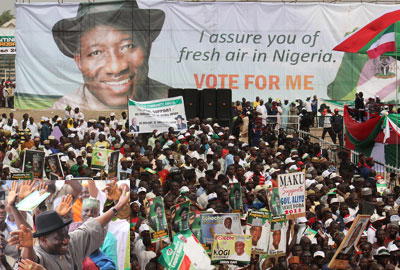
A cross section of supporters during the flag-off ceremony of President Goodluck Jonathan’s Presidential Bid at the Lafia Township Stadium, Lafia Nassarawa State. Photo by Abayomi Adeshida
By Ochereome Nnanna
PRESIDENT Goodluck Jonathan seems dead serious about reforming our body politic. Less than six months after he was sworn in as elected president, he has made a second attempt to show this.
The first time was in July 2011, barely two months in the saddle. He flew his kite about a pending proposal for a six-year single tenure for presidents and governors (which he later adjusted to seven years). Many people were outraged that with daunting economic problems and a resurgent Boko Haram terrorism staring him and the nation in the face, he was floating an idea that some suspected was a tenure elongation bid.
Last week Thursday, November 20, 2011, he named a 21-member Presidential Committee on the Review of Outstanding Constitutional Issues (PCRCOCI), with retired Chief Justice of Nigeria, Salihu Alfa Belgore as the Chairman.
I can comfortably describe this assortment of individuals as “moderates”, as I could not see anyone from the extreme right (or conservative wing in the mould of Professor Jibril Aminu or Alhaji Mahmood Attah) or extreme left (or radical reminiscent of Asari Dokubo or Ralph Uwazuruike). Suffice it to say that most of them (except, perhaps, Ledum Mitee) have either been in government or are “highly exposed persons” (apologies Farida Waziri) to the workings of government, especially at the federal level.
The President charged them to look into the areas where consensus had been reached in the past through constitutional conferences and the various panels and come up with draft constitutional bills that the Executive will submit to the National Assembly for deliberation. They are not to dabble into areas that have not been agreed. That aspect will come later, when the group is enlarged to bring in “probably some ethnic nationalities, some opinion leaders, some cultural groups to represent their interests”.
Did you notice the inclusion of “ethnic nationalities”?. That was the first time a Nigerian president or head of state would use the term: “ethnic nationalities” as part of groups that would discuss Nigeria’s constitutional issues since the military intervened in our politics in 1966.
That has been an agitation of the Awoists or the “True Federalists”, from which federal governments (including those led by General Olusegun Obasanjo) had distanced themselves as if the idea is poisonous. To them, true federalism is a euphemism for national disintegration! Does it mean that GEJ is actually promising Nigerians that representatives of ethnic nationalities will be part of the delegates to a future constitutional talks which he will empanel to discuss the yet-to-be-settled issues of our nationhood? Or did he use the term glibly or loosely? Time will tell.
But one thing we can go home with from GEJ is that there will be a conference that will discuss issues which, under the rule of the military and their sectional sponsors and supporters were regarded as taboo.
I agree with GEJ that empanelling a constitutional conference at this time will be foolish. Thank God for kites. The kite he flew earlier and received a scorching has taught him a lesson that it is foolhardy to dabble into major political reforms when the nation is plagued with Boko Haram terror and is poised on knife edge over plans to remove petroleum subsidy.
Islamic terrorism
These two problems have to be resolved first before a political conference that could determine the new shape of our body politic can safely take place. Right now, the growing threat of foreign-induced Islamic terrorism in the north with tacit support or toleration by the section of the northern political establishment disgruntled by their loss of power is stoking the embers of sectional suspicion and uncertainty as to what might happen next. One hopes and prays that the Justice Belgore Committee will be able to achieve much under the prevailing circumstances.
Left to me, the Committee does not need to go back to proceeds of the conferences that produced the 1979 Constitution, the 1989 aborted Constitution and the 1995 Abacha draft Constitution. It has been drummed on the rooftops that after twelve years of the end of military rule Nigeria is ripe for a constitution democratically drawn by the people reflecting the true wishes and aspirations of the nation.
In this regard, the recommendations of the National Political Reform Conference set up by former President Olusegun Obasanjo (minus the tenure elongation clause) should form the major focus of Belgore Committee’s work. It was the closest we went to agreeing as a nation on a firm set of issues to correct the many anomalies in the system.
It will be interesting to see in which direction GEJ wants to take Nigeria through constitutional reforms. We have not seen any ideological or philosophical compass. We are only seeing a yearning, though we are left to guess at the motive behind it.
I wish us all good luck.
Re: Create regions, abolish states
MY two-part serial on the above topic drew a lot of interesting responses. Since we are exploring the ways of working out a more functional political system, I’d like to reproduce two of these ideas from our readers for your evaluation. Excerpts from our online edition:
NNANNA, your suggestions are excellent. In fact, I had advocated the abolition of the states more than twenty years ago when a group of people were appointed to go round the country to collect and synthesize suggestions on a new constitution. We had fewer states then.
Now we have more states, more entrenched vested interests, more sinecures, more looting centres, and mindlessly ballooning recurrent expenditures in the insolvent states. The problem is that your very good suggestion will be opposed tooth and nail by the beneficiaries of the current system. Do we have enough patriotic and selfless people in the Senate, the House and the State Houses who will support excellent measures that can legislate them out of relevance? I doubt it.
See the amount of furore being heaped on Jonathan’s proposal for single tenure for office holders. Nigeria cannot produce a patriotic benevolent dictator in the mould of Ataturk or De Gaulle or even Rawlings to impose a good constitution on us. See how Murtala ended up. And revolutions, even the North African type, don’t assure good constitutions or good governance.
Chances are that Nnanna’s excellent suggestions will be ignored (like mine) by the beneficiaries of the current system and we go on wobbling until literally the “centre can no longer hold” and the edifice either quietly submerges under its contradictions or blows up in a violent cataclysm. This is not my wish but I see it coming.
Certainly citizens of the United States are happier than the citizens of 20 or so banana republics south of the border. Thousands of Mexicans risking everything to cross into US are a testimony to the fact that a well-governed large country is better than a hundred unstable, unviable Bokassa type empires. My prayer is that Nigeria does not go the South American way. But prayers are not enough. People who control the levers of power and decision-making must be patriotic and see beyond their pockets and personal comforts. EMEKA
Good talk gentle men. However, there is one vital aspect which our political class has failed to realise and appreciate. The fact is that Nigeria is a conglomerate of nations like Igbo, Ijaw, Hausa/Fulani, Kanuri, Tiv, Oduduwa and other small ones.
During the Amalgamation of these Nations in1914 by the British, there was no primary understanding how they would remain under one umbrella. Up till today when the President of USA, is addressing the Americans, he calls it: “The State of The Union” because there was that primary understanding of the Union. The States in US are like sovereign entities.
There is no area of this country which is not rich in resources. Therefore the former regional structure is still preferable. Our unity is still a camouflage after fifty one years of independence. Or how do we explain the meeting of Northern Governors or Eastern Governors and so on? You don’t hear of this in US or anywhere for that matter. It is simply because nobody wants to lose his/her identity, an indication we are not one.
The constitution should reflect this. In 2009, an NYSC lady from the south was raped in the open street and killed in Maiduguri not by accident but because she wore a dress which was not compatible with their custom.
Some areas are desperate for Western education, as opposed to certain areas. In fact, some areas have been carrying the burden of the unity more than others over the years. The amendment to the existing constitution is not the solution but the states (better still, regions) should be sovereign while the Federal Government should attend to common factors like military, external affairs etc.
A situation where some people lost their lives and properties just because they were in alcohol business and VAT from alcohol is for everybody cannot foster the desired unity. NUELSYMBOL
Disclaimer
Comments expressed here do not reflect the opinions of Vanguard newspapers or any employee thereof.