
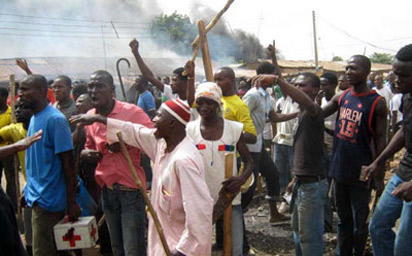
File photo: Protesters during the post-election riots in Kaduna
By Rotimi Ajayi
Since Nigeria gained independence as a sovereign state and started the democratic journey through conduct of elections, the April 2011 elections may, for some time, perhaps forever, be the most bloody in the country. The post-election violence that erupted in parts of the country left very ugly taste in the mouth especially in Kaduna State. The violence prompted the Federal Government to inaugurate a panel that would examine the causes.
The Ahmed Lemu-led Panel must have recognized the significance of the assignment given it on May 11, 2011 by President Goodluck Jonathan and worked within the stipulated time to submit its findings so that the Federal Government could move into mitigation measures. At the submission of the report of the panel in Abuja on October 10,2011, the panel identified public frustration and lack of confidence in the polity as the major factors that triggered the post-election violence. It warned that unless governments move quickly to remove causes of frustration among citizens, Nigeria may witness untold catastrophes in the near future.
Given the scale of the post-election violence, the Federal Government, through its Institute For Peace and Conflict Resolution (IPCR) based in Abuja, sought a paradigm shift in conflict and peace management in Nigeria. Working with a team of experts with experience in conflict management, the IPCR came up with a novel idea of community development dialogue programme. With the support of the Department for International Development (DFID), a UK-development assistance agency, the IPCR moved into the theatre of the post-election violence recently and mobilized the communities not to engage in abstract talks about peace but to dialogue about peace through community development.
According to one of the experts that conducted the community dialogue programme, Dr Lanre Adebayo, “the project is primarily aimed at addressing the challenges faced by communities as a result of the recent post-election violence in the country and to establish an inclusive community structure that will promote cooperation, collaboration and mutual support and a focus on joint solution to common community problems.
The community dialogue programme, which could otherwise be called Community Governance Model actually aimed at tapping the traditional strength brotherliness that bonded Nigeria Communities together in the years past. Tapping at this existential value of unity among Nigeria communities in the past must have informed the coming on board of the DFID. By its structuring, the community dialogue programme will provide lasting platform for intra-community peace as the project addresses the problem of economic, political and social exclusion which the Lemu-Panel warned as the tinderbox that must be diffused to avert catastrophe.
An important feature of the project is the Community Action Plan (CAP) which enables each community to collectively identify its needs, prioritize projects to solve problems as well as mobilize funds for project execution. This may actually trigger flurry activities on the part of the donor agencies in Nigeria and change the path of development assistance and funding in Nigeria as funds may now be channeled directly to the communities on the basis of their needs projects rather than through the government machinery which often mis-appropriate the donated funds.
This community projects are to be put together through the established Community Development Associations (CDAs). This would enable the communities to buy directly into the development of their places. This is a new paradigm in peace building through re-channeling community energies into problem solving and mutual dependence.
Addressing the opening of the conference of the communities at the Arewa House, Kaduna State Governor Patrick Ibrahim Yakowa harped on the novelty of the dialogue programme.
An immediate achievement of the dialogue programme, which was implemented in Zaria, Kaduna, Jema’a and Zangon Kataf, was the signing of social charters by the community Development Associations, which were saddled with developing Community Action Plans (CAPs) for local development. The development of the Action Plans would be aided technically by the project with a promise to assist towards the implementation of at least one priority activity.
The idea of national development using bottom-up approach, which is what the new peace building mechanism of the IPCR revolves around, may need to be marketed across the country by a critical body such as the National Orientation Agency (NOA) and the state governments in order to create a healthy environment that would bring about the virtue of serving the communities by political office holders.
Disclaimer
Comments expressed here do not reflect the opinions of Vanguard newspapers or any employee thereof.