
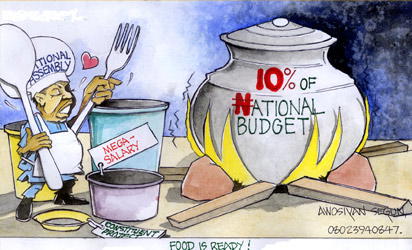
By Inalegwu Shaibu
ABUJA— Director General of Bureau of Public Procurement, Engr. Emeka Eze has raised fresh concern over the 2012 budget saying it may fail due to the infiltration of the budget with projects that have no designs, just as Chairman of the Senate Committee on Federal Character and inter-governmental Affairs, Senator Dahiru Kuta disclosed that Nigeria loses about N3 trillion to corruption in public offices carried out through ghost workers.
The Federal Government had at an extra-ordinary meeting in Abuja approved the 2012 budget framework based on $75 per barrel oil price.
At a meeting presided over by President Goodluck Jonathan, the budget expected to be submitted to the National Assembly for consideration any time from now, is aimed at completing the about 6000 federal government projects across the country. The budget would lay emphasis on security, power, works, agriculture, housing, education, health, and other flagship projects.
The projection for the country’s crude oil production for 2012 is put at 2.4 million barrels per day and this is expected to increase to 2.6 million barrels by 2015. No sooner was the budget framework approved than the government informed the National Assembly of its intention to reduce the benchmark which it initially fixed for $75 per barrel of crude oil in the 2012 appropriation Bill to $70 per barrel to enable it generate enough fund to finance the budget.
While speaking during an interactive session with members of the House Committee on Finance, the Minister of State, Finance, Alhaji Yerima Lawal Ngama Ngama, said that the 2012 Budget was before premised on $75 per barrel of crude oil, but was pruned down to $70 per barrel, while the Exchange rate was fixed at $1 to N153.
The Central Bank has also indicated its intention to devalue the naira by adjusting its exchange rate from the present N150 to the dollar to between N155 to N156. These developments have cast a cloud of uncertainty in the making of the 2012 budget.
Eze raised the new concern while briefing the Senate Committee on Federal Character and inter-governmental Affairs during an oversight tour of the agency. He feared that the inflation of the budget which has been the trend over the years may yet again lead to poor implementation of the 2012 budget when eventually passed by the National Assembly, adding that projects are being rushed into the 2012 budget without studies and designs.
According to him, “We also noticed that most a times, projects are rushed into budgets without necessary studies and designs. As we are about to prepare 2012 budget, a lot of people want to add projects into the budget.
“We have realized that since the time of Shehu Shagari, once you take a decision and you award a contract without design, two things will happen, either the project will not be done, or if it is going to be done, it will require endless augmentations, because you have not had enough time to study and do designs.
“In some cases, a project will last four years. We have to tie money for it in appropriation.”
, and then what happens when you do that is that even the contractor cannot perform as to warrant the payment of unpaid money and there is no way the ministry can pay for a job not done and then people say budget performance is low. Budget performance cannot be high when a contractor has not raised enough interim certificates for you to pay him.”
Eze also alleged widespread corruption in the contract process, admitting that the Bureau lack the capacity to deal with fraudulent contractors.
His said, “We have small publication called chain of corruption; this chain of corruption can start from any point, starting from the day the project is conceived. A corruption can start from that point where a contractor influences a project and get it admitted instead of the agencies determining what needs to be done, and when that happens, the consultants over design to suit the technology of the contractors, making it impossible for other contractors to bid because the technology belongs to one particular person. I want to bring this to your notice so that you will not approve it.
“Then during procurement process, the consultant that are engaged will manipulate the process to suit that contractor they have chosen from day one and then during execution, everybody is happy, the contractor, the consultants, but one person is losing, our country, because budget are inflated nobody can talk, the contractor does anyhow because the contractor has settled everybody. That is a chain that I want the members of the national assembly to break.”
While responding, Chairman of the Committee, Senator Dahiru Kuta disclosed Nigeria losses about N3 trillion to corruption in public offices carried out through ghost workers, falsification documents and inflation of contract sums, and other sharp practices.
He lamented that the nation’s corruption index is on the rise because of widespread corruption in the civil service, adding that the National Assembly will provide the legal framework to tackle public corruption.
Disclaimer
Comments expressed here do not reflect the opinions of Vanguard newspapers or any employee thereof.