
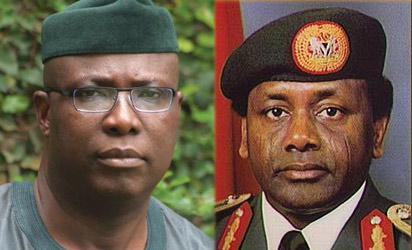
By Bashir Adefaka
Senator Babafemi Ojudu, Vice Chairman Senate Committee on Public Service and Establishment, represents Ekiti Central Senatorial District in the Nigerian Senate. in this interview with Vanguard, he disclosed that his brand of politics will continue to be people oriented. Ojodu also spoke on other national issues. Excerpts:
Let’s start by looking at your person. From what background is Senator Femi Ojudu coming?
Oh, let me tell you that I always don’t like to talk about myself being that there are a lot of problems on our hands, than for me to be dwelling on my personality. I will answer and I will not shy away from telling you about myself.
I come from a very humble background. I was born in Ekiti here, in Ado-Ekiti precisely to a humble parenthood; a trader mother and a father who was a bricklayer and I grew up like every other local person in the city of Ado-Ekiti here. I attended a public primary school and public secondary school before I went to the university, first the University of Ife and later University of Lagos.

Senator Ojudu and Late Abacha
As a seasoned journalist, would you say journalism was what you set out in life to become?
Well, I came to journalism by accident. Of course in spite of the fact that my father was not educated, when I was in primary five and he was coming home, he used to buy Daily Times for me to read.
Then he had a friend who was a bank director and when he went to see his friend in Lagos he would come back with bulk of Financial Times, the pink looking newspaper then, which became an attraction for me and I kept on trying to figure out what was written in them and all that.
Then when I got to Ado Grammar School, I was little rascally and I was about the youngest person in my class because there were guys who were older than me and I used to draw their caricature on the black board in the afternoon and they would run at me and beat me up.
You know, many times leading to commotion and I make jest of their big heads, their ears or their big mouths. I think it became problematic because they would beat me, I would still continue to do those things and the principal called me one day and said, “I know what to do for you.
It seems you have a lot of time on your hands, that’s why you keep making troubles with your classmates. I will buy you a transistor radio: every morning you should wake up five o’clock, listen to VOA, BBC and put down all of the news you picked from those broadcasting stations and past it on the notice board.” And that was class three.
So I started doing that. What they thought they were doing for me was punishment but I fell in love with it; there and then, I made up my mind and said that I was going to become a journalist. When I came out of secondary school my father insisted that I should go and study law but I told him that I wanted to become a journalist. Going back a little bit, the moment I started doing that, I started reading more newspapers and I began to contribute to the letters pages of Tribune and Sketch. When that was published, people would call my father’s attention to it and he would cut it and brought it to me in the school. So I always felt excited that I was contributing something in the newspapers and that furthered my interest.
When I came out of secondary school and he talked of my becoming a lawyer I said I was going to become a journalist. He said, “I don’t know the processes of someone can become a journalist,” and he took me to one of the topmost men in Ado-Ekiti then, Chief Anisulowo, and asked the man to advise me to change my mind from becoming a journalist to becoming a lawyer. And I told him outrightly that look, “I have made up my mind to become a journalist” and the man said, “well, I don’t know the process of how to become a journalist but I have people who are seasoned lawyers that I can send you to, who can advise you properly.”
I worked briefly before I sat for my JAMB and I later went to Ife to study English. When I got to Ife, the first club I joined there was the Association of Campus Journalists and I got myself attached to Cobra; it was a vibrant news organ on the campus at that time. And I was a reporter for Cobra for one year and in my second year, I always want to pioneer things, I called a few of my friends and said, “Gentlemen, let’s start something of our own. This doesn’t have to be the only paper on the campus.” They agreed with me and we set up what then we called Parrot. I think it’s still in existence. I became the editor-in-chief of the Parrot.
I didn’t stop at that, you know, I now started writing opinion article for The Guardian and sometimes I sent to Punch. Each time they published me I used to be excited and they used to pay me N22 or N25 for writing opinion article in Guardian. When I finished in Ife I was posted (as a youth corper) to Ibadan to serve at the Publication Unit, Faculty of Education of the University of Ibadan. While there I continued to write for The Guardian’s opinion page and so when I completed my NYSC, it was easy for me to go there (Guardian) to apply as a reporter and I was immediately hired as a reporter and I worked there briefly maybe for one or more years before I went to Concord Group of Newspapers.
In the days of gorilla journalism, how did you manage to escape the onslaught of General Sani Abacha military regime?
It was a very terrible period. I had to tell you that I actually didn’t escape but I can also say that well I escaped because I lost a colleague to that struggle during the cause of that regime. But I can also tell you that between 1993 and 1998 I was arrested for about 15 times: a day in police cell, two days, one week and the longest period was nine months, which I spent right in the middle of policemen. And I was not released until after Abacha died. So, really, I didn’t escape but then, we were able to manage to survive that military regime.
BOLD is your personal initiative.
Yes. It is.
Can we know about this initiative?
Let me say that one of my major concerns has been how do we begin to nurture a new generation of leaders for this state (Ekiti)? One thing that we lack here is a crop of leadership over the years, leaders that could take us to the height or where to be proud of. And the more I look at it the more critical I believe that the problem becomes.
You know, politics is about service to the people. It’s not about festering one’s own nest or that kind of thing. You could see that since 1999 we have had leadership challenge in Ekiti State to the extent that it got too bad; we had someone here who did not possess any qualification for leadership and that led to a lot of problems: assassinations, murders, abuses, tampering on people’s rights and all of that until Dr. Fayemi took up the challenge and took us to where we are now.
In spite of the fact that we could say now that we have the right type of leadership, but what happens in the future? How can we ensure that what happened in the past does not repeat itself? That question motivated me to say okay let me start this initiative for the development of the leadership of tomorrow and that is why we called it, “Initiative of Babafemi Ojudu for Leadership Development (iBOLD).
You know, let’s begin to nurture young people from the schools and gradually pick them from the point whereby they can be able to represent us well at the local level, at the state level, at the national level and even at the point of representing us so well at the private sector so that they can use their experience and come back home to develop the wealth of the state.
How do you intend to achieve this?
I said okay let’s start it in a little way. Let’s get young people from the tertiary institutions to come out and write essays. I mean there was time in history where people were asked to write J.K. Kennedy essay competitions. We’ll ask them to write essays and get the best among them and we begin to nurture them.
I’m going to be Senator for only four years, by the grace of God, in the four years, if we are able to select 20 persons annually, who have a good idea of what leadership means and how the state could be developed, that in four years will be a collection of 80 young people from across the state and we begin to nurture them, take them around with you, get them to attend functions, organize seminars for them on leadership. We may be lucky that in the next 10, 15 years, those 80 will find themselves in positions of authority and, having been well equipped, they will be able to use what they have learnt to manage the positions they will have found themselves. That simply is the idea for bringing about iBOLD.
What happens to iBOLD after your four years term as a Senator?
I don’t have intention to stop it even after my term as Senator. I want it to outlive me and that is exactly what I’m doing. I will go ahead to maintain it so that we can be able to mentor people who can offer to become President of this country in future, people who can offer to become ambassadors, to become senators, to become the governor of the state and they, in turn, will mentor people who are coming behind them.
That is the way society can be developed. You don’t just allow people to be on their own leaderless or so, without people to look up to, without role models. Frankly, if I’m able to do this thing, I will have succeeded in doing something for my community.
When is this programme taking off?
The first one is taking off in November. Already some people have put in their entries and we are processing those entries and hopefully by November, as I said, we will be able to stage a function whereby we will give this awards; cash awards, laptops to assist them in doing their works, in conducting their researches and linking up with the rest of the world.
It is said that politicians say a lot of things during election campaign only to be elusive among their people immediately after they have won election. How visible have you been in your community since your election victory?
I make sure I come here virtually every weekend, if not, maybe every two weeks, to link up with the community, to link up with the constituency and to get to know what the problems are in order to proffer solutions. And like what you said about politicians, we are strictly following up our electioneering promises.
I will not be one that make promises and will not fulfill them. I remember that when I appointed 57 coordinators for the 57 wards in Ekiti State, I told them, particularly some of them who are in rural areas, that, “for those of you who have to move from one place to another and who need the means of transportation, I will provide you with motorcycles.”
Among them are teachers and students. So, when I won election and I assumed duty at the Senate, even before I was paid my constituency allowance, I made sure that I fulfill that promise by buying them all, the motorcycles that I promised them. I bought all my 57 coordinators 57 motorcycles for easy movement from one point to the other. Also there young men and women in the rural areas who are engaged in their different vocations and those I think I have been to assist in their works.
I promised the women that I was going to help in trying to finance their trade. There are women here in Ekiti that could not find five thousand, ten thousand naira to conduct their trading activities. They are vegetable sellers, …sellers, fish sellers in the market.
They survive on that, they train their children on that but they don’t sufficient capital to support their trading.
So what we have done is that, we have consulted a finance company to look for a design for giving out this money to them in a way that we can be sure that they are going to use it for exactly the purpose of improving their trades.
We are organizing them into a kind of cooperative that in each of the wards, give us 10 women per ward; we are going to train them, we are going to finance them using this finance company to give them collectively an amount of money.
We want to say okay we are ten and we give them the money, go and trade with the money, you return the money in form of a revolving loan so that other people can be able to access the fund. The trade is going to be managed by the women themselves and the finance company will only ….in all the wards.
Also I promised that I was going to have an office in each of the Local Government headquarters and we have 16 Local Governments in Ekiti State and we’ve been able to commence the process of having offices in those so that people in these various communities will be able to know where to reach me. They will go there and submit letters of protest about what is wrong in their communities, those who are unemployed will be able to go there and drop their CVs, pensioners who have not gotten their pensions will have a place to go and complain, if they want to meet me we have a meeting venue and so on.
There are several other things. We are going to organize town hall meetings where I’m going to be telling them, “These are my plans, this is what I want to do, what are your feelings? What are your complains and so and so forth?”
I’m also tinkering with an idea of having a pilot agricultural project. I’ve written a proposal, which I have given to a friend of mine who is working with Agricultural Development Bank. He will take a professional look at it and see what we can bring out it, whereby we set up ….for our people. Take them outside the municipality unto a virgin land, build a farm centre for them, let them live in the farm, get some modern implements for them and let’s see if that will attract them to the farm and then begin to act as an e.ample to others.
I’m still working on that, I believe that it is doable and I believe that before I complete my four years in the Senate I should be able to have something close to that.
You are known to have set up a centre for women development. How did you come about that and how far have you gone with it?
Right in front of my house there I’m setting up a project to be named after my mum, “Raliat Ojudu Women Development Centre”. We have trustees whose chairman is Professor (Mrs.) Dupe Adelabu, an educationist of the Obafemi Awolowo University, Ile-Ife.
The idea is that, women in this state are very resourceful and highly industrious. They labour very hard in taking good care of their children, sponsoring them and taking care of their husbands. Even when their husbands do not have they don’t give up; they keep sponsoring the children.
Many of my generation were sponsored by their mothers. You know, rather than become helpers to the husbands the husbands became helpers to the women.
For me, I have observed that and I see it is something commendable and we must begin to immortalize that attitude in our women. That is why I’m setting of women development centre where we can train our women and educate them by providing adult education and providing some opportunities to support them in conducting their trading.
My mother used to trade in garri and some little things and I could see that, that little took me to where I am today and I believe that if we encourage more women in what they do, the society is going to be better for it.
There is another thing which I’m also working on.
I intend to acquire a mobile clinic and provide it with a vehicle to enable them to reach out to the villages and so on and with maybe two or three nurses that can conduct scan for pregnant women who cannot come to the clinic in the city.
They can conduct scan for them to determine whether they have problems or not and if any of them has problem, she can be brought to Ado-Ekiti or wherever we have bigger hospitals for further medical attention. A lot of my friends abroad are also helping in developing this.
These are the kind of things I’m planning to do and I hope if I’m able to achieve even just 70 per cent of all this, I will be satisfied.
Disclaimer
Comments expressed here do not reflect the opinions of Vanguard newspapers or any employee thereof.