
• There is the need to seek medical advice and counseling in the event of an episode of convulsion.
BY SOLA OGUNDIPE
Convulsion is a medical condition in which a person’s body appears to shake in an uncontrollable manner. A person with seizures or epilepsy may experience convulsions and when this happens, the muscles quickly contract and relax repeatedly, causing the appearance of rapid shaking movements.
An episode of convulsion is often a scary and unpleasant experience, but contrary to a common myth that convulsion is contagious, medical experts have explained that it is neither contagious nor caused by witches or wizards as it is believed in certain circles.
Outreach
These were some of the facts established recently during an outreach programme at the Mosafejo market, Oshodi, Lagos. The event was organised by the Federal Neuro-Psychatric Hospital, Yaba, in conjunction with Sanofi-Aventis, to demystify the common beliefs around convulsion.
For instance, it is not uncommon for children who suffer from epileptic fits of convulsions to be hidden away from the public by their parents.
In a chat, Dr Oluyemisi Ogun of the Federal Neuro-psychiatric Hospital, Yaba, Lagos, observed the urgent need for public education and enlightenment to demystify the phenomenon of convulsion.
“We came to create awareness in the community about seizures and epilepsy about seizures and epilepsy. We realise that many of our patients suffer from seizures and epilepsy, especially the children. Actually over a quarter of patients attended to at the Federal Neuro-psychiatric Hospital, Yaba, especially children, experience bouts of convulsion.
“By the time they come to the hospital, it is usually too late and they do not really benefit from medical expertise that is available there. So we thought the best thing is to spread the awareness to the people in the hope that when they are properly educated, they would bring patients to the hospital more promptly.”
Awareness
The awareness creation partnership with Sanofi Aventis to sponsor it into the nooks and crannies of Lagos. “As long as society is aware of these facts, there would be less stigmatisation and misunderstanding,” noted spokesperson for Sanofi Aventis, Pharm Jerome Ebonwe.
Harping on the need to seek medical advice and counseling in the event of an episode of convulsion, he noted: “The idea is to sensitise the people such that when they see certain symptoms that could be convulsion, they would visit the hospital for proper counselling.
“Convulsion is not contagious and it can be controlled, and as long as people have this awareness about the disorder, the stigmatisation will be reduced,” he said.
Although convulsions can be quite traumatic to witness, they are usually harmless to the person experiencing them. In most cases, convulsions last anywhere from 30 seconds to two minutes, though much longer convulsions may also occur.
If convulsions last for a long period of time, generally defined as 15 minutes or more, they may be considered a medical emergency. The same is true if a person has several episodes of convulsions and does not appear to awaken between these episodes.
Muscle spasms
When a person experiences convulsions, he or she may suddenly fall or experience uncontrollable muscle spasms. The person may begin to drool or froth from the mouth, start snorting and grunting, and stop breathing for a period of time.
The person may also act in an unusual manner, such as laughing for no reason, suddenly becoming angry, or picking at his or her clothes.
Causes
There are several potential causes of convulsions. Repeated convulsions signify epilepsy. Children under five years of age may also experience convulsions as the result of a fever that quickly rises in temperature. Children who have convulsions due to fever do not experience long term brain difficulties or any other side effects from the convulsions.
Management
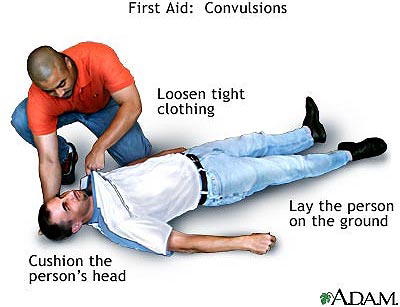
When a person experiences convulsions, those around him or her should clear the area in order to prevent injury from occurring. It is best for the person to lie in a safe area, with the head cushioned. Any tight clothing, particularly clothing around the neck, should be loosened.
The person should lie one side in order to prevent inhaling of any vomit into the lungs. The convulsions should cease on their own. If they do not stop after five to 10 minutes, call for help.
Disclaimer
Comments expressed here do not reflect the opinions of Vanguard newspapers or any employee thereof.