
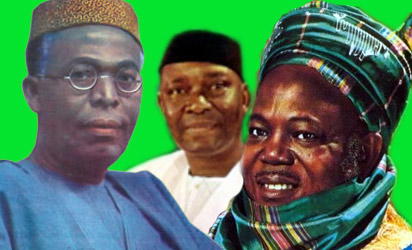
Obafemi Awolowo, Nnamdi Azikiwe and Ahmadu Bello – founding fathers of Nigeria
Amb.Oladapo Fafowora delivered this paper at the All Nigeria Editors Conference of the Nigerian Guild of Editors in Benin City last week
Geography, Power, and Politics in Nigeria NIGERIA is a state of wide cultural diversity consisting of several distinct ethnic groups. What role do these ethnic ethnic groups play in Nigerian politics and what impact do they have on political developments in Nigeria? The issue involved here is whether or not the Nigerian federation is being hobbled by the centrifugal tendencies and activities of these ethnic groups.
Nigeria developed over time, under British colonial rule, as a federal state consisting of various ethnic groups. The British colonial power recognized the ethnic diversity of Nigeria and, with the support of the various Nigerian leaders in colonial times, decided that the federal system of government was the best political and constitutional arrangements for Nigeria.
Only one political party, the National Council of Nigeria and the Cameroons (NCNC), formed in 1944, pressed for a unitary form of government. But this idea found very little support among the leaders of northern Nigeria and western Nigeria. In his Path to Nigerian Freedom, published in London in 1947, Chief Obafemi Awolowo, who emerged as the leader of the Action Group (Egbe Omo Oduduwa), rejected the idea of a unitary system of government for Nigeria, arguing that in view of Nigeria’s ethnic diversity, a federal system of government best suited Nigeria’s condition.

Obafemi Awolowo, Nnamdi Azikiwe and Ahmadu Bello
Both the Sardauna of Sokoto, Ahmadu Bello, and Tafawa Balewa, later Prime Minister of the federation, shared Awolowo’s views regarding the preference for a federal system of government in Nigeria. But their rejection of the idea of a unitary system of government was borne out of fear that under a unitary system of government the North will be dominated by the better educated and vociferous elite of the South, and that northern interests would not be protected.
By the 1950s two major regional political parties embracing the idea of a federal system of government in Nigeria had emerged. These were the Northen Peoples Congress in NorthernNigeria and the Action Group in the Western Region.
The colonial authorities also preferred a federal system of government. The oldest of the three major parties, the NCNC, which argued and campaigned hard for a unitary system of government in Nigeria, lost out in the period of political agitation for independence.
Ethnic diversity and plurality
By 1951 it was clear that federalism had been broadly accepted as the system best suited to Nigeria’s ethnic diversity and plurality. The McPherson Constitution of 1951 had firmly established the foundation for a federal system of government in Nigeria. In view of the ethnic plurality of Nigeria this development of a federal system for Nigeria was broadly accepted by all the ethnic groups as it reflected the cultural and political realities of Nigeria at the time.
A few radical politicians mainly in the so-called Zikist movement preferred a unitary system of government. But they were a hopeless minority.
In view of the large size of some of these ethnic groups, (the Yoruba, the Hausa-Fulani, and the Igbo), many analysts prefer to describe Nigeria as a federation of sub-nationalities. Whatever their various sizes it is necessary to define what is commonly referred to as ethnic groups in the context of Nigeria, and its political variant, ethnic nationalism. Ethnic groups have been defined as “social formations distinguished by the communal character of their boundaries in terms of language and culture, or both” with language constituting the most crucial variable in Africa.
Colonial and European ethnographers and demographers prefer to use the word “tribe” in referring to African linguistic groups. But this term is generally unacceptable to educated and enlightened Africans. They consider it pejorative and intended to emphasize a lower ranking for Africans in the general scale of human development and civilization.
There are other definitions of ethnicity but we need not go into further details here as the preceding definition is adequate for our purpose. Ethnic groups existed in Nigeria long before the advent of colonial rule. But contacts among the various groups were limited.
Many of them, particularly the smaller ones, had only limited trade contacts with other groups. In most cases, they were self sufficient as their main occupation was farming and hunting for games. The advent of colonial rule was to change all that as the introduction of colonial institutions on a national scale brought the various ethnic groups increasingly into contact with one another. It made the various ethnic groups increasingly aware of their distinct and varying cultures.
This process was facilitated by the building of infrastructure such as roads, the railways, electricity, communications, and public transportation. The emergence of urban centres in colonial Nigeria, itself a response to colonial rule, brought many migrants into the new urban areas to look for employment following the introduction of a tax regime by the colonial government. This was to facilitate colonial rule and make the economic exploitation of the colonies easier.
But this development set in motion a process that was to lead to greater contact and competition among the various ethnic groups for dominance and the economic advantage over other ethnic groups that would accompany such dominance.
As linguistic and socio-cultural entities, each ethnic group in Nigeria can be identified with a specific geographical territory or space, while allowing for diffusion and migration. But how many such groups exist in Nigeria or can be identified? Estimates of this vary. The United Nations says there are 250 ethnic groups in Nigeria. Many consider this as underestimated.
A federal government demographic survey in 1976 identified 394 language groups. One estimate put it as high as 400 with the highest density of languages in Taraba and Adamawa states. From these figures, Nigeria can be described as one of the most diverse ethnic states in the world, only surpassed by India and Indonesia. Nigeria’s share of African ethnic groups has been put at over 40 per cent.
The sheer number of different local languages in Nigeria and the consequent cultural pluralism makes the Nigerian political scene very complex. This immense cultural diversity tends to make the country look increasingly difficult to govern.
To be continued
Disclaimer
Comments expressed here do not reflect the opinions of Vanguard newspapers or any employee thereof.