
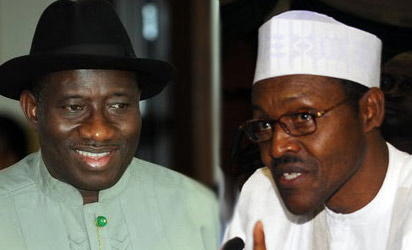
President Goodluck Jonathan and Gen. Muhammadu Buhari (rtd)
By Ikechukwu Nnochiri
It is exactly 141 days since Congress for Progressive Change, CPC, launched its bid to get the April 16 general election that brought President Goodluck Jonathan of the ruling Peoples Democratic Party, PDP, into power, nullified.
Remarkably, Section 134 of the Electoral Act, as amended, explicitly gave the presidential election petition tribunal, 180 days (six months), to dispose every dispute that emanated from the conduct of a presidential poll.
Section 140 (1) of the Electoral Act on the other hand, imbued the tribunal with powers to nullify such election if the petitioner successfully proves its case.
According to the aforementioned section, “subject to subsection (2) of this section, if the tribunal or the court as the case may be, determines that a candidate who was returned as elected was not validly elected on any ground, the tribunal or the court shall nullify the election.”
Even as sub-section 2 of the same section 140 provided that “where an election tribunal or court nullifies an election on the ground that the person who obtained the highest votes at the election was not qualified to contest the election or that the election was marred by substantial irregularities or non-compliance with the provision of this ACT, the election tribunal or court shall not declare the person with the second highest votes or any other person as elected, but shall order a fresh election”.
Thus, going by the provisions of the law, CPC has barely 39 more days to sack President Jonathan from office.
Motivated by their National Chairman, Prince Tony Momoh, (a lawyer), chieftains of the party, on Sunday, May 8, defied a downpour and approached the registry of the tribunal with a petition challenging all the election results that were declared by the Chairman of the Independent National Electoral Commission, INEC, Professor Attahiru Jega, on April 18, 2011.
It specifically prayed the court to void all results garnered by PDP in all the 17 states in the South, annul that of Sokoto, Kaduna, Plateau, Kwara, Benue, Adamawa, Nasarawa states in the North, as well as the result announced by INEC in respect of the Federal Capital Territory, FCT.
CPC alleged that the ballot papers meant for certain polling units were illegally diverted to other units and subsequently used for ballot stuffing, even as it beseeched the tribunal to declare that President Jonathan failed to fulfil the requirement of Section 134 (2) of the 1999 Constitution.
It insisted that the court has the jurisdictional powers to nullify the election and order a re-run between it and the ruling party, PDP.
Those it listed as respondents in the matter were INEC, its chairman, Jega, all the Resident Electoral Commissioners in the 36 states and the FCT, President Jonathan, his Vice, Namadi Sambo, as well as the Peoples Democratic Party, PDP.
NO fewer than 10 Senior Advocates of Nigeria, SANs, volunteered to represent President Jonathan in the matter ‘free’, while those who could not make it into the list of the chosen silks, quickly defected to the ‘legal ship’ of PDP.
Lead counsel to President Jonathan and his Vice, Chief Wole Olanipekun, SAN, and that of PDP, Chief J.K.Gadzama, SAN, approached the tribunal with a motion asking it to dismiss the suit forthwith.

President Goodluck Jonathan and Gen. Muhammadu Buhari (rtd)
The respondents had on May 24 asked the tribunal to compel the petitioner to furnish them with specific particulars of the allegedelectoral malpractices that it said culminated to the failure of its candidate, Buhari, in the April 16 presidential election.
President Jonathan via a motion he filed on May 20, and a replica motion filed by PDP on May 22, maintained that availing him with the further and better particulars of all the accusatory averments made against him in the petition, would aid his team of lawyers to file a sustainable defence on his behalf, a request that was accordingly granted by the court which was then presided by the now suspended President of the Court of Appeal, PCA, Justice Isa Ayo Salami.
Other justices on the adjudicatory panel were Mohammed Garba, M.A. Owoade, I.I. Agbube and Justice Obande Ogbuiya.
While seeking an immediate dismissal of the suit, PDP and Jonathan relied on the combined provisions of Section 137 (3) of the Electoral Act 2010 (As Amended), Order 3 Rule 9 of the Court of Appeal Rules 2011, Order 46 Rule 4 of the Federal High Court (Civil Procedure) Rules 2009 and Paragraphs 4 (d) and 47 (1) of the 1st Schedule to the Electoral Act 2010 (As Amended), to contend that the Registry of the Tribunal, ought not to have accepted CPC’s petition on Sunday, May 8, stressing that the day the petition was filed (weekend) rendered it “dies non-juridicus”.
Arguing the motion on July 6, Olanipekun, SAN, faulted Section 140(2) and Section 134(4) of the Electoral Act which CPC relied upon to seek a nullification of the April 16 presidential election, saying that the tribunal was bereft of the powers to order a re-run election in a situation where the candidate of the petitioner in the contested election, Buhari, was not joined as a necessary party in the suit.
However, on July 14, the then Justice Salami-led panel, dismissed every objection that was raised against the suit, adding that the tribunal has the jurisdiction to entertain the suit, stressing that terminating the petition at that stage would tantamount to burying contention of the litigants on the ground of technicalities.
The panel relied on the provisions of Section 150(1) of the Evidence Act, to hold that there was presumption of regularity, noting that “the hey days of relying on technicalities are over.”
Justice Salami who read the ruling said the respondents failed to disclose the injury, injustice or damages they stand to suffer should the case be heard on its substance.
He, therefore, certified the petition as “competent”, though the panel agreed with the respondents that it was wrong for CPC to accuse the Nigeria Police Force, Nigeria Security and Civil Defence Corps and Nigerian Army of complicity in election rigging, without joining them as necessary parties in the suit, thus the paragraphs concerning them were duly expunged.
The panel, on that day, further ordered INEC to grant the petitioner access to the bio-metric database created by the Direct Data Capturing machines, as well as all the ballot papers used during the April 16 presidential poll.
Expectedly, the ruling did not go down well with PDP and Jonathan, as they immediately appealed the decisions to the Supreme Court for further judicial scrutiny, insisting that the Justice Salami-led panel erred in law by declining to dismiss CPC’s petition.
On August 1, CPC approached the tribunal, complaining that INEC blatantly refused to grant it access to any of the materials used during the election.
The party had in a separate application, sought and secured an order that compelled INEC to seal all the DDC, machines, and ballot boxes used for the presidential elections, which CPC said it would subject to an extensive forensic analysis with a view to proving that the poll was rigged by PDP.
Beside, CPC had equally prayed the tribunal for an order, directing INEC to allow its biometric experts access to all the biometric data base of every registered voters in the country for cross-checking fingerprints on the face of the ballot papers cast in states, local government areas, wards and polling units across the 36 states of the federation and the Federal Capital Territory, Abuja, with what was captured in INEC’s database.
It urged Justice Salami to direct INEC Chairman, Jega, to furnish it with the list of all the local contractors that were engaged by the electoral body to print ballot papers used for the presidential election as well as oblige it with copies of the contract papers executed by the electoral body, as evidence that the said contracts were actually awarded by the commission.
Though the panel accordingly granted the request, CPC returned to court, saying none of the orders were complied with.
Meantime, August 15, Justice Salami, gave President Jonathan till August 29 to respond to a fresh application that was filed by CPC, asking that Buhari should be declared as the bona-fide winner of the April 16 presidential election.
CPC, had in a motion on notice it filed pursuant to paragraphs 18 (11) of the 1st schedule of the Electoral Act 2010, as amended, and Section 149 (D) of the Evidence Act, alleged subterranean collaboration between PDP and INEC, insisting that it was the grand reason why the electoral body refused to make available to it any of the materials used in the conduct of the poll.
It, therefore, sought for “an order entering judgment in favour of the Petitioner in Petition No. CA/A/EPT/PRES/1/2011 under Paragraph 18(11) of the 1st Schedule to the Electoral Act, 2010 as amended and Section 149 of the Evidence Act on the ground that the order for inspection granted by this Honourable Court on May 24, 2011 is refusal or failure or neglect of the respondents to comply with the terms contained in the said order.”
This request was still pending when the National Judicial Council, NJC, suspended Justice Salami from office over alleged judicial misconduct.
Sequel to the development, when hearing resumed on the matter on August 29, only four Appeal Court justices, led by Justice Mohammed Lawal Garuba, sat over the application seeking Buhari’s declaration as president. While moving the application, counsel to CPC, Dipo Okpeseyi, SAN, pleaded the court to hold that the refusal of INEC to grant the petitioner access to all the materials used for the presidential election, was an indication that the election was rigged by PDP.
His application was vehemently opposed by counsel to Jonathan, Dr. Alex Izinyon, SAN, who contended that granting CPC access to voters’ information in the DDC machines, will amount to an infringement on the right of privacy of electorate which he said was made sacrosanct by the constitution of the Federal Republic of Nigeria, adding that what the petitioner requested for would be a breach of Section 125 (3) of Electoral Act.
After listening to the arguments, Justice Garuba, in consonance with other members of the panel, reserved ruling on the petitioners motion sine-die (indefinitely).
On September 6, a reconstituted panel at the tribunal, dismissed the application, and went ahead to authorize INEC not to allow the petitioner to take copy of any of the ballot papers used in the conduct of the presidential poll.
Clarifying the previous order made by the ousted PCA, Justice Salami, on May 24, the new panel told CPC that the order was not an express permission for it to “take copies” of any of such electoral materials, noting that it could only be allowed to inspect them.
At the resumed hearing on September 7, the tribunal handed CPC 10 days to prove that the April 16 general election was rigged by PDP.
The panel while concluding pre-hearing session on the petition, also gave President Jonathan and other respondents in the matter, five days each, to respond to allegations of electoral malpractices levelled against them by CPC, adding that all the parties would be accorded five minutes each to cross-examine witnesses that may be called against them.
On September 11, CPC, went to court with a fresh application, seeking leave to tender software evidence it said would prove that INEC boss, Jega, manipulated the 2011 voters registration in favour of President Jonathan.
CPC said the reason it filed the motion pursuant to paragraph 47 (1) of the 1st Schedule to the Electoral Act 2010 and/or the Court’s inherent jurisdiction, outside the pre-hearing session of the substantive petition, was due to the blatant refusal of the electoral body to grant its forensic experts access to the biometric data base of registered voters in the country.
It told the tribunal that aside Exhibits 1-14, earlier tendered against the April 16 presidential election, it intend to submit a “Blog extracts from Lagos, GTUG, of Femi Taiwo (lead Software Developer) of INEC Open Voters Registration project (The soft ware used by INEC for voters registration).”
The next day, the Acting PCA, Dalhatu Adamu, appointed a new presiding Justice, Kumai Bayang Akaas who was hitherto serving at the Calabar Division of the appellate court, to take over position left by the suspended PCA, Salami.
It was also the day CPC opened its substantive case amid drama, as its National chairman, Momoh, who was billed to testify as a witness in the matter, was disqualified over a legal blunder that was committed by the lead counsel to the petitioner, Malam Abubakar Malami, SAN.
Momoh, who was to testify as PW- 2 in the matter, was disqualified by the panel, few minutes after the Acting National Secretary of the party, Mr. Buba Galadima, who had while testifying as PW-1 conceded that the presidential candidate of CPC, Muhammadu Buhari, benefited from election rigging.
Galadima, who made the assertion while under cross-examination, told the panel that even the states won by CPC during the presidential poll, suffered the menace of election malpractices.
Cross-examining him, counsel to Jonathan, Olanipekun asked: “Malam Galadima, sir, you said in your statement that election was rigged in the 36 states of the federation including the FCT, are you now telling this court that even in the area your party won, that it was rigged?”
Before Olanipekun could finish the question, the CPC scribe bellowed: “yes, election was rigged even in those places! Rigging has different facets but in the general perspective, I will say yes, it was substantially rigged!”
Shortly after the other respondent took turns to cross-examine the CPC scribe on the basis of the said statement which he earlier identified as his own, counsel to the petitioner, Malami, SAN, ushered in the chairman of the party, Momoh, as his next witness.
Malami specifically told the panel that Momoh, who was number 11 on the original list of witnesses’ tendered ab-initio by the petitioner, would rely on all the depositions he made in pages 17-55 of the witness statement on oath.
In a bid to administer witness oath on the CPC chairman, the court clerk asked him: “Sir, are you a Christian or Muslim?”
Momoh said: “I am both a Muslim and a Christian when they are not quarrelling!”
Irked by the answer, a justice on the panel, bellowed: “Mr Momoh, it is a serious business we are doing here, please answer the clerk! What do you believe in?”
“I believe in God Almighty”! Momoh retorted.
To save the situation, counsel to CPC, Malami, decided to delve into the examination-in-chief, and pleaded the court to take judicial notice of two newspaper publications that he said would prove that PDP manipulated INEC with a view to ensuring that President Jonathan won the April 16 election.
It was at this point that he realized that there was a mix-up between the witness statement accredited to Galadima and that of Momoh.
It dawned on Malami that the witness statement and signature identified by Galadima in pages 17-55 of the proof of evidence, as his own, actually belonged to Momoh, while the evidence of PW-1, was actually contained in pages 8-14 of the petitioners document.
Sequel to confusion created by the discovery, the panel stood down the case to enable the petitioner to resolve the discrepancy.
Disclaimer
Comments expressed here do not reflect the opinions of Vanguard newspapers or any employee thereof.