
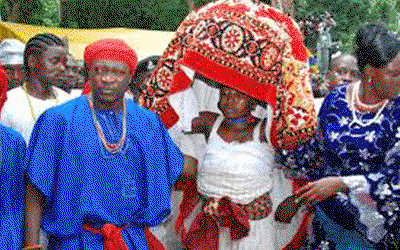
Osogbo, the capital of Osun State will be agog again with lovers and admirers of the annual Osun Osogbo festival, which holds today. Of all the internationally celebrated festival in Nigeria, Osun Osogbo stands out as the most venerated and most attended, as it is not only about merry making, but also about the mind, heart and divinity of a people, who are bonded by unique culture and history.
The annual festival symbolises the greatness of a goddess, who came to the rescue of a people faced by famine, barrenness and other form of illness, took away their suffering and blessed the women with fertility, replaced famine with abundance and cure their ill children with the magical powers of her herb.
This inherent feature reflects in such eulogy ascribed to the goddess as “seleru agbo agbara agbo l’osun fin we omo re ki dokita o’to de” (meaning Osun used natural and powerful herb mixture to cure her children before the arrival of modern medicine).
One significant attribute of the festival is that it brings devotees of the deity from all over the world together annually, from Cuba to Brazil, United States of America to Jamaica, Canada to Spain, they come together to pay homage to the goddess, who they believe is the source of life.


The votary maid, Arugba, will be the cynosure of all today at the grand finale of the annual Osun Osogbo festival.
The festival is held usually at the end of every second quarter of each year with the Osun River being the centre of activity. The rituals involved, which takes a total of four weeks, is also significant because it is believed to be a spiritual medium of cleansing the land and ridding it of bad omen and at the same time inviting good in form of fertility and bountiful harvest.
The four-week festival is usually kick started with holy divination, where high priests in the town, led by the Araba consult the Ifa on behalf of the reigning Ataoja in the palace to seek the wisdom of the gods on the festival, after which the Iyere is sung for the monarch to dance round his family compound in company of his queen(s).
Following the Iyere, is the open declaration of the commencement of the festival, through the Iwo Popo, which sees the Ataoja walks from his palace through the major road to Gbaemu (another royal compound in the town) junction, where he would sit and pray for his subjects, after paying homage to him.
Three days after the Iwo Popo, the ancient lamp called ATUPA OLOJUMERINDINLOGUN, that is the lamp consisting of sixteen faces, is fired up inside the palace square where it burns from night till dawn during which the Ataoja comes out with his queens to dance with his subjects, symbolising his humility and concern for their well-being.
During all these periods, the focus is on the Ataoja, a symbol of authority and custodian of the people’s culture. The ATUPA OLOJUMERINDINLOGUN was a sixteen-point lamp which was allegedly kept burning from dusk to dawn to maintain the glory of the place at night. This can be likened to the modern day electrification of a community area.
Today the Queen and her descendants and admirers are referred to in praise as: -OMO ATUPA MERINDINLOGUN TI I TAN L’ OROKI ILE.B’ O BA TAN F’ OBA, A TAN F’ OSUN.A TUN TAN FUN IRUNMALE, A TAN F’ ENYAN.
While this is on, devotees, admirers, tourists, as well lovers of art work flows into the town anticipating the main and final events, where all attention is shifted from the Ataoja to the calabash-bearing maiden called Arugba; usually a week after the ancient lamp is off.
Then comes the main event, devotees in their thousands trooped to the groove; tourists, as well as lovers of art join in the procession. The groove, besides being the venue of the final event, also houses the first palace of the Ataoja, it is a site to marvel, as the various art work that beautify the environment is beyond description.
People thronged the road leading to the groove, anticipating the passage of the celebrant, the calabash-bearing maiden, followed by the Ataoja. At this point, the people are not much interested in the monarch, but the ARUGBA.
Unlike in the previous outings, the Ataoja in this case is not leading the procession, but the Arugba, whose appearance from palace road prompt the people into prayers refuting bad for good, as well as hoping that her appearance ushered new things in their lives. dignitaries that join the Ataoja at the groove, where all the high chiefs come one after the other to pay homage to the Ataoja, who in turn pray for them and also give them token gift symbolising his appreciation of their support and cooperation in helping him to maintain peace in the town for the year.
Sent by Oyintiloye Olatunbosun, Assistant Director, Community Forum, Osun State.
Disclaimer
Comments expressed here do not reflect the opinions of Vanguard newspapers or any employee thereof.