
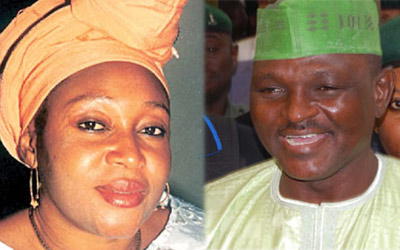
Late Kudirat Abiola and Al-Mustapha
By Innocent Anaba
LAGOS—Major Hamzat Al-Mustapha, former Chief Security Officer to late Head of State, General Sani Abacha, who is currently standing trial before a Lagos High Court, over the murder of late Kudirat Abiola, yesterday, told the court that the torture he went through in the hands of security agents while he was being interrogated by the Special Investigative Panel was such that he admitted any property shown to him as belonging to late General Abacha.
Major Mustapha who continued his evidence yesterday in his trial also said that associates of late Chief M.K.O. Abiola, stabbed him in the back as they were always pretending to be fighting for his mandate while they were doing the contrary behind his back. In his testimony, he denied directing anyone to kill Kudirat or any other persons assassinated while Abacha was Head of State.
Al-Mustapha under cross-examination

Late KudiratAbiola and Al-Mustapha
Al-Mustapha under cross-examination, said he sent a former member of the strike force, Rabo Lawal to Lagos to protect the property of Abacha, which were threatened by the National Democratic Coalition, NADECO, and not to kill Kudirat.
He also accused NADECO chieftains of not being sincere in their agitation because they were saying different things when they met Abacha compared to what they made the public to believe.
He said, “When tension was so high, NADECO chieftains were visiting Abacha and even Abiola was visiting Abacha and I was the one facilitating it. The issue of the June 12 mandate demanded by NADECO was at that time to me a compromised stand. All those who came to discuss with Chief MKO Abiola regarding his mandate are the same people who went behind him and said the contrary. That is another issue for Nigerian tomorrow.
According to him, NADECO was not the strongest opposition to the government of General Abacha, but incessant military coup attempts planned against his government.
“From my own professional view, the strongest opposition to Gen. Abacha’s government was the military coups. We had to curtail about three to four coup attempts. Civil society groups had the right to be in opposition but a military coup that comes with force is quite different.
That was what I am trained to look for and that was what I preach against, to protect the seat of power. Any civilian that comes in form of opposition is exercising his constitutional rights.”
Al-Mustapha told the court that he on several occasions assisted the late Kudirat to see late MKO, who was detained at the time, adding “I did not order the arrest of any political figure in the country during the administration of Abacha but I sent Rabo Lawal to confirm the act of burning Abacha’s property in Lagos and not to checkmate the activities of NADECO in the state.
In fact, it was the Garrison Command in Lagos led by retired General Patrick Azazi, who was directed to take over protection of the said property.”
On who ordered the arrest of Abiola, Al-Mustapha said it was then Inspector General of Police, Alhaji Ibrahim Coomasie and that Abiola
was kept in Police custody until he began to complain. He told the court that he later became responsible for Abiola’s custody and took good care of him. “I became responsible when he complained about the police. I was the one feeding him. I spent N800, 000 quarterly to feed him. Those who stood against Chief Abiola are those who are in “high places” in this country and they can never be brought to book.”, he said
He denied ordering Sergeant Rogers to shoot Kudirat, adding that Rogers had confessed that what he wrote in his confessional statement that he (Al-Mustapha) ordered him to kill Kudirat was dictated to him under duress and because severe of torture he was subjected to in the hands of the Special Investigation Panel, SIP, so that he could be given the liberty to go to court as well as to see his lawyers, which was denied him for one year.
“I appeared last before the SIP in October 13, 1999 after intense torture I will never forget and my statement to them was like a visa that they needed to begin my prosecution. It was under duress that I made it. If the prosecution had seen the torture and the conditions we were subjected to, you would never have prosecuted this case,” he said.
According to him, the statement which he described as a dictation became a visa because it was on account of it that he was taken to Lagos for prosecution. “It was a dictation. I decided to do that so that I would be sent to court or the prisons so that I can see my lawyers. For one year, I could not set my eyes on my lawyers or members of my family,” he said.
He added that the “panel was constituted to identify property belonging to Gen Abacha in Abuja. The panel often came to me in detention, whether certain houses belonged to Gen. Abacha or not, whenever I denied, the panel will subject me to torture. So it came to a point that any house that was shown to me, I will accept that it belonged to Gen Abacha.”
He said he knew nothing about late Pa Alfred Rewane and Isaac Pobeni but knew the Guardian publisher, Mr. Alex Ibru, because he was a minister under Abacha. He said that Pa Anthony Enahoro was a father to him and that the late elder statesman was always communicating with him in the prison before his demise.
On the panel constituted by the National Judicial Council, NJC, to investigate the allegation of bias against the immediate past Chief Judge of Lagos State, Justice Ade Alabi, he said “we had a problem with one of the courts we faced in the year 2002 and the NJC was petitioned. The NJC set up a panel to determine the allegation made by us, we filed a petition to the NJC and they looked at it.”
But reminded that NJC absolved Alabi of any wrong doing, Al-Mustapha said “what happened was when the NJC finished sitting because of the absence of the witness, who was to appear before it, they reconvened for him to appear, and then his lawyer announced to the panel the death of the witness, four hours before the panel began sitting. Chief Matins (the witness) died and nobody can investigate but I have been doing it.”
Disclaimer
Comments expressed here do not reflect the opinions of Vanguard newspapers or any employee thereof.