
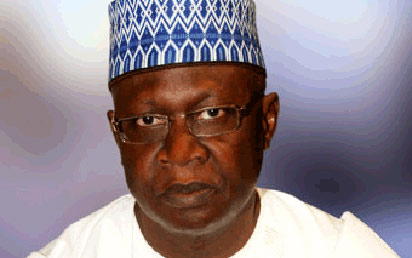
Code of Conduct boss
*Code of Conduct Bureau talk tough
*Former governors, public servants to face tribunal
Saddled with challenges in his bid to transform the country, President Goodluck Jonathan has come to the realisation that with a renewed anti-corruption war, a sense of discipline may be instilled in public servants with the ultimate goal of blocking leakages within the system. Crucial to this renewed war on corruption is a role for the Code of Conduct Bureau, CCB, a constitutionally-established body with enormous powers and responsibilities to checkmate the excesses of corrupt public office holders. This is the story of how a re-invigorated CCB would stake a bigger, perhaps the biggest onslaught on corruption. The revelations here would shock you.
By Jide Ajani, Deputy Editor,
The former governor sweated profusely; and the scene was comical. Having just lost out at the polls, he sat before the Code of Conduct Bureau, CCB, Commissioner for South-West, Dr. Ademola Adebo, to answer questions regarding his assets and financial profile. The understandably fair-complexioned politician was just one of the public servants that appeared before the CCB Commissioner in the dying days of May 2011. The category of those CCB officials met were governors and their deputies, commissioners, Secretaries to State Governments, SSGs, et al.
Indeed, the interaction with the public servants was interesting, very interesting. Another governor actually missed his appointment when CCB officials visited his state. His deputy, a female, honoured her’s. Generally believed to be a hard-working governor in his second term now, he pleaded with the officials that he be taken to a neighbouring state. He was obliged. The governor had to hurriedly travel to the neighbouring state to face CCB. Even, the immediate past governor of the state where the sitting held, reportedly sat before the CCB officials when they told him in clear terms that most of his activities while in office, like those of his colleagues, fell foul of the conduct expected of public office holders. In fact, on a scale of compliance, most public officers would accomplish a breach than an observance.
In times past, it was mere invitation from CCB to public servants to appear before it at its Federal Capital Territory, FCT, Abuja, office. Then, governors treat CCB’s invitation with disdain. Today, it is another tune. Welcome to President Goodluck Jonathan’s transformational war against corruption. Penultimate week, President Jonathan, at an event on public procurement, charged public servants to make due process their watchword. Former President Olusegun Obasanjo lent his voice to the charge. So, how did all these renewed efforts against corruption come about? Sunday Vanguard discovered that the story goes back to the late President UmaruYarÁdua.
Before his health challenge negotiated a turn for terminality, Yar’Adua was said to have consulted widely on how to ensure that provisions of the 1999 Constitution regarding the establishment of commissions was followed to the letter. In doing this, he carried his deputy, Jonathan, along.
Before Yar’Adua, CCB had never really been constituted following the expectations and intendment of the nation’s. For instance, whereas one of the sections of the constitution states that the 10 members to be appointed into CCB shall at the time of appointment, “not be less than 50 years of age and subject to the provisions of Section 157 of this Constitution shall vacate his office on attaining the age of 70 years,” this had not really been so. But, before Yar’Adua could fill the Bureau with members, he died.
In a country where former President Obasanjo told Nigerians that loyalty should be absolute, and who treated his then deputy, Atiku Abubakar, with so much disdain, Yar’Adua carried Jonathan along so much so that the first engagement of Jonathan upon becoming Acting President, was to send the names of the proposed commissioners of the Bureau to the Senate for confirmation. Sunday Vanguard gathered that because Yar’Adua kept faith with Jonathan, the then Acting President did not tamper with the list of nominees prepared by Yar’Adua before his death. Sunday Vanguard also discovered that indeed,
Jonathan’s nominee into the Bureau as a commissioner was endorsed by Yar’Adua. And, so, when Jonathan presented the list, he did not change any name. So much for cross-loyalty! That was the first time in the history of the Bureau that it would be properly constituted. This batch of commissioners were sworn-in on April 30, 2010, and Jonathan charged them that their agency is the one with the capacity to fight corruption and the constitution empowers their Bureau to handle all public servants – mind you, public servants are seen largely as the group of people driving the entrenchment of corruption in the country.
Today, Western powers have made anti-corruption a condition precedent for support, aid and assistance to developing countries. The new impetus for the fight against corruption is driven by the inspiration provided by President Jonathan.
Relying on the provisions of the 1999 Constitution, CCB has started charging. Sunday Vanguard learnt that the commissioners met last week to deliberate on the outcome of their nationwide compilation of records. The compilation was launched on May 23, 2011, in the states and zones of the federation and it was simultaneous.
Now those reports are being deliberated on. At the meeting, all the issues and findings were discussed. A source at the Presidency told Sunday Vanguard that “the law says you must declare your assets when you’re coming in or when you’re leaving that office. In declaring, the Assets Declaration Form demands some things – income, assets and liabilities; you must declare for your children under the age of 18; if your wife is not a public servant, you must declare for her; salaries, lands (C of O) and all that; if you say you’ve built a house, where is the house; bank accounts’ statements of at least 6 months before the date of declaration so the history of the account can be monitored. The form also demands that you indicate the value of the item at the time of purchase and then indicate the current value”.
But what Sunday Vanguard has discovered from the round of compilation by CCB last May was that “some public office holders just give estimates and we told them that it is not done in a whimsical manner.”
In fact, a deputy governor was said to have whimsically told the CCB officials that she has about 10 flat screen sets at home and that they were gifts. She was then reminded of the issue of gift and what it constitutes, which is a breach. Another governor was so meticulous, or so he thought, that he “balanced his asset declaration”. Sunday Vanguard learnt that what the governor filled in his form was balance sheet where income matched expenditure.

Code of Conduct Bureau chairman, Sam Saba
“What the public servant did was to ensure that what he had before he became a public servant was the same thing he filled out in the form, such that nothing was added and nothing was removed. He was then asked if he thought the process was a joke or how come no assets were added to the ones he had before becoming a state governor when he had free accommodation, free feeding, free transportation and many other pecks which ordinarily should have meant a better life.” The governor’s response was that “one of my assistants filled the form for me”. He, thereafter, reportedly apologised for the slipshod.
All the things the public officers claim and claimed to own, they must have declared them in court. They brought the photocopies and original of the documents to the CCB panel across the country.
What the CCB officials are now about doing is going into the field so as to verify the claims for the following reasons:
(1) Take care of anticipatory declaration
(2) Take care of under declaration
(3) Take care of over declaration
(4) Deal with outright lies
(5) Verify the claims of properties outside the country.
Account lodgments are also to be studied in the process. Sunday Vanguard learnt that CCB is expecting that some people would forward petitions to it regarding those from whom documents have already been collected. “Members of the public know these people; they live in their midst, they live in their villages”, a CCB source told Sunday Vanguard.
Sunday Vanguard was also made to realise that “it is the Monitoring and Investigation Committee that plays the real role for the commission in its pursuit of the intendment of the laws governing the conduct of the Bureau.”
Sunday Vanguard has also been told that the on-going verification would likely catch most public servants on the off-side.
And, to drive the message home clearly, Chairman of CCB, Mr. Sam Saba, has warned top officials of CCB drawn from the 36 states not to accept bribes from public officers.
“It is obvious that we shall continually face challenges in our operations given the nature of our mandate. However, how we view these challenges defines us. Do we choose to see the challenges as stepping-stones or as obstacles? I believe that the right choice for us in the Bureau is to choose to see challenges as stepping stones. Opportunities that we have encountered along the way for us to use, to step on so we can achieve more, develop further and ultimately actualise more of our goals,” he said.
“We, therefore, need to introduce new thinking and approach where feasible and we need to stop what isn’t working. We need to create a vision whereby our name becomes synonymous with excellence, innovation, honour, integrity, transparency, accountability and outstanding quality of service delivery. This simply means that we need to promise less and deliver more every time”, he added.
Well, Nigerians and President Jonathan are watching.
CODE OF CONDUCT FOR PUBLIC OFFICERS
Below are constitutionally-stated code of conduct for public officers, most of which are flouted whimsically:
1. A public officer shall not put himself in a position where his personal interest conflicts with his duties and responsibilities.
2. Without prejudice to the generality of the foregoing paragraph, a public officer shall not
(a) receive or be paid the emoluments of any public office at the same time as he receives or is paid the emoluments of any other public office; or
3. The President, Vice-President, Governor, Deputy Governor, Ministers of the Government of the Federation and Commissioners of the Governments of the States, members of the National Assembly and of the Houses of Assembly of the States, and such other public officers or persons as the National Assembly may by law prescribe shall not maintain or operate a bank account in any country outside Nigeria.
4. (1) A public officer shall not, after his retirement from public service and while receiving pension from public funds, accept more than one remuneration position as chairman, director or employee of –
(a) a company owned or controlled by the government; or
(b) any public authority.
(2) a retired public servant shall not receive any other remuneration from public funds in addition to his pension and the emolument of such one remunerative position.
5. (1) Retired public officers who have held offices to which this paragraph applies are prohibited from service or employment in foreign companies or foreign enterprises.
(2) This paragraph applies to the offices of President, Vice-President, Chief Justice of Nigeria, Governor and Deputy governor of a State.
6. (1) A public officer shall not ask for or accept property or benefits of any kind for himself or any other person on account of anything done or omitted to be done by him in the discharge of his duties.
(2) for the purposes of sub-paragraph (1) of this paragraph, the receipt by a public officer of any gifts or benefits from commercial firms, business enterprises or persons who have contracts with the government shall be presumed to have been received in contravention of the said sub-paragraph unless the contrary is proved.
(3) A public officer shall only accept personal gifts or benefits from relatives or personal friends to such extent and on such occasions as are recognised by custom:
Provided that any gift or donation to a public officer on any public or ceremonial occasion shall be treated as a gift to the appropriate institution represented by the public officer, and accordingly, the mere acceptance or receipt of any such gift shall not be treated as a contravention of this provision.
7. The President or Vice-President, Governor or Deputy Governor, Minister of the Government of the Federation or Commissioner of the Government of a State, or any other public officer who holds the office of a Permanent Secretary or head of any public corporation, university, or other parastatal organisation shall not accept –
(a) a loan, except from government or its agencies, a bank, building society, mortgage institution or other financial institution recognised by law,; and
(b) any benefit of whatever nature from any company, contractor, or businessman, or the nominee or agent of such person:
Provided that the head of a public corporation or of a university or other parastatal organisation may, subject to the rules and regulations of the body, accept a loan from such body.
8. No persons shall offer a public officer any property, gift or benefit of any kind as an inducement or bribe for the granting of any favour or the discharge in his favour of the public officer’s duties.
9. A public officer shall not do or direct to be done, in abuse of his office, any arbitrary act prejudicial to the rights of any other person knowing that such act is unlawful or contrary to any government policy.
10. A public officer shall not be a member of, belong to, or take part in any society the membership of which is incompatible with the functions or dignity of his office.
11. (1) Subject to the provisions of this Constitution, every public officer shall within three months after the coming into force of this Code of Conduct or immediately after taking office and thereafter –
(a) at the end of every four years; and
(b) at the end of his term of office, submit to the Code of Conduct Bureau a written declaration of all his properties, assets, and liabilities and those of his unmarried children under the age of eighteen years.
(2) Any statement in such declaration that is found to be false by any authority or person authorised in that behalf to verify it shall be deemed to be a breach of this Code.
(3) Any property or assets acquired by a public officer after any declaration required under this Constitution and which is not fairly attributable to income, gift, or loan approved by this Code shall be deemed to have been acquired in breach of this Code unless the contrary is proved.
12. Any allegation that a public officer has committed a breach of or has not complied with the provisions of this Code shall be made to the Code of Conduct Bureau.
13. A public officer who does any act prohibited by this Code through a nominee, trustee, or other agent shall be deemed ipso facto to have committed a breach of this Code,
14. In its application to public officers –
(a) Members of legislative houses shall be exempt from the provisions of paragraph 4 of this Code; and
(b) the National Assembly may by law exempt any cadre of public officers from the provisions of paragraphs 4 and 11 of this Code if it appears to it that their position in the public service is below the rank which it considers appropriate for the application of those provisions.
CODE OF CONDUCT BUREAU HONOURABLE FEDERAL COMMISSIONERS
MR. SAM SABA, Chairman, CCB (North-Central Zone)
ALHAJI MOHAMMED DISINA , Finance, (North-East Zone)
AMB. HABIB ELABOR, Human Resources (South-South Zone)
DR. ADEMOLA ADEBO, ICT (South-West Zone)
PRINCE OKECHUKWU NWADINOBI, Investigation & Monitoring (South-East)
DR. CHRISTY EKOJA, Education & Advisory Services (North-Central Zone)
CHIEF STEPHEN BEKEFULA, Assets Declaration (South-South Zone)
MR.YAKUBU TUKUR (MFR), Legal Affairs (North-East Zone)
ALHAJI IBRAHIM MANZO, Procurement & Supply (North-West Zone)
KEY FUNCTIONS OF CCB
The Bureau shall have power to:
(a) receive declarations by public officers made under paragraph 12 of Part I of the Fifth Schedule to this Constitution;
(b) examine the declarations in accordance with the requirements of the Code of Conduct or any law;
(c) retain custody of such declarations and make them available for inspection by any citizen of Nigeria on such terms and conditions as the National Assembly may prescribe;
(d) ensure compliance with and, where appropriate, enforce the provisions of the Code of Conduct of any law relating thereto;
(e) receive complaints about non-compliance with or breach of the provisions of the Code of Conduct or any law in relation thereto, investigate the complaint and, where appropriate, refer such matters to the Code of Conduct Tribunal;
(f) appoint, promote, dismiss and exercise disciplinary control over the staff of the Codes of Conduct Bureau in accordance with the provisions of an Act of the National Assembly enacted in that behalf; and
(g) carry out such other functions as may be conferred upon it by the National Assembly.
Disclaimer
Comments expressed here do not reflect the opinions of Vanguard newspapers or any employee thereof.