
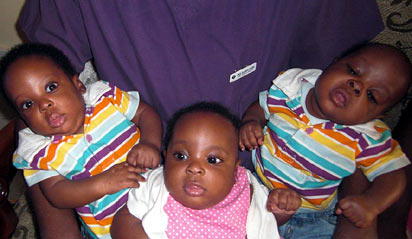
By CHIOMA OBINNA
ALL of a sudden, so many women are having so many babies all at one time. In the recent past, there’s been a phenomenal rise in the number of multiple births. For one, the number of twin births has more than doubled while number of births involving three or more babies has quadrupled.
The world is witnessing the “miracle of multiples”. But the question is, why? Part of the reason could be that treating infertility has improved tremendously but causes of most of the unassisted cases remain unknown. Trends in assisted conception are a major factor. Use of ovulation induction agents (drugs used to stimulate ovulation in women who are not naturally ovulating) have revolutionalised the occurrence of multiple pregnancies.
In the world today, there are over 100,000 multiple births occurring each year of which high order births (three and above) constitute less than three per cent. By all means, multiple birth is not an uncommon occurrence in the country, particularly in the SouthWest. But with increasing medical advances, particularly in the areas of infertility and care of pre-term births, the number of multiple births has increased dramatically, and the need for correct care and support as well as information and support to multiple birth families and health professionals, has never been greater.
Fascination
So, the world has never ceased to be fascinated by the birth of “multiples”—even identical twins ceaselessly draw attention, talk more of sets of three, four, five, six or more babies.
In Nigeria, particularly, the lives of families with triplets, quadruplets, quintuplets, sextuplets and septuplets or higher, are an open book of amazement plus fascination. Even as much as debate perpetually reigns within the medical community over the consideration of ethics and “relevance” of these multiple births, they have nevertheless grown more prevalent and new ethical issues have emerged.
Contributory factors
Factors such as maternal age, socio-environmental factors, increase in the use of contraceptives, the race of human population, increase in the spontaneous abortion rate, and seasonal variations are among the factors that could influence multiple birth including twinning (two babies), triplets (three babies) and quadruplets (four babies), quintuplets (five) Multiple births occur when multiple foetuses are carried during a pregnancy with the subsequent delivery of multiple births.
Widespread use of assisted reproductive techniques and advancing maternal age at conception is also associated with this phenomenon. Others are:
• Heredity: A history of multiple births on a woman’s side of the family increases her chances of having a multiple pregnancy.
• Race: Women of African descent are the most likely to have multiple pregnancies.
• Number of prior pregnancies: Having more than one previous pregnancy, especially a multiple pregnancy, increases the chance of having a multiple pregnancy.
• Delayed childbearing: Older women who get pregnant are more likely to have multiples.
• Infertility treatment: Fertility drugs, which stimulate the ovaries to release multiple eggs, or assisted reproductive technology (ART), which transfers multiple embryos into the womb (such as in vitro fertilisation, or IVF), greatly increase a woman’s chance of having a multiple pregnancy.
Risks
According to medical experts, multi-foetal pregnancies are high-risk pregnancies, and are complicated by a higher incidence of hypertensive diseases such as anaemia, preterm labour, and several delivery complications such as Ceasarean Section, operative delivery, mal-presentation, cord accidents, etc.
Multiple birth has devastating physical consequences and complications both for mother and babies.
From argument over higher risk to the babies of brain damage, cerebral palsy and death rise with each additional foetus, to the mothers’ vulnerability to life-threatening conditions, multiple births are really a mixture of multiple blessings and problems, depending on the perspective from which is being considered. Multiple births could be a bundle of joy one minute, and a bundle of grief the next. For instance, the high cost of raising multiples alone, can bring many families to the brink of financial ruin.
Success stories
Prof. Oladapo Ashiru, an experienced endocrinologist and joint pioneer of In-vitro Fertilisation (IVF) Research in Nigeria and the West African region, in a presentation, entitled “High Incidence/order of Multiple Pregnancies and Multiple Births in the last two years (2009 to 2011), noted that 20 women within the age range of 30-54 had multiple pregnancies ranging from twins to quintuplets at the Medical ART Centre, Maryland, Lagos.
“Of these women,” argued Ashiru, “one delivered singleton, six delivered twins, three delivered triplets, one delivered quadruplet, while two delivered quintuplets. In addition, five women have ongoing singleton pregnancies, two have ongoing twin pregnancies, one has ongoing triplet pregnancy and two have ongoing quadruplet pregnancies.”
Trends
Explaining the trend, Ashiru, who is the Chief Medical Director, MART, and Adjunct Professor at the University of Illinois, Chicago, described multiple birth as a type of birth in which a woman gives birth to two or more offspring from the same pregnancy. The occurrence and frequency, however, varies dramatically.
He said it was in the 2009 series that the centre first recognised it had mainly twin pregnancies while in the 2010 series, there were higher number of multiple gestations such as quintuplets. “Thus, we reduced the number of embryos transferred this year (2011 series). Though we have had multiple gestations this year, the number has reduced compared to last year.
Protocol
“Also, we recognised the fact that the multiple pregnancies were due to the effectiveness of the stimulation protocol, the efficiency of the lab especially with ICSI (Intracytoplasmic sperm injection) and the quality of embryos as well as the use of ultrasound guided embryo transfer. Ashiru also noted that “We equally recognise the role of our pre IVF evaluations such as Hysterosonography, ovarian improvement regime, and the use of immune support as contributing factors to the success. In addition, the quality of the embryos and success rate is due to additional services in our system such as the use of pre-implantation genetic diagnosis (PGD) and blastocyst transfer.
On benefits, successful IVF treatments have saved many marriages were saved. Many women prior to their successful IVF treatment had many psychosocial and emotional issues that were solved after their IVF treatments.
“Many of these women, prior to their successful IVF treatment, had many psychosocial and emotional issues that were solved after their IVF treatments. We believe it is now left for couples to narrate their personal stories; we have noticed that in this environment there is still some resistance to people sharing their own personal stories after a successful IVF treatment.
Myths
“It is important for us to dispel myths around IVF babies; IVF, produces normal babies who grow up to be bright and intelligent children. People should be encouraged to share their stories which may help other couples find succour. We believe the more people talk about their success openly the better it will be for those who need such services, and the more acceptable the process will be.
Many mothers that have carried triplets, quadruplets and higher order births to a healthy outcome, have had to cope with many considerations that only they and their healthcare professionals could take to reach such a decision.
Things to consider
•Health risk vis-à-vis the mother and all of the babies. If one (or more) foetuses have anomalies, reduction may be the decision to make, thereby giving the healthy foetuses a better chance at a healthy gestation and life.
Learn the survival statistics
• Seventy-five per cent of quadruplets survive. Of that figure, 50 per cent have disabilities
• Ninety per cent of triplets survive and 10 per cent impairment rate can be expected, with an average gestation of 33.5 weeks.“
• Ninety-eight per cent of twins survive with a five per cent impairment rate and the average gestation is 35-38 weeks ( a singleton gestation rate is based on 40 weeks)
Information is best
Someone once remarked that to make the decision to have or not to have a multiple birth, “should come from the woman’s head, and not her heart”. How many couples agree with the intent of this comment? How many would rather admit that the answer lies somewhere between your head and your heart, what you know and what you feel, you will find the answer. Allow yourself to listen to both, they conclude. But the bottom line is that an informed decision remains the best decision.
Disclaimer
Comments expressed here do not reflect the opinions of Vanguard newspapers or any employee thereof.