
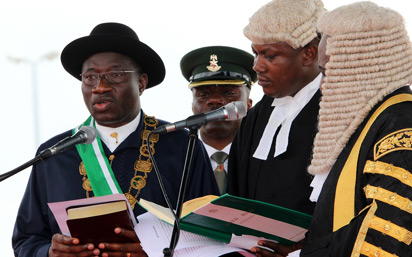
President Jonathan taking his oath of office.
THE events of the last fortnight, precisely of April 16, 2011 cannot pass unrecorded for history and posterity. I am one of those who will not take the risk of allowing that day to pass like any other day because it is not. I will thus proceed to put the Goodluck Jonathan victory in the presidential polls of April 16, 2011 in its proper perspective and in its proper historical context.
It is important to do this because for the large majority of Nigerians who either voted for or wished for change and whose votes or wishes were thus vindicated that day, they need to know just the significance of what happened.
For those who are minded to repeat history by working against the time and the tides there is a need to warn them of the futility of such machinations so that they can save it for their own sakes and for the sake of the country.
For the first time a national leader was elected in Nigeria with the nearest thing to absolute legitimacy by universal standards. From Sir Tafawa Balewa to Alhaji Shehu Shagari to MKO Abiola to General Olusegun Obasanjo in 1999. President Jonathan will be right to claim to have been elected with the greatest legitimacy in comparison to all these icons of the nation’s political past, pre- and post-independence.
I think that until something bigger and better comes along, which may be sometime in coming, Dr Jonathan’s election may very well turn out to be Africa’s own little Obama event, a historic breakthrough, heralding a new era, not quite like the old one.
In this election, it is actually heartening to see that opposition voices in general are conciliatory and appear to have largely accepted this verdict of history. There have been extreme reactions, mostly in the North, but the good thing is that Northern potentates religious, political or otherwise have distanced themselves from such reactions, at least by their words if not by their deeds, with a good many warning the perpetrators to desist.
From Alhaji Atiku Abubakar to Alhaji Tanko Yakassai the acceptance of the result directly or not is indeed a sign of changing times and of a historical importance. It may now be recalled that one of the reasons the First Republic failed was that opposition politicians really never ‘forgave’ the NPC, in particular Sir Tafawa Balewa, for winning the series of national elections that kept the party and the Prime Minister in power until reactionary elements struck in January 1966. Judging from the reactions to his victory, President Jonathan does not seem to have a need to worry about any such entrenched, insidious or inflexibly hardened ethnic, religious or even ideological jingoisms.
What President Jonathan does need to worry about is the enormity of other challenges before him and the magnitude of the political responsibility that such electoral legitimacy confers. It is all very well to talk about the infrastructure deficit: roads, railways, electricity, affordable broadband communications, aviation, security, working pipeline systems, refineries, etc. But the more you talk about these services without bringing their fulfilment to reality the more platitudinous such rhetoric sounds.
Also in my view these services are merely economic utilities that any average government can deliver as a matter of routine (for example as South Africa and many other countries are currently doing, without making much noise about it ) in a proper political setting. In today’s Nigeria, the most important challenge is political stability, not just social equilibrium.
If we have political stability every other expectation will fall in place. It may be recalled that despite the colossal sums expended on infrastructure notably electricity, during the Obasanjo administration (1999-2007) nothing came of it. The government needed stability to effectively fight corruption but was unable to do so, so the money and the rhetoric invested in infrastructure simply disappeared.
You need stability, at the very minimum, a balance between the forces of the right and those of the left to fight corruption effectively and without fighting and eliminating corruption nothing will be achieved, even in a Jonathan- led government.
The Obasanjo government was corrupt to the extreme. Corruption was not just tolerated but actively promoted, often times with the resources of the state. Remember, the African Pride saga,the first appearance of bulging ‘Ghana-must-goes’ on the floors of the National Assembly, the advent of billionaire judges and so on. Had there been progressive elements in the government, the situation would have been different. There would have been a different outcome.
Lt. Col. PETER ULU,rtd, wrote from Lagos.
Disclaimer
Comments expressed here do not reflect the opinions of Vanguard newspapers or any employee thereof.