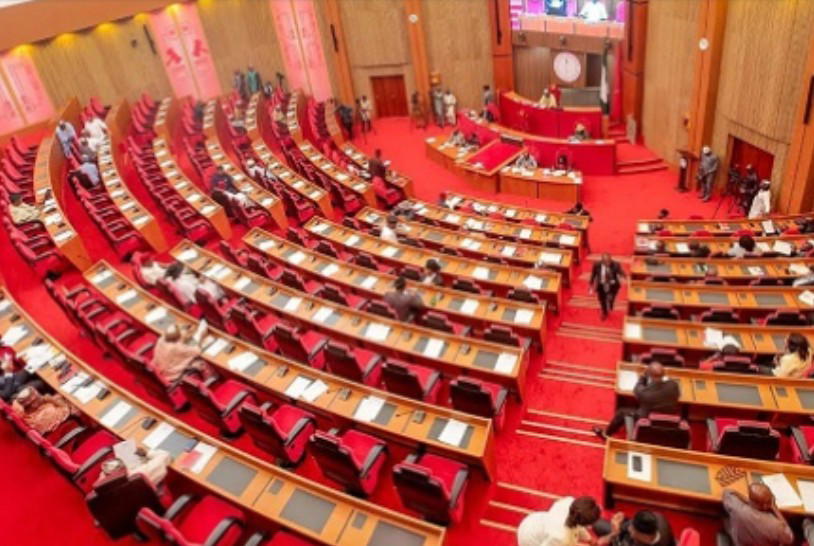
Senate
By Gabriel Ewepu
ABUJA — A coalition of civil society organisations (CSOs) on Wednesday called for the withdrawal of the proposed Foreign Aid (Regulation, Transparency and Disclosure) Bill 2026, arguing that it could impose excessive restrictions on organisations receiving funds from foreign sources.
The coalition made the demand at a press conference in Abuja, where it raised concerns about provisions of the proposed legislation relating to the disclosure, monitoring and regulation of foreign funding.
The organisations involved include Gatefield, Accountability Lab Nigeria, BudgIT Nigeria, Yiaga Africa, Pan African Lawyers Union (PALU), Socio-Economic Rights and Accountability Project (SERAP), Nigeria Network of NGOs and Centre for Transparency Advocacy (CTA), among others.
According to the coalition, provisions of the bill could expose individuals to up to five years’ imprisonment and a minimum fine of N5 million, while organisations could face a minimum fine of N20 million, as well as possible suspension or revocation of their operating licences.
The coalition noted that the bill’s referral to the relevant Senate committee provided an opportunity for stakeholders and members of the public to make submissions before further legislative action.
It urged the National Assembly to withdraw the proposed legislation and called for broader consultations with civil society and other stakeholders on any framework aimed at improving transparency and accountability in foreign-funded activities.
The Country Director of Accountability Lab Nigeria, Odeh Friday, described the bill as an attempt to “police empathy” and impose undue restrictions on citizens and organisations providing support to communities.
Friday said Nigeria already had several regulatory and institutional mechanisms for monitoring the activities and finances of non-governmental and not-for-profit organisations.
He cited the Corporate Affairs Commission (CAC), the Economic and Financial Crimes Commission’s Special Control Unit Against Money Laundering (SCUML) and the Nigeria Financial Intelligence Unit (NFIU) as statutory institutions mandated to monitor financial activities and potential illicit financing.
He also pointed to existing disclosure requirements under Nigerian law, including provisions of the Financial Reporting Council of Nigeria Act and the Companies and Allied Matters Act (CAMA) 2020.
According to him, incorporated trustees are required to disclose their sources of income in annual returns filed with the CAC, while organisations considered vulnerable to terrorism-financing risks have additional obligations under the Terrorism (Prevention and Prohibition) Act 2022 and related SCUML regulations.
CSOs question scope of proposed law
The proposed legislation, originally introduced in 2016 by the late Hon. Umar Buba Jibril, is currently sponsored by Senator Ibrahim Hassan Dankwambo.
It has passed first and second readings in the Senate and was referred to the Committee on Civil Society and Development Partners for further legislative consideration.
The Executive Director of DigiCivic Initiative, Mojirayo Ogunlana, questioned provisions that would require foreign-funded projects to align with national development plans.
While acknowledging that such alignment could be relevant to government ministries, departments and agencies, Ogunlana argued that imposing the same requirement on independent civil society organisations could affect their autonomy.
She said CSOs played a role in challenging government priorities, documenting alleged abuses, advocating for marginalised communities and providing services in areas where government intervention might be limited.
Ogunlana also cited United Nations Human Rights Council resolutions, including Resolutions 24/21 and 32/31, which she said addressed the operating environment for civil society organisations.
She further cited Resolution 22/6, which she said called on states to ensure that reporting requirements did not impede organisations’ access to resources.
She raised concerns about the scope of the proposed legislation, particularly provisions relating to foreign-sourced funds.
According to her, the proposed framework could give the regulatory authority powers to inspect the financial records of organisations and monitor funds received from foreign sources.
Ogunlana argued that the provisions could extend beyond conventional NGOs to other registered organisations, including religious institutions and associations whose members may receive or contribute funds from people living abroad.
She expressed concern that broad regulatory powers could potentially be used against organisations whose activities or advocacy positions were critical of government policies.
Also speaking, the Strategic Lead, Democracy, Rights and Public Sector at Gatefield, AbdulRahman Adebayo, questioned what he described as the broad definition of “foreign aid” in the proposed legislation.
Adebayo said vague provisions in legislation could create uncertainty over how the law would be applied, citing Nigeria’s experience with cybercrime legislation as an example of concerns that could arise from broadly worded legal provisions.
He also questioned the justification for introducing additional measures to track foreign funding, particularly where government agencies already monitor financial transactions and organisations operating in the country.
The CSOs argued that existing regulatory institutions were capable of addressing concerns around money laundering, terrorism financing and financial transparency without introducing what they described as additional layers of regulation.
Under the proposed bill, failure to register, providing inaccurate disclosures or obstructing the proposed commission could attract criminal and financial penalties.
Disclaimer
Comments expressed here do not reflect the opinions of Vanguard newspapers or any employee thereof.