
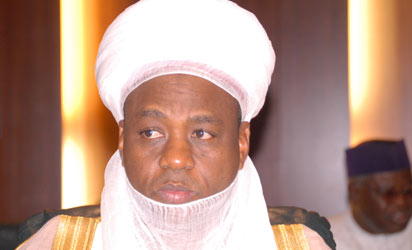
Sultan of Sokoto, Alhaji Muhammad Sa’ad Abubakar III
Continued from last week
Sultan of Sokoto, Alhaji Muhammad Sa’ad Abubakar IIIFor reasons of their own advantage they will deceive the ruler and make injustice acceptable to him so that they may obtain their objectives. In order to satisfy these desires, such people would surely use their ruler as a fisherman may use his net, to achieve their purpose.
Their services are for their own benefit and not for him. If they hear some rumours that their ruler would be dismissed from office and someone else would be appointed in his place, they would surely turn their backs on him and ingratiate themselves with the new person. Wherever there is money to be had, they will offer their services and prostrate. “
The Fifth Principle is the imperative of sustaining a robust mechanism for the defence of the state. Once again, in the words of Shaykh Abdullahi Ibn Fodio, “The ruler must organize his State to serve the interest of his people by having civil servants to manage (affairs of state) and men of wisdom to give advice. He must have trustees to keep the treasury and to spend the funds for prescribed purposes. He must have clerks and accountants to take care of the tax revenue.
He must have envoys, spies, guards, policemen as well as scholars to serve as guides. The ruler must have military experts whose advice would help overcome crises, for it is certain that victory in war depends upon strategy and not on the numerical strength of the army.
“ In another place, Shaykh Abdullahi admonished rulers in the following words buttressing the essential role which the Intelligence Services play in the State: “The ruler should find out about the condition of the enemy through trusted intelligence officers at all times – peace or war – so that nothing of the adversary’s activities may be hidden from him at any moment. For he who is ignorant about something is also blind to it; while he who can perceive it, is able to defeat a thousand blind men. “
Colonial transformation
Despite the expanse of Nigeria’s traditional domains and the residual strength of its value-systems, its independence began to wane as from 1861 and came to an abrupt end at the beginning of the twentieth century. The new British rulers, dictated more by necessity than intent, were constrained to incorporate the traditional system of governance into the new dispensation, albeit under the guise of indirect rule.
The new traditional councils, especially at the provincial and district levels, played significant roles in their areas of jurisdiction and handled all aspects of local government administration.
The traditional councils, it must be stated, also managed, very effectively, the security of their domains and deployed the extensive network of officialdom at their disposal, to mount an efficacious surveillance system. The religious scholars, who usually constituted a~ integral part of the traditional system, also helped to maintain place within their sub-domains. Errant preachers and those holding unorthodox ideas were quickly identified and put under surveillance. Those bent on causing trouble were handed over to the security agencies.
It is also worthy of note that the new administration took pro active measures in incorporating sons of traditional rulers into the emerging security architecture. As I pointed out in my keynote address at the National Security Summit held in Abuja on the 1 ih of August 2015,
The formation of a modern Police Force- the Native Authority Police Force (NAP F), was credited to the Egba United Government (EUG) under the Alake in 1905 which was followed a year later by the Ibadan Council.
Subsequent Native Authority police formations were patterned along these sterling examples, but all closely associated with or supervised, in both the Western and Northern Provinces, by traditional councils. In many provinces of the North, the Police Liaison Officer Scheme, among traditional title- holders, was also instituted.
My father, Sultan Abubakar IlL served as one of such liaison officers in Sokoto from 1931 and only relinquished the position in 1938 when he became the Sultan of Sokoto. “I even went to Kaduna, “ he once said, “for formal Police training so that I could liaise with the police more efficiently. “ In other places, sons and close relatives of Emirs actually commanded their forces. Alhaji Usman Nagogo of Katsina, Alhaji Aliyu Mustafa of Adamawa and Alhaji Ado Bayero of Kano all served as Chiefs of Police before becoming Emirs of their respective Emirates.
During the colonial transformation, it should also be pointed out, the British made a conscious effort to incorporate traditional rulers into the emerging governance structures. Although Lord Lugard did make a spirited attempt to bring them into the Nigeria Council of 1914, it was not until the promulgation of the Richards Constitution in 1946 that a House of Chiefs for the Northern Region was established. The Macpherson Constitution added another House of Chiefs for the Western Region in 1951.
It was not until the eve of independence that the South-South Chiefs put the Eastern Region under much pressure for the creation of an Eastern Region House of Chiefs. Those Houses remained as flagships of the traditional system’s participation in politics until the demise of the First Republic in 1966.
The real decline in the influence of traditional and religious institutions began in earnest after the collapse of the First Republic. As early as 1967, Emirs and Chiefs, especially in the Northern States, were deprived of their control over the Native Police, Prisons and Alkali Courts.
Chieftaincy matters
The most decisive blow was, however, the Local Government Reforms of 1976, which created elected local government councils, and left traditional authorities with little to do except to preside over ceremonies. It was therefore not surprising that while the 1979 Constitution provided for a Council of Chiefs at the States levels, it had no defined functions for them except to regulate chieftaincy matters. The 1999 Constitution built on this precedent to remain silent on this age-long institution.
The enduring roles of traditional and religious institutions
Conflict Management and Settlement of Disputes: The promotion of social harmony through conflict management and resolution of disputes is an area of strategic interest and importance to traditional and religious institutions in Nigeria. These institutions have always resolved conflicts using internal and external social control mechanisms.
The traditional mechanisms for peace and conflict resolution are well-structured, time-proven social systems geared towards reconciliation and improvement of social relationships. The methods are deeply founded in the customs and traditions of peoples that have gradually developed over a long period of time, based on dialogue, compromise, compensation and genuine reconciliation.
The increasing challenges of combating contemporary threats to peace and security require the articulation of a robust and well-structured framework that allows traditional and religious institutions an expanded complementary role in relation to other formal state institutions during conflict management.
Therefore, fusing traditional and religious institutions’ mechanisms of promoting peace and conflict resolution into Nigeria’s peace and security architecture could have positive implications for surmounting some of the challenges to national security in Nigeria. Advisory Support to Government:
The offering of strategic advice is one of the critical roles that traditional and religious institutions have played for enhanced national security with positive impact on development in Nigeria. Part One of the Third Schedule and Section 140 of the 1999 Constitution, as amended, clearly spelt out that traditional institutions can only play advisory role through the Council of State arrangement.
They have acted and continue to act as respected interlocutors on behalf of the people with their elected and appointed government officials. It has been noted that, “whenever the policy makers are overwhelmed by a sense of inadequacy in carrying the masses along on some critical security issues, the assistance of traditional and religious leaders is always resorted to”. Some of the traditional and religious institutions have leveraged on their wealth of experience to provide strategic advice to government on how to promote peace and stability.
Custodians of Traditions: The socio-cultural norms and traditions embedded in the traditional institutions have remained an integral part of every organized society in Africa. Traditional institutions are the custodians of their peoples’ norms, cultures and practices. Apart from being a powerful human tool for survival, the defined cultural norms and values also form the basis for the existence of every civilized society.
These norms and values have helped in sanitizing the various societies both in the pre and post-colonial Nigeria. The traditional institutions also form the basis upon which traditional and religious rulers exercise power, authority and influence on their subjects. The traditional rulers are closely linked to the grassroots, and so understand the problems of their people intimately.
Hence traditional and religious institutions have acted as the custodians of customary law and communal assets, such as lands. Apart from the fact that they embody the dynamic, evolving links to our historic past and future, they also give us pride in the uniqueness and ethics of our society by serving as guardians and symbols of cultural values and religious practices that engender national cohesion with positive implications for national security.
Community Mobilization
Traditional and religious leaders are critical agents of community mobilization in Nigeria. They actively protect the interest of diverse groups and constantly seek their involvement in enduring economic, social and political order and development in their domains.
Programmes and polices of Government can be better achieved through community mobilization and active participation of the grass root. Equally, general awareness on government programmes has easily been passed across through church pulpits or mosque messages.
This is because traditional and religious institutions in most cases are held in high esteem by their people, enabling them to sensitize their subjects to support government programmes. For instance, during the National Population Census and the Death and Birth Registration programmes, traditional and religious institutions were called upon to educate their subjects on the programmes to foster national security.
The participation of traditional and religious leaders in the campaign against polio also had a positive impact on the success of the programme and had received wide acclaim from the international community, including the United Nations and Bill and Melinda Gates Foundation. Traditional and religious rulers were also instrumental in the campaign against the menace of Boko Haram to the populace in their domains.
This had led to better participation at both local and national levels, thus fostering nation building and collective security architecture with positive implications to national security.
By His Eminence, Alhaji Muhammad Sa’ad Abubakar
Disclaimer
Comments expressed here do not reflect the opinions of Vanguard newspapers or any employee thereof.