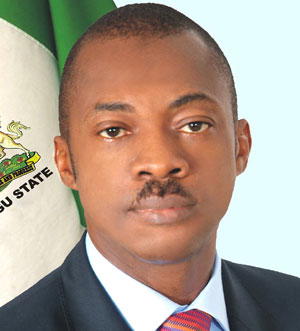
Chime
By Ejikeme Udeh
As the dust raised by the mid-term report of the President Goodluck Jonathan-led Federal Executive Council settles, the case for a similar report by the National Assembly has become imperative. The case is made all the more compelling by the fact that the legislative arm of government claims to being the embodiment of the sovereign will of the Nigerian people. In particular, the South-east is in dire need of periodic assessment of its representatives at the National Assembly, given the marginalization of the zone in numerical terms in both chambers.
Whereas the other five geo-political zones of the country are each represented by at least 18 senators (with the North-west zone having 21 senators) in the upper chamber of the National Assembly; the South-east has 15. The situation is replicated in the House of Representatives where the South-east’s 43 members compare unfavourably to the South-south’s 55, South-west’s 61, North-central’s 50, North-east’s 48, and North-west’s 97. If the foregoing is anything to go by, then it is a fair summation that the South-east is equal to less than half of the North-west zone, for all practical political purposes.
Although this unwholesome lopsidedness in the structure of the federation can only be fully and satisfactorily redressed through constitutional engineering, until we arrive at that juncture and, in the interim, the adverse ravages of the situation can actually be mitigated through effective representation from the South-east. From this standpoint, therefore, periodic assessment of South-east’s representatives in the National Assembly makes sense, failing which a zone already relegated to the margins of political power runs the risk of double jeopardy.
Enugu remains the capital of the South-east, and I would elect to start this crucial assignment with the state. Senator Ike Ekweremadu, the Deputy Senate President, who represents Enugu West at the red chamber, was the first to draw attention to this debilitating dilemma of a race literally submitting itself to the leadership of the ignorant. Delivering the 2012 Annual Zik Lecture organized by the Anambra State chapter of the Nigerian Union of Journalists (NUJ) at Awka on October 15, he bemoaned the intellectual quality of contemporary political leadership in the country, observing:“We now have leaders who cannot think beyond their immediate environment. “Such leaders have nothing new to offer their people”. Narrowing his discourse to the South-east, he said: “It is still a surprise to me that as educationally advanced as the South-east is, we still send to the National Assembly some people who can barely write their names!”
The latter part of the speech, coming from the Deputy Senate President, qualifies as a veritable bombshell, since he cannot but be presumed to be in possession of certain salient facts that informed his comments. Fact is, Ekweremadu might, as well, have been referring pointedly to some elements within the larger Enugu State contingent in the National Assembly. For they are conspicuous within the ranks of representatives of south eastern origin “who can barely write their names;” or in fact spell correctly the names of the various committees of their oversight functions.
Their intellectual impairment has somewhat reduced them to perpetual bench warmers who laugh away as others state the agenda of their various constituencies. This category of representatives are keen to savour the benefits associated with the offices, but are incapable of rising up to the challenges and weight of the expectations heaped on such high positions.
For Ekweremadu and Senator Ayogu Eze, Chair of the Senate Committee on Works, it may be said that, on the strength of their visibility in the Senate alone, they have laid down a marker by which their colleagues will be judged. Invariably, however, any team is as good as its entire make up and not just a part thereof. Thus, when, recently, Governor Sullivan Chime engaged the Enugu representatives in the National Assembly where he pronounced that the state would be sending new faces to Abuja to replace those of them who would have spent two terms or more by the 2015 general elections, the open sore of a baleful absence of even minimum representation must have weighed heavily on his mind.
From plenary to plenary, from one parliamentary year to another, the majority of the state’s representatives, including Senator Gilbert Nnaji, Honourables Ofor Chwukuegbo, Peace Nnaji, Kingsley Ebenyi, Ogbuefi Ozomgbachi, Toby Okechukwu, Pat Asadu and Ifeanyi Ugwuanyi … are mere spectactors as heated debates and contribution
s rage and positions are articulated and further amplified among the disparate tribes of Nigeria on burning national issues.
The preponderance of benchwarmers from Enugu is, no doubt, a huge disservice to the people of the state in particular and the South-east in general, more so in the light of the grim picture we painted before now. It is this sense of vicarious complicity of our own so-called ‘elected representatives’ in the political marginalization of their own people that this writer finds reprehensible to say the least.
Of this category of characters who have left the politics of the state abysmally poorer than they met it, the case of Senator Gilbert Nnaji, representing Enugu East senatorial zone, is worth mentioning. By the way, this is the same Senate seat that has, at various times since the inception of the fourth republic, been occupied by Chief Jim Nwobodo, Chief Ken Nnamani and, lately Dr Chimaroke Nnamani. On scale any day, Nnaji comes away as a featherweight against any of his predecessors in office.
Having held one political position or another since 1997 to date, Nnaji stands out as one of the greatest beneficiaries of the current political dispensation in Enugu even as he fancies his run of luck to endure interminably. Crucially, at every level of office that he has found himself in the past 16 years, he has virtually been boxing above his weight, either as council chairman for three terms or as a two-term member of the House of Representatives and now as a first term senator and Chair, Senate Committee on Communications. At the House of Representatives where he succeeded the inimitable Mao Ohuabunwa as Deputy Leader of the House during his first term (2003-2007), he appears unable to keep the level of representation his predecessor gave.
As the Senate screened ministerial nominees in July 2011, he could barely manage to exercise his mandatory chance to audibly pose a question to one of the nominees.
In politics as in everyday life, the morning surely tells the day. The laborious exercise of having to read from a script as Nnaji allegedly did to be able to ask a ministerial nominee a question over and done with, the voice of Enugu East senatorial zone has stayed muffled at best, so much so that on the highly contentious issue of Constitutional Review, the zone was alone out of 109 senatorial districts in the country that did not hold a public hearing on the proposed amendments, thereby denying the people of the zone a chance to participate in this all-important process.
Curiously, Nnaji finds it politically expedient to blame this profound act of negligence and incompetence on others, but any discerning mind knows better. That singular incident has not only returned to haunt him, it has in a concrete sense defined his adventure in the Senate, nay politics.
The palpable extent of his alienation from reality and the sound bite of his long suffering constituents is betrayed by his animated billboards that adorn the major streets of Enugu metropolis with hardly any discernible message beyond a desire to massage his ego. Wearing a baby face, he oddly beckons a bewildered public: ‘Arise and Shine.”In what ways the people are expected to follow his bidding, the message does not say. Understandably, these are the reflexes of a representative in denial, a senator whose imagination and horizons are not big enough for the job the times have thrust upon him. As things stand now, the mid-term report of Nnaji is in itself a mirror of the performance of most of National Assembly members from Enugu.
Disclaimer
Comments expressed here do not reflect the opinions of Vanguard newspapers or any employee thereof.